
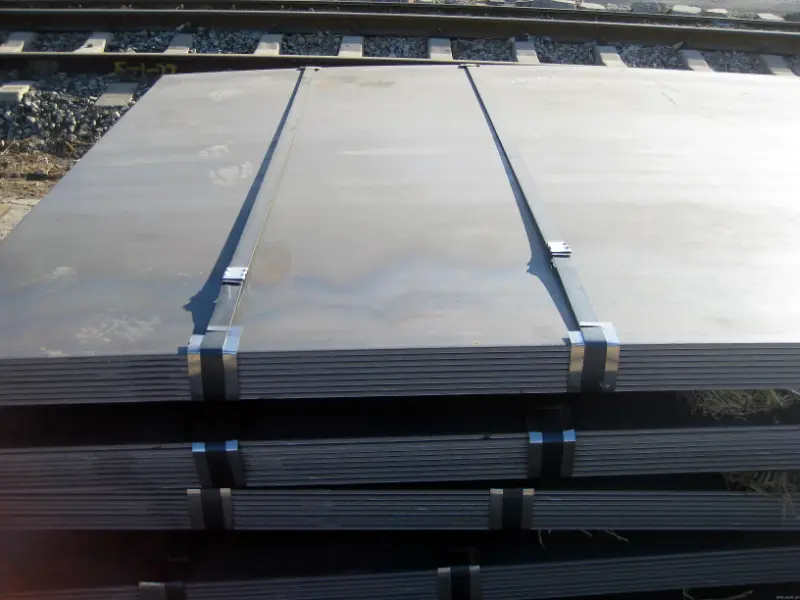
LR Grade EH46 Shipbuilding Steel Plate
LR Grade EH46 Shipbuilding Steel Plate: High-Strength Tough Steel for Arctic Marine Structures
LR Grade EH46 is a high-strength, low-temperature toughness shipbuilding steel plate certified by Lloyd's Register. With a minimum yield strength of 460 MPa and guaranteed impact energy at -40°C, it is ideal for critical structural components in ships and offshore platforms operating in harsh environments.
Thermomechanical controlled rolling (TMCP), normalising rolling (NR), or quenching and tempering (Q&T) depending on thickness and mill capability
- Phone : +8618037372205
- Email : [email protected]
- WhatsApp: Contact via Whtsapp
- WeChat: +8618037372205
LR Grade EH46 Shipbuilding Steel Plate Introduction
LR Grade EH46 is a high-strength structural steel plate for shipbuilding, classified under Lloyd's Register (LR) Rules for the Manufacture, Testing and Certification of Materials. As an 'E' grade (E = extra high toughness) with a nominal yield strength of 460 MPa, it delivers superior notch toughness at temperatures down to -40°C.
Key features:
- High strength-to-weight ratio allowing reduced plate thickness and deadweight.
- Excellent low-temperature impact properties, essential for ice-class vessels and Arctic operations.
- Fine-grain microstructure achieved through thermomechanical controlled processing (TMCP) or normalising rolling.
- Good weldability using standard shipyard procedures when preheat guidelines are followed.
- Stringent quality control with 100% ultrasonic testing and strict chemical limits.
EH46 is widely used in hull structures, including decks, bottom shells, bulkheads, and ice-strengthened zones, as well as offshore platforms and wind turbine foundations.
LR Grade EH46 Shipbuilding Steel Plate Chemical Composition
The chemical composition is strictly controlled to achieve the required strength and low-temperature toughness. Carbon equivalent (CEV) is limited to ensure good weldability (typically CEV ≤ 0.45% for thickness ≤50 mm). Grain-refining elements such as niobium, vanadium, titanium, and aluminium are added singly or in combination. Sulphur and phosphorus are kept at very low levels to guarantee cleanliness and through-thickness properties. All values comply with LR requirements for EH46 grade.
| Element | Typical Requirement | Remarks |
|---|---|---|
| C | ≤ 0.18% | Max; carbon content may be further restricted by thickness to meet CEV |
| Mn | 1.00 – 1.70% | Higher side for strength, controlled for toughness |
| Si | ≤ 0.55% | Deoxidation element |
| P | ≤ 0.025% | Max |
| S | ≤ 0.025% | Max (can be lower for improved Z-quality) |
| Cu | ≤ 0.35% | If added |
| Cr | ≤ 0.20% | May be present as residual or added for strength |
| Ni | ≤ 0.40% | May be added for toughness (especially at thick gauges) |
| Mo | ≤ 0.08% | May be present as residual |
| Nb | 0.02 – 0.05% | Grain refinement |
| V | 0.05 – 0.10% | Precipitation strengthening |
| Ti | ≤ 0.02% | Grain refinement; typical target 0.005–0.02% |
| Al (total) | ≥ 0.020% | Killed steel; sufficient for grain refinement |
| N | ≤ 0.012% | Max; if alloyed with Al, V, Ti it is fixed |
LR Grade EH46 Shipbuilding Steel Plate Physical and Thermal Properties
The following physical properties are typical for fine-grain high-strength structural steels of the 460 MPa yield class and can be used for engineering calculations. Exact values may vary slightly depending on the exact chemical composition, heat treatment, and temperature. Data are derived from standard references for comparable steel grades (e.g., EN 10025-4 S460ML). These properties are not stipulated by LR rules but are essential for design.
| Property | Typical Value | Unit | Test Condition |
|---|---|---|---|
| Density (ρ) | 7.85 | g/cm³ | Room temperature |
| Elastic modulus (E) | 210 | GPa | Room temperature |
| Shear modulus (G) | 81 | GPa | Room temperature |
| Poisson's ratio (ν) | 0.3 | – | Room temperature |
| Thermal expansion coefficient (α) | 11.5 – 12.0 | 10⁻⁶/K | 20–100°C |
| Thermal expansion coefficient (α) | 12.2 – 12.8 | 10⁻⁶/K | 20–200°C |
| Thermal conductivity (λ) | 42 – 38 | W/(m·K) | at 20–200°C |
| Specific heat capacity (cp) | 460 – 480 | J/(kg·K) | 20°C |
| Electrical resistivity (ρe) | 0.20 – 0.25 | µΩ·m | Room temperature |
LR Grade EH46 Shipbuilding Steel Plate Mechanical Properties
The mechanical properties are verified by tensile tests (transverse specimens) and Charpy V-notch impact tests (longitudinal specimens) in accordance with LR Rules. EH46 requires impact testing at -40°C. The minimum average absorbed energy is 41 J for thickness ≤ 50 mm (values may be adjusted for thicker plates or specific product tests). Yield strength may show slight thickness dependency, with a minimum of 420 MPa for thicknesses above 50 mm up to 100 mm (check specific LR rules). The elongation requirements are based on a proportionality gauge length of 5.65√S₀.
| Property | Specified Value | Unit | Test Condition |
|---|---|---|---|
| Yield strength (ReH) min. | 460 | MPa | Transverse, at ambient temperature, t ≤ 50 mm |
| Tensile strength (Rm) | 570 – 720 | MPa | Transverse, at ambient temperature |
| Elongation (A5) min. | 17 | % | Gauge length 5.65√S₀, transverse |
| Impact energy (KV₂) min. avg. | 41 | J | Longitudinal, Charpy V-notch, -40°C, t ≤ 50 mm |
| Bend test (diameter) | 3t | – | 180° bending, no cracks, transverse specimen for plates ≥ 12.5 mm |
LR Grade EH46 Shipbuilding Steel Plate Fully Equivalent Grades from Other Classification Societies and International Standards
The following grades are considered technically equivalent when produced to the respective society's rules for the same yield strength class and toughness designation (EH46). Material certified to one society can often be accepted by another subject to endorsement (multi-class procurement).
| Country / Region | Standard / Society | Grade | Remarks |
|---|---|---|---|
| International (Norway) | DNV Rules | EH46 | Same yield and toughness class |
| International (USA) | ABS Rules | EH46 | Equivalent for hull construction |
| International (France) | BV Rules | EH46 | Equivalent |
| International (China) | CCS Rules | EH46 | Equivalent |
| International (Japan) | NK (ClassNK) Rules | EH46 | Equivalent |
| International (Italy) | RINA Rules | EH46 | Equivalent |
| International | IACS UHR 460 | EH460 | Unified requirement, same strength level, E-grade toughness |
| European Union | EN 10025-4 | S460ML (≥460 MPa, -50°C) | EN grade with identical strength and slightly better low-temperature toughness; plate products may be suitable for marine use if additional requirements are met. |
LR Grade EH46 Shipbuilding Steel Plate Application Introduction
LR Grade EH46 is engineered for the most demanding marine and offshore structures exposed to low temperatures and high dynamic loads. Its combination of high yield strength and excellent toughness at -40°C makes it the material of choice for weight-critical designs and safety-critical components.
The steel is typically delivered in the TMCP condition, which ensures a fine-grained microstructure and good weldability without the need for post-weld heat treatment in many cases. Designers should consider the thickness-dependent yield strength reduction and confirm the precise minimum values from the LR Rules for the nominal thickness used.
Product Applications: Ship hull plates (bottom shell, side shell, strength deck), Bulkheads and transverse frames, Longitudinal stiffeners and girders, Ice belt and bow plates (with additional class notation for ice strengthening), Offshore platform deck plates and module support beams, Jack-up rig leg chords and racks, Wind turbine tower cans and flanges
Processed into products: Hull plating segments cut and welded into ship blocks, Stiffened panel assemblies for decks and bulkheads, Machined flanges for tower sections, Cantilever beams and foundations for offshore cranes, Hinge plates and pin connections for jack-up legs, Welded built-up sections for heavy-duty frames
Application industries: Shipbuilding – tankers, bulk carriers, container ships, LNG carriers, Polar class vessels and icebreakers (ice-strengthened hulls), Offshore oil & gas – fixed platforms, jack-up rigs (legs and spudcans), FPSO hulls, Renewable energy – offshore wind turbine monopiles, transition pieces, substation topsides, Heavy lifting and maritime cranes – booms and structural components, Bridge construction – where high strength and low-temperature toughness are required
LR Grade EH46 Shipbuilding Steel Plate Similar / Substitute Materials for Structural Applications
When LR EH46 certification is not mandatory, or for non-marine applications, the following high-strength grades offer similar mechanical properties and can be considered as alternatives after careful evaluation of toughness and weldability.
| Country / Region | Standard / Grade | Typical Yield Strength | Remarks |
|---|---|---|---|
| European Union | EN 10025-6 S460QL / S460QL1 | ≥460 MPa | Quenched and tempered structural steel; high toughness but may need stricter welding controls. |
| European Union | EN 10210-3 S460NH/S460NLH | ≥460 MPa | Hot-finished structural hollow sections, NLH has -50°C option. |
| United States | ASTM A572 Grade 65 | ≥450 MPa (65 ksi) | Lower strength, but commonly available structural steel; not a direct substitute but used in similar structural roles. |
| China | GB/T 1591 Q460D | ≥460 MPa | Low-alloy high-strength structural steel; D-grade (-20°C impact), needs upgrade to E-grade for -40°C. |
| Japan | JIS G3106 SM570 | ≥460–590 | Welded structural steel with guaranteed toughness (may need special ordering for -40°C). |
Notes:
Further considerations:
- For thicknesses above 50 mm, the minimum yield strength is reduced to 420 MPa (check the LR Rules Table 3.2.3).
- Charpy V-notch impact values are specified as a minimum average of 41 J for thickness up to 50 mm; for thicker plates, the requirement is a minimum average of 37 J (transverse) or 53 J (longitudinal) depending on the specimen orientation and LR inspection criteria.
- Plates are normally supplied with a Class 1 surface finish and 100% ultrasonic testing (UT) per LR requirements; higher UT classes (e.g., Class 2 or EN 10160 S2E3) can be ordered.
- Suitable Z-quality (through-thickness) properties (e.g., Z25, Z35) can be achieved by lowering sulphur content and special production practices, by agreement.
- Weldability: recommend low-hydrogen welding consumables and a minimum preheat of 75–150°C depending on plate thickness and heat input; TMCP plates generally offer better weldability than normalized or Q&T steels.
- Share



