
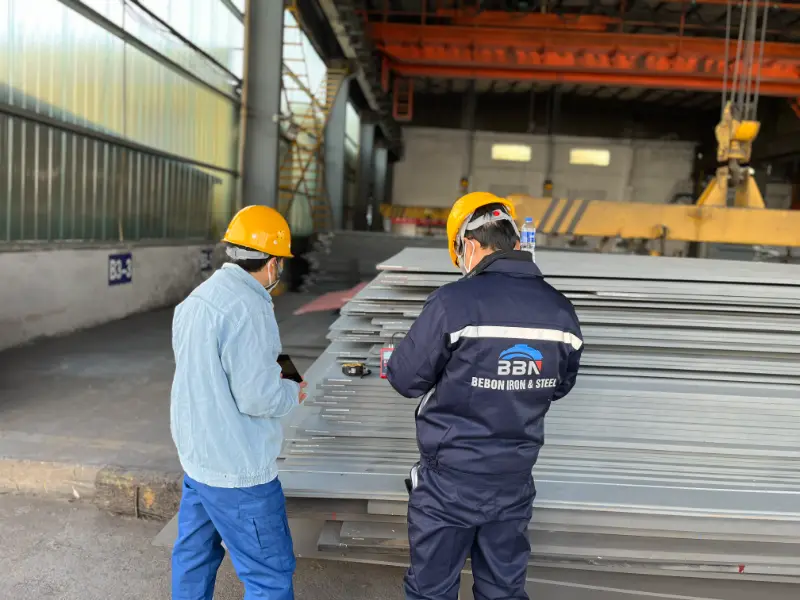
LR Grade FH46 Shipbuilding Steel Plate
LR Grade FH46 Shipbuilding Steel Plate: High-Strength Arctic-Grade Technical Data
Complete technical dataset for LR Grade FH46 shipbuilding steel plate, covering chemical composition, mechanical and physical properties, international equivalents, and application guidance for polar and offshore engineering.
Welding (SMAW, SAW, FCAW, GMAW), cutting (thermal, mechanical), cold and hot forming, bending
- Phone : +8618037372205
- Email : [email protected]
- WhatsApp: Contact via Whtsapp
- WeChat: +8618037372205
LR Grade FH46 Shipbuilding Steel Plate Introduction
LR Grade FH46 is a high-strength shipbuilding steel plate certified by Lloyd's Register (LR). It delivers a minimum yield strength of 460 MPa together with outstanding low-temperature impact toughness down to -60°C, making it ideal for critical structures operating in polar and harsh marine environments. The steel is typically supplied in normalized (N) or thermo-mechanically controlled processed (TMCP) condition, which ensures a fine-grained microstructure that provides excellent weldability and cold-forming characteristics. FH46 is extensively used in icebreaker hulls, offshore platform legs, and other load-bearing components that demand reliable ductility at sub-zero temperatures. Its chemical composition is finely balanced with microalloying elements such as niobium, vanadium, and titanium to achieve the required mechanical properties while maintaining good weldability and toughness.
LR Grade FH46 Shipbuilding Steel Plate Chemical Composition
The chemical composition of LR Grade FH46 is strictly controlled under LR Rules. The steel is fully killed and fine-grained treated, with microalloying elements such as Nb, V, Ti added to ensure high strength and low-temperature toughness. Maximum limits are applied to harmful elements like P and S.
| Element | Standard Value (wt%) | Remarks |
|---|---|---|
| Carbon (C) | ≤0.18 | |
| Silicon (Si) | ≤0.50 | |
| Manganese (Mn) | 0.90 ~ 1.60 | |
| Phosphorus (P) | ≤0.025 | |
| Sulfur (S) | ≤0.025 | |
| Aluminum (Alacid soluble) | ≥0.015 | Minimum for fine grain practice |
| Niobium (Nb) | ≤0.05 | |
| Vanadium (V) | ≤0.10 | |
| Titanium (Ti) | ≤0.02 | |
| Copper (Cu) | ≤0.35 | |
| Chromium (Cr) | ≤0.20 | |
| Nickel (Ni) | ≤0.40 | |
| Molybdenum (Mo) | ≤0.08 | |
| Nitrogen (N) | ≤0.012 | |
| Iron (Fe) | Balance |
LR Grade FH46 Shipbuilding Steel Plate Physical Properties
Physical properties are typical for a medium-carbon microalloyed structural steel at ambient temperature. Values may vary slightly with exact composition and processing. These are provided for design calculation purposes.
| Property | Typical Value | Unit | Conditions / Notes |
|---|---|---|---|
| Density (ρ) | 7850 | kg/m³ | at 20°C |
| Modulus of Elasticity (E) | 205 | GPa | at 20°C |
| Shear Modulus (G) | 79 | GPa | calculated |
| Poisson's Ratio (ν) | 0.3 | - | typical |
| Thermal Expansion Coefficient (α) | 12.2 × 10⁻⁶ | /K | between 20°C and 100°C |
| Thermal Conductivity (λ) | 50 | W/(m·K) | at 20°C |
| Specific Heat Capacity (c) | 460 | J/(kg·K) | at 20°C |
| Electrical Resistivity (ρe) | 0.20 × 10⁻⁶ | Ω·m | at 20°C |
LR Grade FH46 Shipbuilding Steel Plate Mechanical Properties
Mechanical properties are tested on specimens taken from plates in delivery condition. Values vary with plate thickness. Impact test temperature is -60°C. The bending test is performed with a specified former diameter. All values are minimum unless a range is given.
| Property | Standard Requirement | Unit | Test Conditions |
|---|---|---|---|
| Yield Strength (ReH) | ≥460 | MPa | Plate thickness ≤ 50 mm (transverse) |
| Yield Strength (ReH) | ≥440 | MPa | Plate thickness > 50 mm ≤ 70 mm (transverse) |
| Yield Strength (ReH) | ≥420 | MPa | Plate thickness > 70 mm ≤ 100 mm (transverse) |
| Tensile Strength (Rm) | 570 ~ 720 | MPa | Plate thickness ≤ 100 mm |
| Elongation (A5) | ≥17 | % | Gauge length 5.65√So (transverse) |
| Bending Test | No cracks after 180° bending | - | Former diameter 3t (t = plate thickness) |
| Impact Energy (KV, Charpy-V) | ≥41 (longitudinal) | J | Test temperature -60°C |
| Impact Energy (KV, Charpy-V) | ≥27 (transverse) | J | Test temperature -60°C |
LR Grade FH46 Shipbuilding Steel Plate Fully Equivalent Material Standards and Replacement Grades
| Country/Region | Standard | Grade | Remarks |
|---|---|---|---|
| International (IACS) | IACS UR W11 | FH46 | All IACS classification societies recognize FH46 |
| USA / ABS | ABS Rules | ABS FH46 | Equivalent low temperature grade |
| Norway / DNV | DNV Rules | NV FH46 | Equivalent |
| France / BV | BV Rules | BV FH46 | Equivalent |
| China / CCS | CCS Rules | CCS FH46 | Equivalent |
| South Korea / KR | KR Rules | KR FH46 | Equivalent |
| Japan / NK | NK Rules | NK FH46 | Equivalent |
| Italy / RINA | RINA Rules | RINA FH46 | Equivalent |
| Europe / EN | EN 10225 | S460G2+M | May require verification of impact toughness at -60°C. G2 usually covers -40°C to -60°C depending on options. |
LR Grade FH46 Shipbuilding Steel Plate Application Introduction
LR FH46 steel is engineered for demanding applications where high strength and excellent low-temperature toughness are essential. It allows weight reduction and structural integrity in harsh environments. Proper welding procedures and preheating may be required depending on thickness and carbon equivalent. Post-weld heat treatment is generally not required for TMCP steel.
Product Applications: Ice-strengthened ship hulls, Offshore platform columns and bracings, Polar crane booms, Structural modules, Pressure vessels (if code allows), Bridge components for cold climates
Processed into products: Icebreaker hull plating, Frame webs and girders, Bulkhead plates, Deck stringers, Bottom plates, Side shells, Transverse frames, Stiffeners, Rudder horns
Application industries: Shipbuilding (especially polar class vessels), Offshore and marine engineering, Arctic and subarctic infrastructure, Wind energy (jacket foundations), Heavy construction
LR Grade FH46 Shipbuilding Steel Plate Similar and Alternative Materials
| Country/Region | Standard | Grade | Remarks |
|---|---|---|---|
| International | IACS UR W11 | EH46 | Impact temperature -40°C; otherwise identical mechanical properties |
| International | IACS UR W11 | DH46 | Impact temperature -20°C |
| International | IACS UR W11 | FH40 | Lower yield strength 390 MPa, same -60°C toughness |
| International | IACS UR W11 | FH50 | Higher yield strength 500 MPa, same -60°C toughness |
| Europe | EN 10025-4 | S460ML | Thermo-mechanically rolled, -50°C impact, similar strength; not identical to FH46 due to different certification |
| Europe | EN 10025-3 | S460NL | Normalized, -50°C impact, similar strength |
| USA | ASTM A131 / A131M | EH46 | EH46 with -40°C impact; equivalent mechanicals but less stringent toughness temperature |
| Japan | JIS G 3106 | SM570 | Similar tensile strength, but different toughness specification; not directly equivalent for low temperature marine use |
Notes:
FH46 is typically supplied as Class 1 (impact tested -60°C). In LR certification, suffix "M" (e.g., FH46M) indicates thermo-mechanical rolling. Welding consumables shall be selected to match base metal toughness. Consult LR Rules for detailed thickness ranges, dimensional tolerances, and supplementary requirements (e.g., through-thickness properties Z-grade). For corrosion resistance, coatings are generally applied; the steel itself is not inherently corrosion resistant.
- Share



