
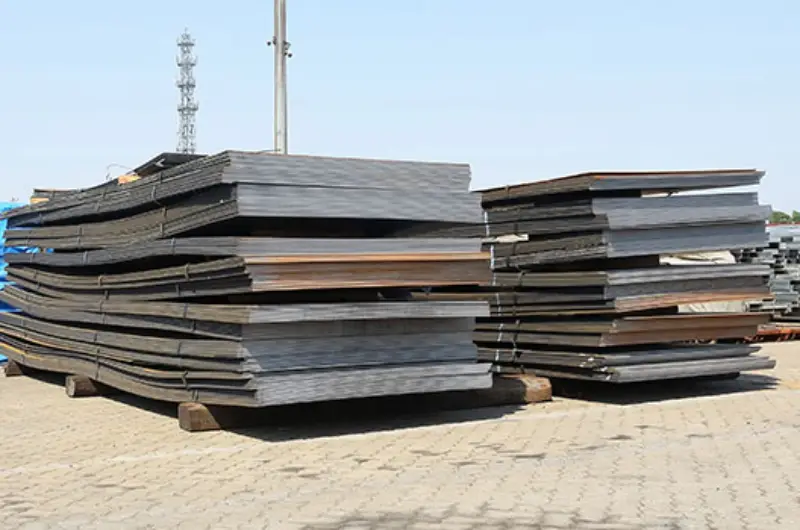
LR Grade AH50 Shipbuilding Steel Plate
LR Grade AH50 Shipbuilding Steel Plate - High-Strength, Weldable Structural Steel for Marine Applications
Comprehensive technical data for LR Grade AH50 shipbuilding steel plate, including chemical composition, mechanical properties, and physical properties per Lloyd's Register rules.
Thermo-mechanical controlled process (TMCP), normalized rolling, normalizing, quenching and tempering (subject to agreement)
- Phone : +8618037372205
- Email : [email protected]
- WhatsApp: Contact via Whtsapp
- WeChat: +8618037372205
LR Grade AH50 Shipbuilding Steel Plate Introduction
LR Grade AH50 is a high-strength, weldable structural steel plate specifically designed for ship and offshore structures. It is certified by Lloyd's Register (LR) and meets the requirements of the International Association of Classification Societies (IACS) for yield strength levels of 50 hbar (minimum 500 MPa). This grade offers excellent weldability, good toughness at 0°C, and reliable performance in harsh marine environments. Typical applications include hulls, decks, and support members for ships and offshore platforms. The steel is usually supplied in a thermomechanically controlled processed (TMCP) condition or normalized rolled condition, ensuring a fine-grained microstructure and consistent mechanical properties across thicknesses up to 100 mm.
LR Grade AH50 Shipbuilding Steel Plate Chemical Composition
The following chemical composition limits comply with Lloyd's Register and IACS W11 requirements for AH50 grade. Values are maximums unless a range is shown. Nb, V, Ti are usually added for grain refinement and strengthening. Carbon Equivalent (CEV) is controlled to ensure good weldability.
| Element | Specified Value | Remarks |
|---|---|---|
| Carbon (C) | ≤ 0.18% | For thickness ≤ 100 mm |
| Silicon (Si) | ≤ 0.55% | Typical restriction; slightly higher permitted if Al or other deoxidizers present |
| Manganese (Mn) | 0.90 – 1.65% | Improved hardenability and strength |
| Phosphorus (P) | ≤ 0.025% | For thickness ≤ 100 mm |
| Sulfur (S) | ≤ 0.025% | For thickness ≤ 100 mm |
| Aluminium (Al, total) | ≥ 0.015% | Grain refining; acid soluble or total |
| Niobium (Nb) | ≤ 0.05% | Microalloying element |
| Vanadium (V) | ≤ 0.10% | Microalloying element |
| Titanium (Ti) | ≤ 0.02% | Grain refinement; deoxidation |
| Copper (Cu) | ≤ 0.35% | Residual or added |
| Chromium (Cr) | ≤ 0.20% | Residual |
| Nickel (Ni) | ≤ 0.40% | Residual |
| Molybdenum (Mo) | ≤ 0.08% | Residual |
| Nitrogen (N) | ≤ 0.012% | For thickness ≤ 100 mm |
| Carbon Equivalent (CEV) | ≤ 0.43% | CEV = C + Mn/6 + (Cr+Mo+V)/5 + (Ni+Cu)/15, typically for TMCP |
LR Grade AH50 Shipbuilding Steel Plate Thermal and Electrical Physical Properties
The physical properties listed are typical for high-strength low-alloy steels similar to LR AH50. They are not part of the classification society specification but serve as a reference for design. Density is assumed constant; thermal expansion applies between 20°C and 100°C. Actual values may slightly vary depending on the exact chemical composition and heat treatment.
| Property | Typical Value | Unit | Test Condition |
|---|---|---|---|
| Density (ρ) | 7.85 | g/cm³ | 20°C |
| Elastic Modulus (E) | 210 | GPa | 20°C |
| Shear Modulus (G) | 80 | GPa | 20°C (calculated) |
| Poisson's Ratio (ν) | 0.3 | – | Room temperature |
| Thermal Expansion Coefficient (α) | 12 x 10⁻⁶ | K⁻¹ | 20–100°C |
| Thermal Conductivity (λ) | 50 | W/(m·K) | 20°C |
| Specific Heat Capacity | 460 | J/(kg·K) | 20°C |
| Electrical Resistivity (ρ_e) | 0.20 – 0.25 | Ω·mm²/m | 20°C |
LR Grade AH50 Shipbuilding Steel Plate Mechanical Properties
Mechanical properties are based on Lloyd's Register and IACS W11 specifications for tensile and impact testing. Yield strength (ReH) and tensile strength (Rm) apply to transverse specimens. Elongation (A) is based on gauge length 5.65√S₀. Charpy V-notch impact test at 0°C (AH grade) with specified minimum energy values for longitudinal and transverse specimens.
| Property | Specified Value | Unit | Test Condition |
|---|---|---|---|
| Yield Strength (ReH) | ≥ 500 | MPa | Transverse, thickness ≤ 100 mm |
| Tensile Strength (Rm) | 610 – 770 | MPa | Transverse, thickness ≤ 100 mm |
| Elongation (A) | ≥ 16 | % | Gauge length 5.65√S₀, transverse |
| Charpy Impact Energy (KV) – longitudinal | ≥ 41 | J | 0°C, specimen size 10x10 mm |
| Charpy Impact Energy (KV) – transverse | ≥ 27 | J | 0°C, specimen size 10x10 mm |
LR Grade AH50 Shipbuilding Steel Plate Equivalent Material Standards and Direct Substitute Grades
| Country/Region | Standard | Grade | Remarks |
|---|---|---|---|
| International / IACS | IACS UR W11 | AH50 | Common requirements for all IACS members |
| UK / International | Lloyd's Register (LR) | AH50 | Original specification |
| USA | ABS Rules | AH50 | American Bureau of Shipping equivalent |
| Norway / Germany | DNV Rules | AH50 (NV A50) | Det Norske Veritas notation |
| France | BV Rules | AH50 | Bureau Veritas equivalent |
| China | CCS Rules | AH50 | China Classification Society equivalent |
| South Korea | KR Rules | AH50 | Korean Register equivalent |
| Japan | NK (ClassNK) Rules | AH50 | Nippon Kaiji Kyokai equivalent |
| Italy | RINA Rules | AH50 | Registro Italiano Navale equivalent |
| Europe (EN standard) | EN 10225-1 | S500G1+M | Comparable weldable structural steel for offshore; often accepted as alternate |
LR Grade AH50 Shipbuilding Steel Plate Application Introduction
LR Grade AH50 is mainly used where a combination of high strength, good low-temperature toughness, and weldability is required. It can be processed by cold forming, gas cutting, submerged arc welding (SAW), shielded metal arc welding (SMAW), and flux-cored arc welding (FCAW) with appropriate preheat and heat input control. Heavier sections may require post-weld heat treatment (PWHT) depending on service conditions.
Product Applications: Hull plates (bottom, side, deck), Stiffeners and girders, Legs and nodes of jack-up rigs, Caisson structures, Mooring system components, Heavy-lift crane pedestals
Processed into products: Ship's bottom and side shell plates (especially in ice-strengthened vessels), Longitudinal and transverse bulkheads, Deck stringers and hatch coamings, Support brackets for rudders and propeller shafts, Mud mats and templates for subsea structures, Padeyes and lifting lugs
Application industries: Shipbuilding (naval and commercial vessels), Offshore oil & gas (platforms, jackets, FPSOs), Marine renewable energy (wind turbine substructures, wave energy converters), Heavy lifting and transport (crane booms, heavy-duty trailers), Pressure vessel manufacturing for marine applications
LR Grade AH50 Shipbuilding Steel Plate Similar/Alternative Materials with Comparable Performance
| Country/Region | Standard | Grade | Remarks |
|---|---|---|---|
| Europe | EN 10225-1 | S500G1+M | Structural steel for offshore fixed structures; similar strength and toughness level |
| Europe | EN 10025-6 | S500QL/S500QL1 | Quenched and tempered structural steel; comparable yield but different delivery condition |
| USA | ASTM A871 / A871M | Grade 65 (Type 4) | High-strength low-alloy structural steel with atmospheric corrosion resistance; yield ~450 MPa, lower than AH50 |
| API | API Spec 2H | Grade 50 | Offshore structural steel plates; yield 345–414 MPa, lower strength |
| API | API Spec 2W | Grade 50 | Through-thickness property steel for offshore; similar toughness but lower strength (>414 MPa) |
Notes:
- LR Grade AH50 is primarily produced via the TMCP route, but alternative delivery conditions (normalising, quench and temper) are possible with modified tensile and impact requirements according to the LR surveyor's approval.
- Hydrogen-induced cracking (HIC) resistant grades or grades for sour service (e.g., modified composition with low S, Ca treatment) can be offered under additional testing, but are not part of the base AH50 specification.
- For thicknesses above 100 mm or special toughness demands (e.g., FH50 with -60°C impact), other LR grades may be recommended.
- Weldability should be assessed considering the Carbon Equivalent (CEV) and by controlled hydrogen content in weld consumables.
- Share



