
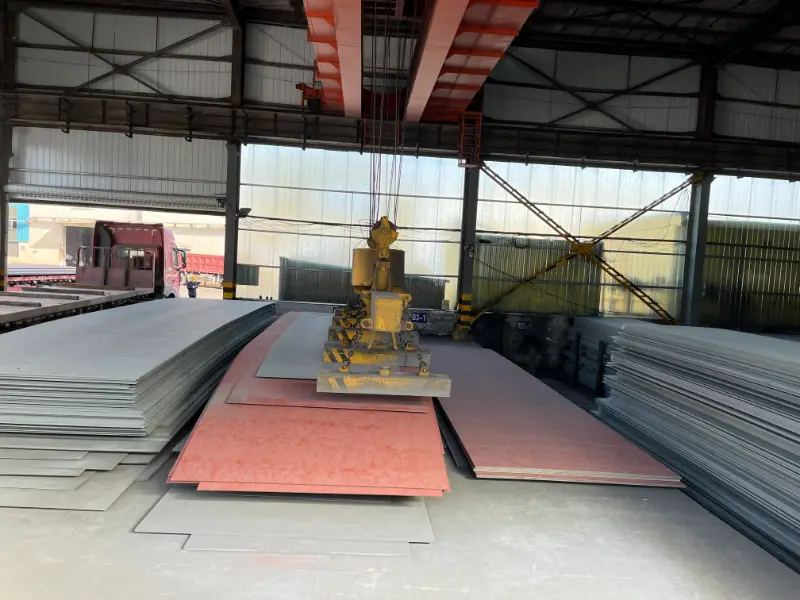
LR Grade DH46 Shipbuilding Steel Plate
LR Grade DH46 Shipbuilding Steel Plate: 460 MPa High-Strength Marine Steel with D-Grade Toughness at -20°C
Comprehensive material data for Lloyd's Register Grade DH46 shipbuilding steel plate: chemical composition limits, mechanical properties across thickness ranges, thermal and electrical physical characteristics, full international equivalents, similar alternative grades, and application guidance for hull structures and offshore engineering.
Normalizing (N), thermo-mechanically controlled processing (TMCP), quenching and tempering (Q&T) according to purchaser's specification; welding, cutting, cold forming, bending, straightening following LR guidelines and class-approved procedures.
- Phone : +8618037372205
- Email : [email protected]
- WhatsApp: Contact via Whtsapp
- WeChat: +8618037372205
LR Grade DH46 Shipbuilding Steel Plate Introduction
LR Grade DH46 is a high-strength, low-alloy shipbuilding steel plate classified under Lloyd's Register Rules for the Manufacture, Testing and Certification of Materials. It belongs to the D-grade toughness category and offers a minimum yield strength of 460 MPa. The steel is typically produced via normalizing or thermo-mechanically controlled processing (TMCP) and is designed for critical structural applications in ship hulls and offshore installations.
- Minimum yield strength 460 MPa (thickness ≤ 50 mm)
- Excellent toughness at -20°C with Charpy V-notch impact energy ≥ 50 J
- Good weldability when appropriate procedures are followed
- Complies with IACS UR W11 for high-strength hull structural steels
LR Grade DH46 Shipbuilding Steel Plate Chemical Composition
The chemical composition is based on Lloyd's Register Rules and IACS UR W11 for high-strength shipbuilding steel H46. The values apply to product thicknesses ≤ 100 mm. Microalloying elements such as Nb, V, or Ti are added to achieve the required strength and toughness. The carbon equivalent (CEV) is normally controlled to ensure good weldability.
| Element | Standard Requirement (wt%) | Remarks |
|---|---|---|
| C | ≤ 0.20 | Carbon; upper limit for weldability and strength |
| Mn | 0.90 – 1.70 | Manganese; contributes to strength and deoxidation |
| Si | 0.10 – 0.55 | Silicon; deoxidizer and strength agent |
| P | ≤ 0.025 | Phosphorus; impurity control |
| S | ≤ 0.015 | Sulphur; impurity control |
| Al (acid soluble) | ≥ 0.015 | Minimum aluminum for grain refinement |
| Nb | 0.02 – 0.08 | Niobium; typical microalloying for grain size control |
| V | 0.05 – 0.10 | Vanadium; optional strengthening |
| Ti | ≤ 0.02 | Titanium; optional grain refiner |
| Nb+V+Ti | ≤ 0.12 | Sum of microalloying elements |
| Cr | ≤ 0.50 | Chromium; incidental or specified |
| Ni | ≤ 1.00 | Nickel; improves toughness and may be specified |
| Mo | ≤ 0.40 | Molybdenum; optional for strength |
| Cu | ≤ 0.50 | Copper; atmospheric corrosion resistance if required |
| N | ≤ 0.020 | Nitrogen; strict control for toughness |
LR Grade DH46 Shipbuilding Steel Plate Thermal and Electrical Physical Properties
Thermal and electrical properties are approximate values for high-strength low-alloy structural steel at room temperature unless otherwise indicated. These are typical for HSLA steel of this strength class and are not part of the mandatory certification test.
| Property | Typical Value | Unit | Condition / Temperature |
|---|---|---|---|
| Density (ρ) | 7.85 × 10³ | kg/m³ | 20°C |
| Modulus of elasticity (E) | 210 | GPa | 20°C, static |
| Shear modulus (G) | 80 | GPa | 20°C, estimated |
| Poisson's ratio (ν) | 0.30 | — | Elastic range |
| Thermal expansion coefficient (α) | 11.5 × 10⁻⁶ | K⁻¹ | 20 – 100°C |
| Thermal expansion coefficient (α) | 12.5 × 10⁻⁶ | K⁻¹ | 20 – 300°C |
| Thermal conductivity (λ) | 52 | W/(m·K) | 20°C |
| Thermal conductivity (λ) | 49 | W/(m·K) | 100°C |
| Specific heat capacity (cp) | 460 | J/(kg·K) | 20 – 100°C |
| Electrical resistivity (ρe) | 0.16 – 0.24 | μΩ·m | 20°C |
LR Grade DH46 Shipbuilding Steel Plate Mechanical Properties
Mechanical properties depend on product thickness. The values below are mandatory minimum/maximum limits from LR rules. Charpy V-notch impact tests are performed at -20°C for D-grade. Bending test requirement is 180° over a former diameter without cracking.
| Property | Value | Unit | Test Conditions / Thickness Range |
|---|---|---|---|
| Yield strength (ReH) | ≥ 460 | MPa | t ≤ 50 mm, transverse |
| Yield strength (ReH) | ≥ 440 | MPa | 50 < t ≤ 70 mm, transverse |
| Yield strength (ReH) | ≥ 420 | MPa | 70 < t ≤ 100 mm, transverse |
| Tensile strength (Rm) | 570 – 720 | MPa | t ≤ 100 mm, transverse |
| Elongation (A5) | ≥ 17 | % | t ≤ 50 mm, gauge length 5.65√S₀, transverse |
| Elongation (A5) | ≥ 17 | % | 50 < t ≤ 100 mm, transverse |
| Bend test (180°) | d = 3a | — | t ≤ 25 mm, no cracking |
| Bend test (180°) | d = 4a | — | 25 < t ≤ 40 mm, no cracking |
| Charpy V-notch impact (KV2) | ≥ 50 (longitudinal) | J | -20°C, t ≤ 50 mm, average of 3 |
| Charpy V-notch impact (KV2) | ≥ 42 (longitudinal) | J | -20°C, 50 < t ≤ 70 mm, average of 3 |
| Charpy V-notch impact (KV2) | ≥ 34 (longitudinal) | J | -20°C, 70 < t ≤ 100 mm, average of 3 |
| Charpy V-notch impact (KV2) | ≥ 34 (transverse) | J | -20°C, t ≤ 50 mm, average of 3 (if required) |
LR Grade DH46 Shipbuilding Steel Plate Completely Equivalent Material Standards and Grades
| Country / Region | Standard / Rule | Grade | Remarks |
|---|---|---|---|
| International / IACS | IACS UR W11 | H46 (D-grade impact temperature -20°C) | Uniform requirement adopted by all IACS members |
| United Kingdom | Lloyd's Register Rules | DH46 | Reference grade; impact test at -20°C |
| United States | ABS Rules, Part 2 | DH46 | American Bureau of Shipping; identical yield strength and D-grade |
| France | BV Rules NR216 | DH46 | Bureau Veritas; equivalent chemical and mechanical requirements |
| China | CCS Rules | DH46 | China Classification Society; same strength and toughness class |
| Norway | DNV Rules Pt.2 Ch.2 | DH460 | DNV designates high-strength grades with 3-digit yield strength; D = -20°C |
| South Korea | KR Rules Pt.2 | DH46 | Korean Register; fully equivalent |
| Japan | NK Rules Pt.2 | DH46 | Nippon Kaiji Kyokai (ClassNK); identical specification |
| Italy | RINA Rules Pt.2 | DH46 | Registro Italiano Navale; D-grade high-strength steel |
| International | ASTM A131/A131M | DH46 | ASTM standard for shipbuilding steel; requires LR acceptance if used as equivalent |
LR Grade DH46 Shipbuilding Steel Plate Application Introduction
LR Grade DH46 steel is designed for welded structures in shipbuilding and offshore engineering where high strength-to-weight ratio and excellent low-temperature toughness are essential. Its D-grade toughness ensures reliable performance at service temperatures down to -20°C. The steel is readily weldable using appropriate low-hydrogen procedures and is delivered in a normalized or TMCP condition that facilitates forming and fabrication.
Product Applications: Shell and deck plates for high-stress areas, Bottom and side shell longitudinals and stiffeners, Hatch coamings and coaming stays, Girders, floor plates, and web frames, Deck crane pedestals and heavy-lift foundations, Offshore module primary steel
Processed into products: Hull plates (outboard shell, keel, side shell), Main deck and strength deck plating, Transverse web frames and bulkhead panels, Stiffeners (T-bars, bulb flats, angles), Brackets and connection plates, Crane boom chords and lattice structure, Jacket leg chord plates
Application industries: Shipbuilding (tankers, bulk carriers, container vessels, Ro-Ro, passenger ships), Offshore oil and gas (jack-up rigs, semi-submersibles, FPSOs, topside modules), Marine engineering (dredgers, crane barges, floating docks), Port and harbor infrastructure (heavy-duty quay structures, strong beams), Defense and naval (patrol vessels, auxiliary ships)
LR Grade DH46 Shipbuilding Steel Plate Similar or Close Alternative Materials
| Country / Region | Standard / Rule | Grade | Remarks |
|---|---|---|---|
| International | IACS UR W11 | AH46 / EH46 / FH46 | Same 460 MPa yield strength; impact temperatures: AH (0°C), EH (-40°C), FH (-60°C). Different toughness class. |
| Europe | EN 10025-4 | S460ML | TMCP structural steel with min yield 460 MPa; not automatically qualified for ship classification approval; requires additional testing. |
| Japan | JIS G 3106 (1999) | SM570 | Welded structural steel with min yield 460 MPa; toughness specification varies; not a direct ship class grade. |
| International | LR Rules / IACS | DH36 / EH36 | Lower strength grade (355 MPa min yield) with same D or E toughness; can be considered for less demanding structural applications. |
| United States | ASTM A131/A131M | DH40 / EH40 | 400 MPa yield strength class with D or E toughness; lower strength than DH46. |
Notes:
Additional requirements such as carbon equivalent (CEV ≤ 0.45% typically), ultrasonic testing, through-thickness (Z-grade) properties, and fracture toughness (CTOD) testing can be specified at the time of order. The steel is capable of being thermo-mechanically control-processed (TMCP) to achieve fine grain structure without extensive alloying. All deliveries must include a Lloyd's Register surveyor inspection and issuance of a classification certificate. Welding consumables should match the strength and toughness of DH46, and proper preheat/interpass temperatures must be followed to avoid hydrogen cracking. For offshore applications, additional compliance with Norsok M-120 or other standards may be requested.
- Share



