
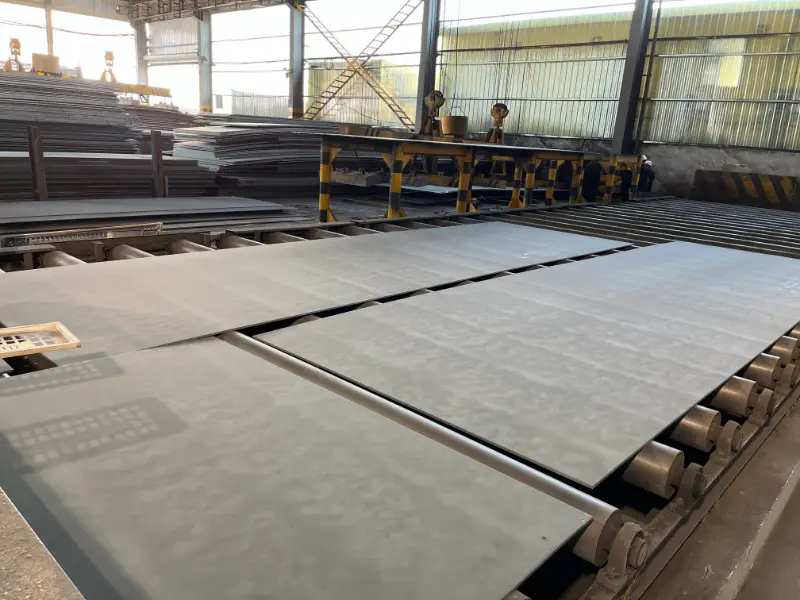
LR Grade AH46 Shipbuilding Steel Plate
LR Grade AH46 Shipbuilding Steel Plate - High Strength Hull Structural Steel for Arctic & Offshore
Comprehensive data sheet for LR Grade AH46 shipbuilding steel plate: chemical composition, mechanical and physical properties, equivalent grades, and application guide.
Cutting, hot/cold forming, welding (all common methods), machining, and drilling. Suitable for automated welding processes with low preheat requirements.
- Phone : +8618037372205
- Email : [email protected]
- WhatsApp: Contact via Whtsapp
- WeChat: +8618037372205
LR Grade AH46 Shipbuilding Steel Plate Introduction
LR Grade AH46 is a high strength shipbuilding steel plate certified by Lloyd's Register. It belongs to the 460 MPa yield strength class with a minimum impact toughness guaranteed at 0°C. AH46 is primarily designed for ship hulls and offshore structures operating in cold or mild environments. The steel is produced via a fine-grain practice and normally delivered in normalized or thermo-mechanical controlled processed (TMCP) condition, offering excellent weldability, good toughness, and high strength-to-weight ratio. It complies with LR Rules for the Manufacture, Testing and Certification of Materials (Chapters 2 & 3) and is widely used in the construction of container ships, bulk carriers, tankers, and offshore platforms where weight reduction and structural integrity are critical.
LR Grade AH46 Shipbuilding Steel Plate Chemical Composition
The chemical composition of LR Grade AH46 steel is controlled to ensure good weldability and strength. Limits are defined by LR Rules for thicknesses up to 100 mm. Microalloying elements (Nb, V, Ti, Al) are usually added for grain refinement and precipitation strengthening. Carbon equivalent (CEV) is typically ≤0.43% (TMCP) or ≤0.45% (Normalized) to maintain weldability.
| Element | Standard Value | Remarks |
|---|---|---|
| Carbon (C) | max 0.21% | Ladle analysis |
| Manganese (Mn) | 0.80 – 1.70% | Depending on thickness, higher Mn for thicker plates |
| Silicon (Si) | max 0.55% | Deoxidizer |
| Phosphorus (P) | max 0.035% | For low temperature toughness |
| Sulfur (S) | max 0.035% | Improved through desulfurization |
| Aluminum (Al) | min 0.015% (total) if Al killed | Grain refinement; typical for fine‑grain practice |
| Niobium (Nb) | max 0.05% | Microalloy, may be present |
| Vanadium (V) | max 0.10% | Optional strengthening element |
| Titanium (Ti) | max 0.02% | Optional, grain refinement |
| Nitrogen (N) | max 0.009% (if Al added) | Controlled to avoid strain aging |
| Copper (Cu) | max 0.35% | Optional (may be present from scrap) |
| Chromium (Cr) | max 0.25% | Residual |
| Nickel (Ni) | max 0.40% | Residual |
| Molybdenum (Mo) | max 0.08% | Residual |
LR Grade AH46 Shipbuilding Steel Plate Thermal and Electrical Physical Properties
The physical properties are typical for carbon‑manganese high‑strength steel and are provided for general engineering calculations. They vary slightly with temperature and processing. The values below are representative for normalized or TMCP AH46 steel.
| Property | Standard Reference Value | Unit | Test Condition / Remarks |
|---|---|---|---|
| Density (ρ) | 7850 | kg/m³ | At 20°C |
| Modulus of Elasticity (E) | 205 | GPa | At 20°C, longitudinal |
| Shear Modulus (G) | 80 | GPa | Approximated as E/(2(1+ν)) |
| Poisson's Ratio (ν) | 0.30 | – | At 20°C |
| Thermal Expansion Coefficient (α) | 12.0 (10⁻⁶/K) | 10⁻⁶/K | Between 20°C and 100°C |
| Thermal Conductivity (λ) | 45 – 50 | W/(m·K) | At 20°C, typical for CMn steel |
| Specific Heat Capacity | 460 | J/(kg·K) | At 20°C |
| Electrical Resistivity (ρ_e) | 0.20 – 0.25 | μΩ·m | At 20°C |
LR Grade AH46 Shipbuilding Steel Plate Mechanical Properties
Mechanical properties are verified in the specified delivery condition. Tensile tests are performed in transverse direction (unless otherwise agreed). Impact energy values are minimum requirements for longitudinal specimens (Charpy V‑notch). For thicker plates, properties may be slightly reduced within allowed limits.
Note: Actual values must meet LR Rules, which may also require through‑thickness testing (Z35) upon specification.
| Property | Standard Requirement Value | Unit | Test Condition |
|---|---|---|---|
| Yield Strength (ReH) | min 460 | MPa | Thickness ≤100 mm, transverse test, ambient |
| Tensile Strength (Rm) | 570 – 720 | MPa | Thickness ≤100 mm, transverse test, ambient |
| Elongation (A5) | min 17 (for t ≤40 mm); min 16 (40 < t ≤100 mm) | % | Gauge length 5.65√So, transverse test |
| Impact Energy (KV) | min 27 (longitudinal) / min 20 (transverse) | J | Charpy V‑notch at 0°C, for thickness ≤50 mm; above 50 mm, separate agreement may apply |
| Bend Test (180°) | d = 3a (for t ≤25 mm), d = 4a (t >25 mm) | – | No cracks or defects; bend diameter (d) where a = specimen thickness |
LR Grade AH46 Shipbuilding Steel Plate Exactly Equivalent International Grades and Standards
| Country/Region | Standard / Rule | Grade | Remarks |
|---|---|---|---|
| International (DNV) | DNV Rules Pt.2 Ch.2 | NV A460 | Identical strength and impact class (0°C) |
| International (ABS) | ABS Rules Part 2, Chapter 1 | AH46 | Same designation, fully equivalent |
| International (BV) | BV Rules, NR216 | A460 | Same strength and toughness requirements |
| China (CCS) | CCS Rules Part 1, Chapter 3 | AH46 | Direct equivalent in CCS classification |
| International (NK) | NK Rules, Part K | KA46 | Equivalent grade with 0°C impact test |
| International (RINA) | RINA Rules, Part D, Ch.2 | A460 | Same strength level, 0°C Charpy |
| International (RS) | Rules for the Classification of Ships | A460 | Also known as RS A460 |
| International (KR) | KR Rules, Pt.2 Ch.1 | AH46 | Fully equivalent Korean Register grade |
LR Grade AH46 Shipbuilding Steel Plate Application Introduction
LR Grade AH46 steel is extensively applied in marine and offshore environments where high strength, good weldability, and reliable toughness at 0°C are mandatory. Its fine‑grained microstructure ensures excellent fatigue resistance and suitability for complex welded joints. Typical applications include:
Product Applications: Hull plates and shell strakes of container ships, bulk carriers, and tankers, Deck plating and longitudinal stiffeners, Web frames and stringers, Floating production storage and offloading (FPSO) units, Jack‑up rig legs and spudcans, Transition pieces for offshore wind monopiles, Bollard and fender structures in port facilities
Processed into products: Ship hull outer shells and side shells, Cargo hold frames and girders, Offshore module support beams and columns, Hatch covers and coamings, Subsea structural elements (after appropriate qualification), Boom and A‑frame components in dredgers and offshore cranes, Base plates and mounting brackets for heavy equipment
Application industries: Shipbuilding and ship repair, Offshore oil & gas platforms, Marine renewable energy (wind turbine foundations), Port and harbor construction, Heavy-lift barges and crane structures, Pressure vessels for marine service, Bridge engineering (especially movable bridges over waterways)
LR Grade AH46 Shipbuilding Steel Plate Similar Grades with Comparable Performance
| Country/Region | Standard / Rule | Grade | Remarks |
|---|---|---|---|
| Europe | EN 10225:2009 | S460G1+M / G2+M | Offshore structural steel, 460 MPa yield, TMCP condition; similar weldability but different NDT temperature classes |
| International | API 2W | Grade 60 | High strength steel for offshore platforms, yield 415–550 MPa; overlap in properties but wider range |
| Europe | EN 10025-4 | S460M/ML | TMCP structural steel for general use; similar strength but less stringent Charpy requirements |
| International | ASTM A131 / A131M | EH46 | Same yield class but impact temperature -40°C; higher toughness variant |
| USA | ASTM A572/A709 | Grade 65 (Type 1/2) | Structural steel with 450 MPa min yield; close but slightly lower strength, not marine certified |
Notes:
- LR Grade AH46 plates are normally delivered with full classification society certificates (Lloyd's Register 3.1 or 3.2 type inspection).
- When ordering, the thickness range, quantity, and any supplementary requirements (Z‑tensile, through‑thickness reduction of area, ultrasonic testing) must be agreed upon at the time of enquiry.
- The steel is suitable for cold forming up to certain strain limits; hot forming may require subsequent heat treatment to restore mechanical properties.
- Welding consumables should match the strength level (e.g., E7018‑1, E81T1‑Ni1, or equivalent), and preheating is usually not required for thicknesses below 50 mm under normal conditions, but must be assessed according to the carbon equivalent and joint restraint.
- Share



