
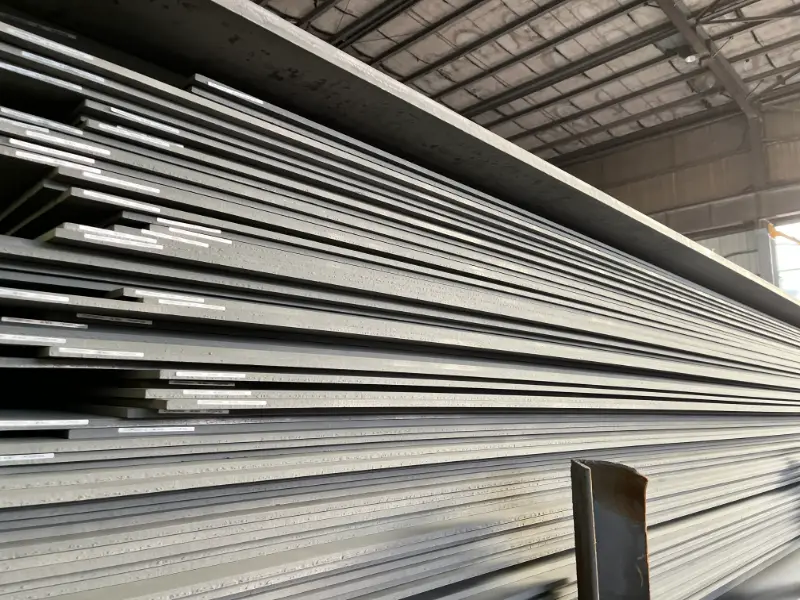
LR Grade FH42 Shipbuilding Steel Plate
LR Grade FH42 Shipbuilding Steel Plate: High-Strength, -60°C Toughness, Global Standards
Detailed material data for LR Grade FH42 shipbuilding plate: chemical composition, mechanical properties, thermal & electrical properties, exact international equivalents, and application guidance for marine and offshore constructions.
Hot rolling, Normalizing (N), Thermo-mechanical Controlled Processing (TMCP), Quenching and Tempering (Q&T) upon agreement
- Phone : +8618037372205
- Email : [email protected]
- WhatsApp: Contact via Whtsapp
- WeChat: +8618037372205
LR Grade FH42 Shipbuilding Steel Plate Introduction
LR Grade FH42 is a high-strength hull structural steel plate certified by Lloyd's Register (LR). Designed for critical marine and offshore applications, it offers a minimum yield strength of 420 MPa and guaranteed Charpy V-notch impact energy at the demanding temperature of -60°C (FH classification).
This steel belongs to the family of high-strength shipbuilding steels defined by IACS UR W11. It is typically produced via thermo-mechanical controlled processing (TMCP) or normalizing (N), both of which refine the grain structure and enhance toughness. Micro-alloying elements such as niobium, vanadium, and titanium are added to achieve fine grain size, enabling excellent weldability and resistance to brittle fracture even under severe cold conditions.
Plate thicknesses up to 100 mm are common, making this grade suitable for icebelts, stiffeners, and primary hull members of ice-class vessels and arctic offshore structures. Its combination of high strength, superior low-temperature notch toughness, and good formability fulfills the stringent requirements of the latest shipbuilding rules and offshore standards, ensuring safe and durable performance in extreme environments.
LR Grade FH42 Shipbuilding Steel Plate Chemical Composition
Chemical composition according to IACS UR W11 for FH42 high-strength hull steel. Grain-refining elements (Al, Nb, V, Ti) are mandatory to ensure fine austenitic grain size and excellent low-temperature toughness. Residual elements are kept at low levels to guarantee weldability and crack resistance. The carbon equivalent (CEV) is usually limited to ≤0.45% (for TMCP) or as per LR rules.
| Element | Standard Value (Max or Range) | Remarks |
|---|---|---|
| Carbon (C) | ≤ 0.16% | Adjustment for strength and weldability |
| Silicon (Si) | ≤ 0.50% | Deoxidizer and strength contributor |
| Manganese (Mn) | 0.90 – 1.60% | Main solid solution strengthener |
| Phosphorus (P) | ≤ 0.025% | Control for toughness and cold formability |
| Sulfur (S) | ≤ 0.025% | Control for internal soundness and toughness |
| Aluminium (Al total) | ≥ 0.020% | Grain boundary refinement; acid-soluble Al min 0.015% also acceptable |
| Niobium (Nb) | ≤ 0.05% | Micro-alloying for grain refinement |
| Vanadium (V) | ≤ 0.10% | Optional micro-alloying element |
| Titanium (Ti) | ≤ 0.02% | Grain pinning and inclusion shape control |
| Copper (Cu) | ≤ 0.35% | Residual element; may be intentionally added up to 0.35% |
| Chromium (Cr) | ≤ 0.20% | Residual, improves atmospheric corrosion resistance |
| Nickel (Ni) | ≤ 0.40% | Residual, lowers ductile-to-brittle transition temperature |
| Molybdenum (Mo) | ≤ 0.08% | Residual element |
| Nitrogen (N) | ≤ 0.012% | Can be higher if bound by grain refiners, eg Al, Ti |
LR Grade FH42 Shipbuilding Steel Plate Thermal and Electrical Physical Properties
Physical properties for normalized or TMCP FH42 steel at room temperature (unless otherwise noted). These values are typical for carbon‑manganese structural steel and are suitable for design calculations for heat transfer, thermal stress analysis, and electrical considerations. Density and thermal conductivity are essential for weight estimation and welding preheat planning.
| Property | Typical Value | Unit | Test Condition / Temperature |
|---|---|---|---|
| Density (ρ) | 7.85 | g/cm³ | Room temperature |
| Elastic Modulus (E) | 200 | GPa | Room temperature, tension |
| Shear Modulus (G) | 80 | GPa | Room temperature, calculated |
| Poisson's Ratio (ν) | 0.3 | – | Room temperature |
| Thermal Expansion Coefficient (α) | 12.0 × 10⁻⁶ | K⁻¹ | 20 – 100 °C |
| Thermal Expansion Coefficient (α) | 12.5 × 10⁻⁶ | K⁻¹ | 20 – 200 °C |
| Thermal Conductivity (λ) | 51 | W/(m·K) | 20 °C |
| Thermal Conductivity (λ) | 46 | W/(m·K) | 200 °C |
| Specific Heat Capacity (c) | 460 | J/(kg·K) | Room temperature |
| Electrical Resistivity (ρₑ) | 0.20 | µΩ·m | 20 °C |
LR Grade FH42 Shipbuilding Steel Plate Mechanical Properties
Mechanical properties as required by IACS UR W11 and LR Rules. The test pieces are taken transverse to the rolling direction for plates. Charpy V-notch impact tests are performed at -60°C on longitudinal specimens; sub-size specimens require proportionally lower minimum values. Bend test is performed with mandrel diameter depending on plate thickness.
| Property | Required Value | Unit | Test Condition / Remarks |
|---|---|---|---|
| Yield Strength (ReH) | ≥ 420 | MPa | All thicknesses up to 100 mm |
| Tensile Strength (Rm) | 530 – 680 | MPa | Full thickness range |
| Elongation (A on L₀=5.65√So) | ≥ 18 | % | Thickness ≤ 50 mm, transverse |
| Elongation (A) | ≥ 17 | % | Thickness > 50 mm ≤ 70 mm |
| Elongation (A) | ≥ 16 | % | Thickness > 70 mm ≤ 100 mm |
| Impact Toughness (KV₂, longitudinal) | ≥ 41 (average) | J at -60°C | Full‑size 10×10 mm specimen; 3‑sample test |
| Impact Toughness (KV₂, longitudinal) | ≥ 28 (min individual) | J at -60°C | One individual value allowed below average but not below 70% |
| Bend Test (180°) | mandrel diameter = 3a | – | a = specimen thickness; plates ≤ 50 mm |
| Bend Test (180°) | mandrel diameter = 4a | – | a = specimen thickness; plates > 50 mm |
LR Grade FH42 Shipbuilding Steel Plate Exact International Equivalent Grades
| Country / Region | Standard / Specification | Grade | Remarks |
|---|---|---|---|
| United Kingdom | Lloyd's Register Rules | FH42 | Primary classification; fatigue and brittle fracture resistance |
| USA / International | ABS Rules for Materials and Welding | FH42 | American Bureau of Shipping equivalent |
| Norway / International | DNV Rules for Classification of Ships | FH42 | DNV GL (now DNV) equivalent |
| France / International | BV Rules for Materials | FH42 | Bureau Veritas equivalent |
| China | CCS Rules for Materials and Welding | FH42 | China Classification Society equivalent |
| Japan | NK Rules for Ships | FH42 | ClassNK equivalent |
| Italy | RINA Rules for Materials | FH42 | Registro Italiano Navale equivalent |
| South Korea | KR Rules for Steel Ships | FH42 | Korean Register equivalent |
| International | IACS UR W11 | H420 / FH42 | Unified Requirement for high strength hull steel, all IACS members |
LR Grade FH42 Shipbuilding Steel Plate Application Introduction
LR Grade FH42 is engineered for the most demanding cold‑climate ship and offshore structures. Its high yield strength reduces scantling weight, while the -60°C impact guarantee ensures structural integrity in Arctic and sub‑Arctic service. The grade is routinely specified for ice-class vessels, arctic offshore platforms, and high‑strength hull components. With excellent weldability and good formability, it can be fabricated into complex stiffened panels and heavy structural elements.
Product Applications: Icebreakers and ice-strengthened cargo vessels, Floating production storage and offloading (FPSO) units, Semi-submersible and jack-up rig hulls, Module support stools and accommodation blocks, Hull and deck structural modules for large tankers
Processed into products: Shell plating and ice belts, Longitudinal and transverse framing, Bulkhead plates and deep girders, Rudder horns and rudder stocks, Bow plates and stern frames, Deck stringer plates and hatch coamings, Offshore platform jacket nodes and column splice plates
Application industries: Commercial and naval shipbuilding, Offshore oil and gas exploration, Arctic and polar marine construction, Heavy-duty port and terminal structures, Renewable offshore wind energy platforms
LR Grade FH42 Shipbuilding Steel Plate Near Equivalent / Similar Substitute Materials
| Country / Region | Standard / Specification | Grade | Remarks |
|---|---|---|---|
| USA / International | ASTM A131 / A131M | FH42 | Nearly identical chemical and mechanical requirements; also shipbuilding approved |
| Europe | EN 10025-4 | S420ML | Thermo-mechanically rolled weldable fine grain steel; impact at -50°C, not -60°C; minor strength/toughness adjustments needed |
| International | ISO 4950‑3 | E420 DD / E420 E | Higher-strength structural steel with -50°C notch toughness; requires verification for marine class approval |
| Worldwide | API 2H | Grade 42 | For tubular offshore structural nodes; thickness and testing differ from shipbuilding plate |
Notes:
Additional requirements such as carbon equivalent (CEV) limits (typically ≤0.45% for TMCP products) and through‑thickness (Z‑direction) properties (when specified as Z25 or Z35) must be agreed at the time of order. Welding consumables of matching strength and low‑hydrogen procedures are mandatory to preserve the low‑temperature toughness. Preheating and interpass temperature control shall be in accordance with material type, thickness, and design conditions. All repairs, identification, and stamping are to be executed per LR surveyor inspection requirements.
- Share



