
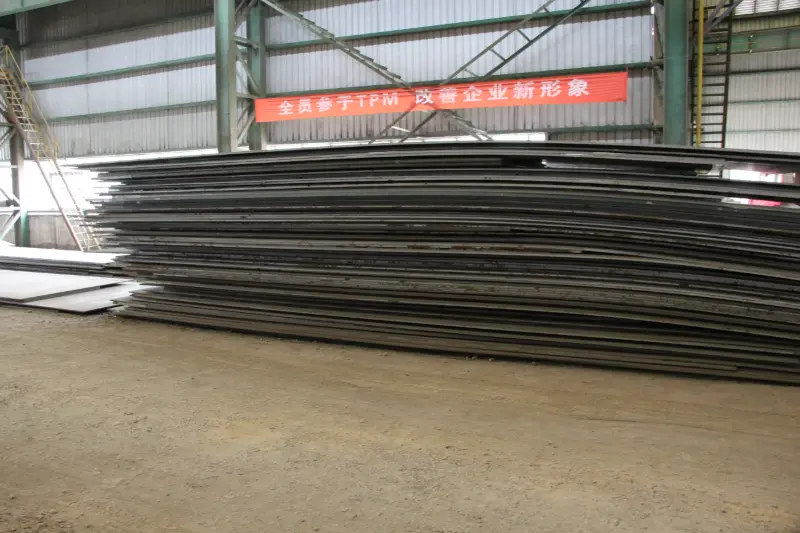
LR Grade EH42 Shipbuilding Steel Plate
LR Grade EH42 Shipbuilding Steel Plate - High-Strength, Low-Temperature Toughness Marine Steel
LR Grade EH42 is a high-strength shipbuilding steel plate classified under Lloyd's Register Rules, featuring minimum yield strength of 420 MPa and excellent impact toughness at -40°C, designed for critical structural components in shipbuilding and offshore engineering.
Controlled rolling (CR), thermo-mechanical controlled processing (TMCP), normalizing (N), quenching and tempering (QT) – depending on thickness and property requirements
- Phone : +8618037372205
- Email : [email protected]
- WhatsApp: Contact via Whtsapp
- WeChat: +8618037372205
LR Grade EH42 Shipbuilding Steel Plate Introduction
LR Grade EH42 is a high-strength, fine-grain structural steel plate specifically developed for shipbuilding and marine applications, certified by Lloyd's Register (LR). It belongs to the EH series of extra-high-strength hull steels, where "E" denotes guaranteed impact properties at -40°C and "42" indicates a minimum yield strength of 420 MPa. The steel is manufactured through controlled rolling or thermo-mechanical controlled processing (TMCP), ensuring a fine, homogeneous microstructure that provides an optimal balance of strength, ductility, and low-temperature toughness. EH42 plates are used in the construction of critical structural members such as deck panels, bottom shells, longitudinal stiffeners, and other load-bearing components of large vessels and offshore platforms operating in harsh environments. The material offers excellent weldability owing to its low carbon equivalent (CEV), allowing efficient fabrication without extensive preheating. Typical plate thickness ranges from 6 mm to 100 mm, and the product is supplied in normalized, TMCP, or quenched and tempered conditions as per LR Rules.
LR Grade EH42 Shipbuilding Steel Plate Chemical Composition
The chemical composition of LR Grade EH42 is controlled to ensure high strength, excellent low-temperature toughness, and good weldability. Carbon equivalent (CEV) is kept low to avoid cold cracking. Microalloying elements such as niobium, vanadium, and titanium are used for grain refinement and precipitation strengthening. The table below lists the maximum allowable values unless a range is specified, based on LR Rules for product analysis limits.
| Element | Typical Range / Maximum (%) | Remarks |
|---|---|---|
| Carbon (C) | ≤ 0.18 | Lower C improves weldability |
| Silicon (Si) | 0.10 – 0.50 | Deoxidizer and strength contributor |
| Manganese (Mn) | 0.90 – 1.60 | Main strengthening element; higher for thicker plates |
| Phosphorus (P) | ≤ 0.025 | Detrimental impurity |
| Sulfur (S) | ≤ 0.025 | Detrimental impurity; low for toughness |
| Aluminium (Altot) | ≥ 0.015 | Fine grain practice |
| Niobium (Nb) | ≤ 0.05 | Grain refiner, can be combined with V/Ti |
| Vanadium (V) | ≤ 0.10 | Precipitation strengthening |
| Titanium (Ti) | ≤ 0.02 | Grain refinement and inclusion shape control |
| Copper (Cu) | ≤ 0.35 | May be present for atmospheric corrosion resistance |
| Chromium (Cr) | ≤ 0.20 | Residual/tramp element |
| Nickel (Ni) | ≤ 0.40 | Improves toughness at low temperature |
| Molybdenum (Mo) | ≤ 0.08 | Residual element, not intentional |
| Nitrogen (N) | ≤ 0.012 | May be combined with V/Al for precipitates |
| Carbon Equivalent (CEV) | ≤ 0.43 (typically) | CEV = C+Mn/6+(Cr+Mo+V)/5+(Ni+Cu)/15; for weldability |
LR Grade EH42 Shipbuilding Steel Plate Thermal and Electrical Physical Properties
Physical properties are typical for low-carbon HSLA steel in the EH42 class and are influenced by chemical composition and processing route. These data are not specified by LR Rules but are useful for design and thermal analysis. They are derived from standard references for similar high-strength structural steels.
| Property | Typical Value | Unit | Test Condition |
|---|---|---|---|
| Density (ρ) | 7.85 | g/cm³ | 20°C |
| Elastic Modulus (E) | 210 | GPa | 20°C |
| Shear Modulus (G) | 80 | GPa | Calculated from E and ν |
| Poisson's Ratio (ν) | 0.3 | — | Elastic range |
| Thermal Expansion (α) | 11.5 – 12.5 | ×10⁻⁶/K | 20–100°C |
| Thermal Conductivity (λ) | 45 – 50 | W/(m·K) | 20°C |
| Specific Heat Capacity (cp) | 450 – 480 | J/(kg·K) | 20°C |
| Electrical Resistivity (ρe) | ~0.22 | µΩ·m | 20°C |
LR Grade EH42 Shipbuilding Steel Plate Mechanical Properties
Mechanical properties are determined in accordance with LR Rules using tensile and impact test specimens. Test specimens are taken transverse to the rolling direction unless otherwise agreed. The mechanical requirements vary with plate thickness; values below are minimum requirements for thickness range ≤50 mm. For thicker plates (50–100 mm), a slight reduction in yield strength may apply. Charpy V-notch impact tests are conducted at -40°C with minimum longitudinal average energy of 34 J (individual min 24 J).
| Property | Standard Requirement (min – max) | Unit | Test Condition / Thickness (t) |
|---|---|---|---|
| Yield Strength (ReH) | ≥ 420 | MPa | t ≤ 50 mm, transverse |
| Yield Strength (ReH) | ≥ 400 | MPa | 50 < t ≤ 100 mm, transverse |
| Tensile Strength (Rm) | 530 – 680 | MPa | All thicknesses |
| Elongation (A5) | ≥ 18 | % | Gauge length 5.65√S0 (transverse) |
| Impact Energy (KV2) | ≥ 34 (av.), ≥ 24 (ind.) | J | -40°C, longitudinal Charpy V-notch |
| Impact Energy (KV2) | ≥ 24 (av.), ≥ 17 (ind.) | J | -40°C, transverse Charpy V-notch |
| Bend Test | 180°, d=3a (t ≤25mm), d=4a (t>25mm) | — | No cracks, diameter related to thickness a |
LR Grade EH42 Shipbuilding Steel Plate Completely Equivalent Material Standards and Replaceable Grades
| Country / Region | Standard / Classification Society | Grade | Remarks |
|---|---|---|---|
| International | Lloyd's Register (LR) | EH42 | Original material discussed |
| USA | American Bureau of Shipping (ABS) | EH42 | Identical mechanical and chemical requirements |
| Norway/Germany | DNV | E420 | Equivalent to DNV extra high strength E420 |
| France | Bureau Veritas (BV) | E420 | Same class as EH42 |
| China | China Classification Society (CCS) | E420 | Direct equivalent for Chinese shipbuilding |
| Japan | Nippon Kaiji Kyokai (ClassNK) | KE42 | NK standard equivalent to LR EH42 |
| Korea | Korean Register (KR) | RE42 | KR high-strength hull steel matching EH42 |
| Italy | Registro Italiano Navale (RINA) | E420 | RINA equivalent to EH42 |
LR Grade EH42 Shipbuilding Steel Plate Application Introduction
LR Grade EH42 steel plates are primarily utilized in the marine and offshore industries where high strength and excellent low-temperature toughness are essential. The material is suitable for both welded and bolted constructions and can be processed by conventional fabrication methods such as cutting, bending, and welding with a low preheating requirement due to its low carbon equivalent. Typical applications include large container vessels, bulk carriers, and arctic-class ships.
Product Applications: Container ships and bulk carriers (hull plates, decks, bottom shells), Offshore platform topsides and jackets, LNG/LPG carriers (cryogenic secondary structural parts), Floating production storage and offloading units (FPSOs), Bridges and civil engineering mega-structures (approved by LR)
Processed into products: Main deck longitudinals and stiffeners, Keel plates and bilge strakes, Bottom shell plates in high-load zones, Upper deck panels and sheer strakes, Longitudinal and transverse bulkhead panels, Cantilever structures for offshore platforms, Heavy-lift crane pedestals and winch foundations
Application industries: Shipbuilding, Offshore oil & gas platforms, Marine engineering, Pressure vessel fabrication (when LR certification is accepted), Heavy structural engineering
LR Grade EH42 Shipbuilding Steel Plate Similar/Alternative Materials with Comparable Performance
| Country / Region | Standard / Specification | Grade | Remarks |
|---|---|---|---|
| European Union | EN 10025-4 | S420ML / S420MLO | Thermomechanical rolled weldable fine grain structural steel; yield 420 MPa, impact at -50°C (ML). Not specifically marine certified but similar mechanical properties. |
| USA | ASTM A572/A572M | Grade 60 [415] | Yield 415 MPa, common structural steel. Lower toughness guarantee; not normally approved for ship classification unless supplementary testing is performed. |
| USA | ASTM A913/A913M | Grade 70 [485] | Quenched & tempered structural shape steel; higher strength but different product form and not LR approved. |
| China | GB/T 712 | EH420 | Chinese shipbuilding steel, very close analogue to LR EH42; under CCS rules. |
| International | API 2W / 2Y | Grade 50/60 | High-strength steel for offshore structures; similar yield level, additional toughness class, but different specification scope. |
Notes:
Additional remarks:
- For thicknesses above 50 mm, the minimum yield strength may be reduced to 400 MPa as per LR Rules; designers should verify with the material certificate.
- Welding consumables must be selected to provide overmatch toughness at -40°C; preheating is generally not required below 50 mm when using low-hydrogen processes.
- EH42 plates may be subjected to through-thickness tensile testing (Z-quality) if specified under LR Rules for lamellar tearing resistance.
- Ultrasonic testing (UT) in accordance with EN 10160 Class S1/E1 or equivalent is commonly requested and should be agreed upon at the time of order.
- Share



