
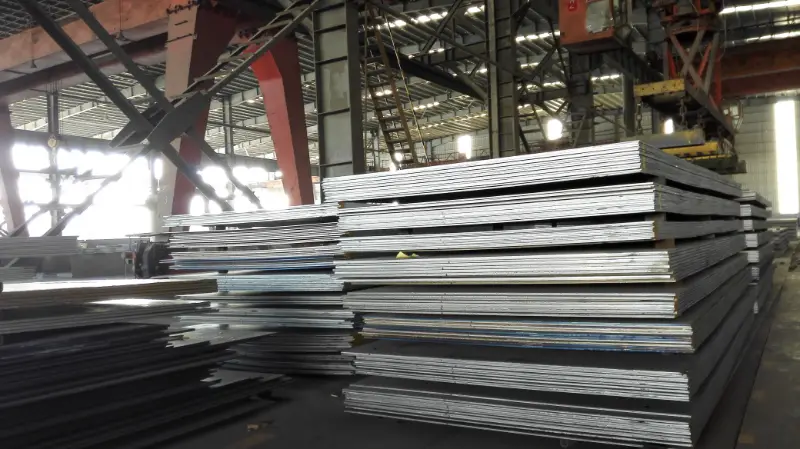
LR Grade DH42 (DH420) Shipbuilding Steel Plate
LR Grade DH42 (DH420) Shipbuilding Steel Plate: Chemical, Mechanical & Thermal Properties, Equivalents
Comprehensive technical data for LR Grade DH42 shipbuilding steel plate, including chemical composition, mechanical properties, thermal and electrical properties, international equivalents, and application guide.
Hot rolling, normalizing, thermo-mechanical controlled processing (TMCP), quenching and tempering (if specified)
- Phone : +8618037372205
- Email : [email protected]
- WhatsApp: Contact via Whtsapp
- WeChat: +8618037372205
LR Grade DH42 Shipbuilding Steel Plate Introduction
LR Grade DH42 (commonly designated DH420 in Lloyd's Register Rules) is a high-strength shipbuilding structural steel with a minimum yield strength of 420 MPa. It is designed for the construction of hulls, decks, and other critical marine structures requiring excellent weldability, good notch toughness at low temperatures, and high resistance to brittle fracture. The material is typically supplied in normalized or thermo-mechanically controlled rolled (TMCP) condition, providing a fine-grained microstructure that ensures consistent mechanical properties across different thicknesses. Its enhanced strength allows for weight savings without compromising structural integrity, making it suitable for large vessels and offshore platforms operating in harsh environments. The steel meets the stringent requirements of international classification societies under the IACS Unified Requirements for high-strength steels.
LR Grade DH42 Shipbuilding Steel Plate Chemical Composition
The typical chemical composition of LR DH42 (DH420) steel is controlled to ensure mechanical properties and weldability. Values are maximum unless a range is given. The exact composition may be adjusted by the steelmaker based on thickness and processing route, but must comply with LR's ladle analysis limits. Key elements like carbon and manganese are balanced with microalloying additions (Nb, V, Ti) to achieve high strength and good toughness.
| Chemical Element | Standard Value (%) | Remarks |
|---|---|---|
| Carbon (C) | 0.18 max | Ladle analysis; lower C improves weldability |
| Manganese (Mn) | 0.90 – 1.60 | Depending on thickness and strength level |
| Silicon (Si) | 0.50 max | Deoxidizing agent |
| Phosphorus (P) | 0.025 max | Strictly controlled to ensure toughness |
| Sulfur (S) | 0.025 max | Strictly controlled to avoid hot cracking |
| Aluminium (Al) total | 0.015 min (acid soluble) | For fine grain practice |
| Niobium (Nb) | 0.05 max | Microalloying; grain refinement |
| Vanadium (V) | 0.10 max | Optional; precipitation hardening |
| Titanium (Ti) | 0.02 max | Optional; grain refinement and nitrogen fixation |
| Chromium (Cr) | 0.20 max | Residual element |
| Nickel (Ni) | 0.40 max | Residual element; beneficial for low-temp toughness |
| Molybdenum (Mo) | 0.08 max | Residual element |
| Copper (Cu) | 0.35 max | Residual element |
| Carbon Equivalent (CEV) | 0.43 max (thickness ≤ 50 mm) | CEV = C + Mn/6 + (Cr+Mo+V)/5 + (Ni+Cu)/15; higher limit for thicker plates may apply |
LR Grade DH42 Shipbuilding Steel Plate Thermal and Electrical Physical Properties
The thermal and electrical properties are typical for low-alloy structural steel and may vary slightly with exact chemical composition and heat treatment. Values are given for ambient temperature (20°C) unless otherwise noted.
| Property | Standard Value | Unit | Test Conditions |
|---|---|---|---|
| Density (ρ) | 7850 | kg/m³ | At 20°C |
| Elastic Modulus (E) | 205 – 210 | GPa | Room temperature |
| Shear Modulus (G) | 80 | GPa | Calculated from E and ν |
| Poisson's Ratio (ν) | 0.3 | – | Elastic region |
| Thermal Expansion Coefficient (α) | 12.0 | 10⁻⁶/K | 20°C to 100°C |
| Thermal Conductivity (λ) | 45 | W/(m·K) | At 20°C |
| Specific Heat Capacity (c) | 460 | J/(kg·K) | At 20°C |
| Electrical Resistivity (ρ_e) | 0.16 | 10⁻⁶ Ω·m | At 20°C |
LR Grade DH42 Shipbuilding Steel Plate Mechanical Properties
The mechanical properties of LR DH42 (DH420) steel are verified through tensile and Charpy impact tests on specimens cut from the plate in accordance with LR test procedures. The values depend on the product thickness and testing direction (longitudinal). The yield strength is the minimum specified upper yield strength (ReH). Impact tests are performed at -20°C on Charpy V-notch specimens.
| Property | Standard Requirement | Unit | Test Conditions |
|---|---|---|---|
| Yield Strength (ReH) | 420 min | MPa | Thickness ≤ 100 mm |
| Tensile Strength (Rm) | 530 – 680 | MPa | Thickness ≤ 100 mm |
| Elongation (A5) | 18 min | % | Thickness ≤ 40 mm, gauge length 5.65√S0 |
| Elongation (A5) | 17 min | % | Thickness > 40 mm to ≤ 100 mm |
| Charpy Impact Energy (KV, longitudinal) | 27 min (average) | J | At -20°C, thickness ≤ 50 mm |
| Charpy Impact Energy (KV, longitudinal) | 34 min (average) | J | At -20°C, 50 < thickness ≤ 70 mm |
| Charpy Impact Energy (KV, longitudinal) | 41 min (average) | J | At -20°C, 70 < thickness ≤ 90 mm |
| Charpy Impact Energy (KV, longitudinal) | 50 min (average) | J | At -20°C, 90 < thickness ≤ 100 mm |
LR Grade DH42 Shipbuilding Steel Plate Fully Equivalent Material Standards and Replaceable Grades
| Country / Region | Standard | Grade | Remarks |
|---|---|---|---|
| International (IACS) | UR W11 | DH420 | Unified Requirement for high-strength hull structural steel |
| United Kingdom | Lloyd's Register (LR) | DH420 | Original grade designation |
| USA | American Bureau of Shipping (ABS) | DH420 | Equivalent to LR DH420 |
| Norway/Germany | DNV GL | DH420 | Now part of DNV rules |
| France | Bureau Veritas (BV) | DH420 | Equivalent high-strength grade |
| China | China Classification Society (CCS) | DH420 | Equivalent to LR DH420 |
| Japan | Nippon Kaiji Kyokai (NK) | DH420 | ClassNK equivalent grade |
| South Korea | Korean Register (KR) | DH420 | Equivalent high-strength steel |
| Italy | Registro Italiano Navale (RINA) | DH420 | Recognized equivalent grade |
LR Grade DH42 Shipbuilding Steel Plate Application Introduction
LR DH42 (DH420) steel is primarily used in the shipbuilding and offshore industries. Its high strength-to-weight ratio enables the design of lighter structures without compromising safety, leading to reduced fuel consumption and increased payload capacity. The steel's excellent low-temperature toughness makes it suitable for ice-class vessels and operations in cold climates. It is easily weldable with standard processes, provided proper preheat and interpass temperatures are observed for thicker sections. The material can be formed, cut, and machined using conventional methods.
Product Applications: Hull plates and shell plating, Bulkheads and watertight doors, Deck plates and stringer plates, Longitudinal stiffeners and girders, Bottom and side longitudinals, Transverse frames and web frames, Offshore jacket legs and bracing, Caissons and module support beams
Processed into products: Main deck and strength deck plating, Side and bottom shell plating (especially ice-strengthened areas), Hatch coamings and coaming stays, Engine room and machinery mounts, Bitts, chocks, and fairleads, Offshore crane pedestal and kingpost structures, Mooring equipment foundations, Transition pieces in offshore wind foundations
Application industries: Commercial and naval shipbuilding, Offshore oil and gas platforms, Marine engineering and port construction, Renewable energy (offshore wind turbine foundations), Heavy lifting and transport barges
LR Grade DH42 Shipbuilding Steel Plate Similar / Alternative Steel Grades for Reference
| Country / Region | Standard | Grade | Remarks |
|---|---|---|---|
| International | IACS UR W11 | DH40 | Slightly lower yield strength (390 MPa), thinner gauges |
| International | IACS UR W11 | EH420 | Same strength, low-temperature toughness to -40°C |
| USA | ASTM A131 | EH36 | Lower strength (355 MPa), but similar low-temp performance |
| Europe | EN 10025-4 | S420ML | Thermo-mechanically rolled structural steel with 420 MPa yield, similar weldability |
| USA | ASTM A709 | Grade 50 | 350 MPa yield, bridge steel with similar nickel additions possible |
| Europe | EN 10225-1 | S420G2+M | Offshore structural steel with comparable properties |
Notes:
Note on designation: The term "DH42" is often used as an abbreviated or commercial name for the grade DH420 defined in Lloyd's Register Rules. All data presented herein correspond to LR DH420 specifications. Actual composition and properties may be customized by steelmakers within LR limits to suit specific thicknesses and delivery conditions. Welding procedures must consider carbon equivalent and possible need for controlled heat input and hydrogen reduction. Third-party certification by LR or another recognized classification society is typically required for marine applications.
- Share



