
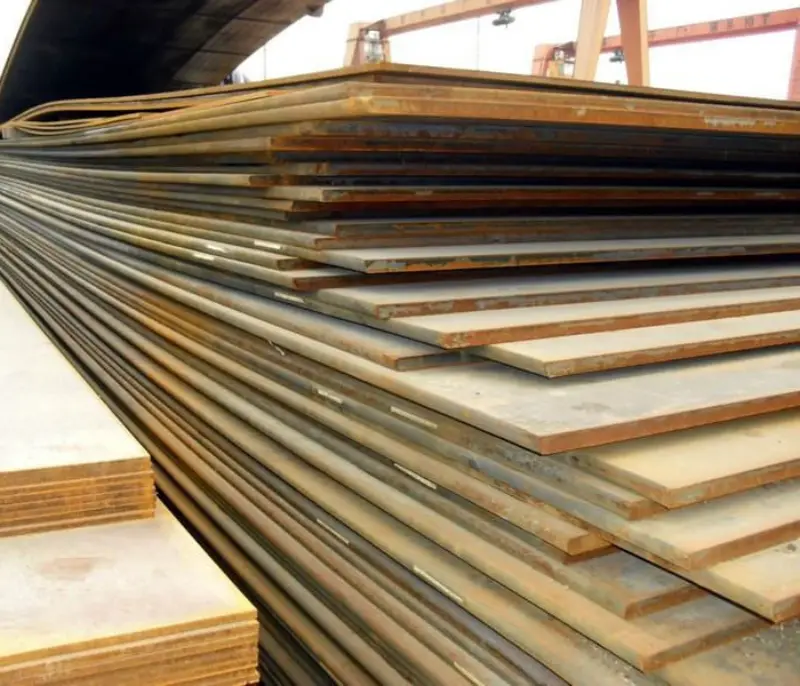
LR Grade AH55 Shipbuilding Steel Plate
LR Grade AH55 Shipbuilding Steel Plate: High-Strength Marine Structural Material
Explore the properties, chemical composition, mechanical and thermal data, international equivalents, and applications of LR Grade AH55 shipbuilding steel plate, a 550 MPa yield strength grade certified by Lloyds Register.
Thermo-mechanical controlled processing (TMCP), normalizing, quenching and tempering as agreed; suitable for cutting, forming, welding, and machining
- Phone : +8618037372205
- Email : [email protected]
- WhatsApp: Contact via Whtsapp
- WeChat: +8618037372205
LR Grade AH55 Shipbuilding Steel Plate Introduction
LR Grade AH55 is a high-strength shipbuilding structural steel plate certified by Lloyd's Register (LR), designated for use in demanding marine environments. With a specified minimum yield strength of 550 MPa, it belongs to the high-tensile category of hull steels. The "AH" prefix indicates that the impact test temperature is 0°C, making it suitable for ambient-temperature applications.
Key attributes include:
- Excellent weldability due to controlled carbon equivalent
- Fine-grain structure achieved through microalloying (Nb, V, Ti)
- High strength-to-weight ratio for reduced structural weight
- Good toughness at low temperatures
- Compliance with LR Rules for the Manufacture, Testing and Certification of Materials
Typical delivery condition is thermo-mechanically controlled rolled (TMCP) or normalized.
LR Grade AH55 Shipbuilding Steel Plate Chemical Composition
The chemical composition is designed to provide high strength and good weldability. Maximum limits for impurities and alloying elements are specified. Microalloying elements (Nb, V, Ti) are used for grain refinement and precipitation strengthening. Carbon equivalent (Ceq) is typically ≤ 0.40 to ensure weldability.
| Element | Standard Value (max unless range given) | Remarks |
|---|---|---|
| Carbon (C) | ≤ 0.20% | Key strength element; limits for weldability |
| Silicon (Si) | ≤ 0.55% | Deoxidizer |
| Manganese (Mn) | 0.90 - 1.65% | Enhances strength and toughness |
| Phosphorus (P) | ≤ 0.030% | Impurity, low for toughness |
| Sulfur (S) | ≤ 0.030% | Impurity, low for cleanliness |
| Chromium (Cr) | ≤ 0.30% | Residual element |
| Nickel (Ni) | ≤ 0.40% | Residual element |
| Molybdenum (Mo) | ≤ 0.08% | Residual element |
| Copper (Cu) | ≤ 0.35% | Residual element |
| Niobium (Nb) | ≤ 0.05% | Grain refinement, precipitation hardening |
| Vanadium (V) | ≤ 0.10% | Strength and grain refinement |
| Titanium (Ti) | ≤ 0.02% | Grain refinement, deoxidation |
| Aluminum (Al) | ≥ 0.015% (acid soluble) | Grain refinement deoxidizer |
| Nitrogen (N) | ≤ 0.012% | Residual element, controlled for toughness |
| Carbon Equivalent (Ceq) | ≤ 0.40% (typical) | Calculated as C+Mn/6+(Cr+Mo+V)/5+(Ni+Cu)/15; essential for weldability |
LR Grade AH55 Shipbuilding Steel Plate Thermal and Electrical Physical Properties
The following physical properties are representative for LR AH55 steel at room temperature and ambient conditions. Slight variations may occur depending on exact chemistry and processing route. These values are useful for engineering calculations and finite element analysis.
| Property | Standard Value | Unit | Test Condition |
|---|---|---|---|
| Density (ρ) | 7850 | kg/m³ | 20°C |
| Modulus of Elasticity (E) | 205 | GPa | 20°C |
| Shear Modulus (G) | 80 | GPa | 20°C |
| Poisson's Ratio (ν) | 0.3 | - | 20°C |
| Thermal Expansion Coefficient (α) | 12.0 | 10⁻⁶/K | 20 – 100°C |
| Thermal Expansion Coefficient (α) | 12.8 | 10⁻⁶/K | 20 – 200°C |
| Thermal Conductivity (λ) | 50 | W/(m·K) | 20°C |
| Specific Heat Capacity | 460 | J/(kg·K) | 20°C |
| Electrical Resistivity (ρ_e) | 0.22 | μΩ·m | 20°C |
LR Grade AH55 Shipbuilding Steel Plate Mechanical Properties
The mechanical properties are determined by tensile and impact testing in accordance with LR requirements. Values are for transverse specimens unless specified. Impact energy is measured at 0°C (AH) for Charpy V-notch tests. Bending test ensures no cracks on 180° bending.
| Property | Standard Required Value | Unit | Test Condition |
|---|---|---|---|
| Yield Strength (ReH) | ≥ 550 | MPa | Transverse, thickness ≤ 50 mm |
| Yield Strength (ReH) | ≥ 530 | MPa | Transverse, thickness > 50 mm ≤ 100 mm |
| Tensile Strength (Rm) | 670 - 830 | MPa | Transverse, all thicknesses |
| Elongation (A) | ≥ 16 | % | Gauge length 5.65√S0, transverse |
| Elongation (A) | ≥ 14 | % | Gauge length 50 mm, transverse, for reference |
| Charpy V-notch Impact Energy (KV2) | ≥ 34 (longitudinal) | J | At 0°C |
| Charpy V-notch Impact Energy (KV2) | ≥ 24 (transverse) | J | At 0°C |
| Bend Test (180°) | No cracks | - | Mandrel diameter = 3a (a = specimen thickness) for thickness ≤ 25 mm |
| Bend Test (180°) | No cracks | - | Mandrel diameter = 5a, thickness > 25 mm ≤ 35 mm |
LR Grade AH55 Shipbuilding Steel Plate Equivalent Standards and Substitute Grades
| Country/Region | Standard & Grade | Designation | Remarks |
|---|---|---|---|
| United Kingdom / LR | LR AH55 | LR Grade AH55 | Original classification |
| USA / ABS | ABS AH550 | ABS Grade AH550 | Same minimum yield strength, impact at 0°C |
| Norway/Germany / DNV | DNV NV A550 | DNV Grade A550 | Identical requirements per DNV rules |
| France / BV | BV AH550 | BV Grade AH550 | Bureau Veritas equivalent |
| China / CCS | CCS AH550 | CCS Grade AH550 | China Classification Society equivalent |
| Japan / NK | NK AH550 | NK Grade AH550 | Nippon Kaiji Kyokai equivalent |
| Italy / RINA | RINA AH550 | RINA Grade AH550 | Registro Italiano Navale equivalent |
| South Korea / KR | KR AH550 | KR Grade AH550 | Korean Register equivalent |
LR Grade AH55 Shipbuilding Steel Plate Application Introduction
LR Grade AH55 is utilized in demanding marine and offshore applications where high strength, good weldability, and sufficient toughness at 0°C are required. It permits lighter designs, reducing hull weight and fuel consumption. It is commonly delivered in TMCP condition, which eliminates the need for post-weld heat treatment in many cases. Typical applications include:
Product Applications: Container ships, bulk carriers, crude oil tankers, FPSO (Floating Production Storage and Offloading) structures, Offshore wind turbine foundation structures, Naval auxiliary vessels
Processed into products: Main deck plates and stringers, Bottom shell plates and keel, Side shell plating above waterline, Bulkheads and structural bulkhead stiffeners, Upper deck longitudinals and beams, Hatch coaming and covers, Offshore platform legs and bracings (when impact 0°C permissible)
Application industries: Shipbuilding (commercial and naval vessels), Offshore oil and gas platforms (jackets, decks, modules), Marine engineering structures, Bridge construction (in some cases where impact property suits), Heavy machinery for marine environment
LR Grade AH55 Shipbuilding Steel Plate Similar / Alternative Materials
| Country/Region | Standard & Grade | Designation | Remarks |
|---|---|---|---|
| All IACS members | IACS UR W11 | AH550 | Unified requirement for high strength hull steel, covers all societies |
| UK / LR | LR DH55 | LR Grade DH55 | Same strength, impact temperature -20°C, for lower temperature applications |
| UK / LR | LR EH55 | LR Grade EH55 | Same strength, impact temperature -40°C |
| UK / LR | LR AH50 | LR Grade AH50 (AH500) | Slightly lower yield strength (500 MPa), may be used where 550 is over-specified |
| Europe / EN | EN 10025-6 S550QL | EN S550QL | Quenched and tempered structural steel, yield 550 MPa, not ship-specific but comparable |
| ISO | ISO 4950-2 E550 | ISO E550 | High yield strength structural steel, similar mechanical properties |
Notes:
Weldability: Preheating may be required for thick sections or high restraint conditions; typically preheat 50-100°C if plate thickness > 30 mm. Use low hydrogen welding consumables to avoid cold cracking.
Certification: Each plate must be stamped with LR stamp, grade, heat number, and surveyor's mark. Full traceability to mill test certificates is mandatory.
- Share



