
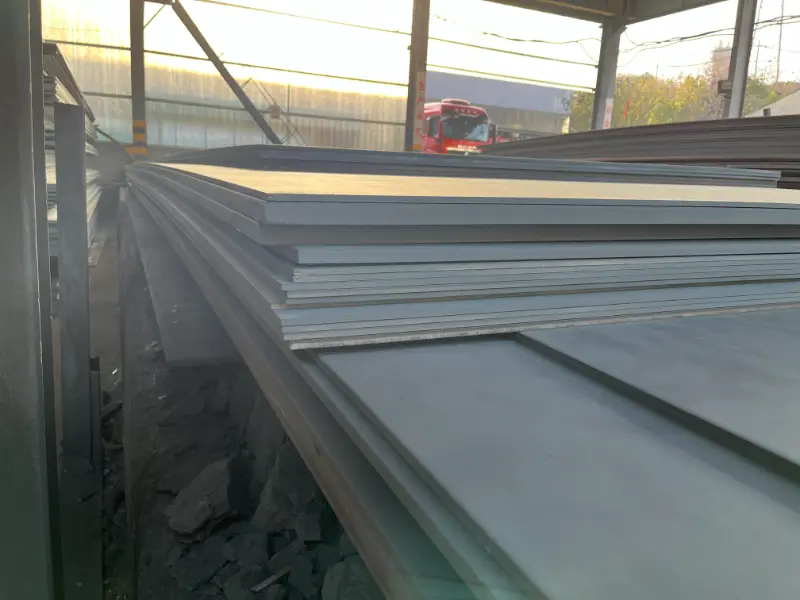
LR Grade DH55 Shipbuilding Steel Plate
LR Grade DH55 Shipbuilding Steel Plate - High-Strength Quenched & Tempered Marine Steel
Complete data sheet for LR Grade DH55 shipbuilding steel plate: chemical composition, mechanical & thermal properties, international equivalents, and application guide according to Lloyd's Register rules.
Welding, thermal cutting, cold forming, bending, machining
- Phone : +8618037372205
- Email : [email protected]
- WhatsApp: Contact via Whtsapp
- WeChat: +8618037372205
LR Grade DH55 Shipbuilding Steel Plate Introduction
LR Grade DH55 is a high-strength quenched and tempered (Q&T) shipbuilding steel plate specified by Lloyd's Register (LR).
It is designed for critical structural applications in shipbuilding and offshore engineering where a minimum yield strength of 550 MPa combined with excellent low-temperature toughness is required.
- Minimum yield strength: 550 MPa
- Excellent toughness down to -20 °C (Grade D)
- Good weldability with controlled carbon equivalent
- Supplied in quenched and tempered condition
DH55 plates are used in heavy-load hull members, decks, and offshore platform components.
LR Grade DH55 Shipbuilding Steel Plate Chemical Composition
Typical chemical composition according to LR Rules for quenched and tempered steels.
Elements are controlled to ensure strength, toughness, and weldability. Carbon equivalent (CEV) is strictly limited.
CEV = C + Mn/6 + (Cr+Mo+V)/5 + (Ni+Cu)/15
| Element | Specification (max, unless range) | Remarks |
|---|---|---|
| Carbon (C) | ≤ 0.20 | |
| Silicon (Si) | 0.10 – 0.55 | |
| Manganese (Mn) | 0.90 – 1.70 | Adjusted for strength and toughness |
| Phosphorus (P) | ≤ 0.025 | |
| Sulfur (S) | ≤ 0.025 | |
| Aluminium (Altot) | ≥ 0.020 | Fine grain practice |
| Niobium (Nb) | ≤ 0.05 | |
| Vanadium (V) | ≤ 0.10 | |
| Titanium (Ti) | ≤ 0.02 | |
| Chromium (Cr) | ≤ 0.25 | |
| Nickel (Ni) | ≤ 0.40 | |
| Molybdenum (Mo) | ≤ 0.08 | |
| Copper (Cu) | ≤ 0.30 | |
| Nitrogen (N) | ≤ 0.012 | |
| CEV (typical) | 0.38 – 0.44 | Depending on thickness |
LR Grade DH55 Shipbuilding Steel Plate Thermal & Electrical Physical Properties
Typical physical properties for quenched and tempered high-strength structural steel.
Values provided at room temperature unless otherwise specified. These are not mandatory specification values but are widely accepted for design calculations.
| Property | Typical Value | Unit | Test Condition |
|---|---|---|---|
| Density (ρ) | 7.85 | g/cm³ | 20 °C |
| Modulus of Elasticity (E) | 200 – 210 | GPa | 20 °C |
| Shear Modulus (G) | 80 | GPa | 20 °C |
| Poisson's Ratio (ν) | 0.3 | – | |
| Thermal Expansion Coefficient (α) | 12.0 × 10⁻⁶ | K⁻¹ | 20 – 100 °C |
| Thermal Conductivity (λ) | 45 | W/m·K | 20 °C |
| Specific Heat Capacity (c) | 460 | J/kg·K | 20 °C |
| Electrical Resistivity (ρe) | 0.20 – 0.25 | µΩ·m | 20 °C |
LR Grade DH55 Shipbuilding Steel Plate Mechanical Properties
Mechanical properties for plates in quenched and tempered condition.
Tensile testing at room temperature, impact testing at -20 °C (longitudinal Charpy V-notch).
Values depend on plate thickness. Bending test: 180° bend over mandrel diameter as specified.
ReH = upper yield strength, Rm = tensile strength, A5 = elongation (gauge length 5.65√S₀).
| Property | Specification | Unit | Test Condition / Thickness |
|---|---|---|---|
| Yield Strength (ReH) | ≥ 550 | MPa | t ≤ 100 mm |
| Tensile Strength (Rm) | 670 – 830 | MPa | t ≤ 100 mm |
| Elongation (A5) | ≥ 16 | % | t ≤ 100 mm (transverse) |
| Charpy Impact (KV2, -20 °C) | ≥ 41 | J | t ≤ 50 mm (longitudinal) |
| Charpy Impact (KV2, -20 °C) | ≥ 50 | J | 50 < t ≤ 70 mm (longitudinal) |
| Charpy Impact (KV2, -20 °C) | ≥ 60 | J | 70 < t ≤ 100 mm (longitudinal) |
| Charpy Impact (KV2, -20 °C) | ≥ 70 | J | 100 < t ≤ 150 mm (longitudinal) |
| Bend Test (180°) | d = 3a | – | No cracks, t ≤ 30 mm |
LR Grade DH55 Shipbuilding Steel Plate Fully Equivalent Material Standards & Substitute Grades
| Country / Region | Standard / Classification Society | Grade | Remarks |
|---|---|---|---|
| International (LR) | LR Rules | DH55 | Original specification |
| DNV (Norway/Germany) | DNV Rules | NV E550 | Identical requirements |
| ABS (USA) | ABS Rules | DH55 | Identical requirements |
| BV (France) | BV Rules | EH550 / DH550 | Identical requirements |
| CCS (China) | CCS Rules | E550 | Identical requirements |
| NK (Japan) | NK Rules | KE550 | Identical requirements |
| RINA (Italy) | RINA Rules | E550 | Identical requirements |
| KR (South Korea) | KR Rules | REH550 | Identical requirements |
LR Grade DH55 Shipbuilding Steel Plate Application Introduction
LR Grade DH55 is designed for structural components that require high strength and reliable low-temperature toughness.
It is widely used in shipbuilding and offshore engineering.
Typical applications include:
Product Applications: Hull bottom and side shell plates, Deck plates and stringers, Longitudinal stiffeners and frames, Transverse bulkheads, Offshore platform legs and braces
Processed into products: Welded beams and girders, Reinforced structural nodes, Heavy-lift crane pedestals, Ice-strengthened hull sections, Fatigue-critical welded joints
Application industries: Shipbuilding (commercial and naval vessels), Offshore and marine engineering, Oil & gas platforms (jack-ups, semi-submersibles), Renewable energy structures (wind turbine foundations)
LR Grade DH55 Shipbuilding Steel Plate Similar / Alternative Materials with Comparable Properties
| Country / Region | Standard | Grade | Remarks |
|---|---|---|---|
| Europe | EN 10025-6 | S550Q (1.8909) | Quenched and tempered structural steel, yield 550 MPa, not specifically for marine but similar mechanical properties. CEV and impact values may differ. |
| Europe | EN 10025-6 | S550QL (1.8926) | Same as above with improved low-temperature toughness (down to -40 °C or lower), requires careful welding procedure. |
Notes:
Material must be supplied with Lloyd's Register certification (LR inspection certificate 3.1 or 3.2).
Welding consumables shall be matched to the base material and qualified according to LR rules.
Preheat and post-weld heat treatment may be required depending on thickness and design. Always refer to the latest edition of the LR Rules for full requirements.
- Share



