
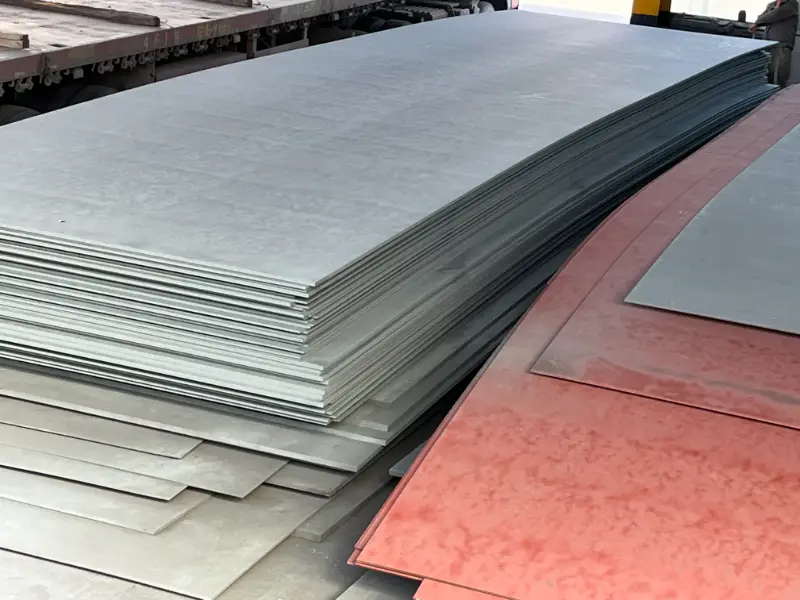
LR Grade FH55 Shipbuilding Steel Plate
LR Grade FH55 Shipbuilding Steel Plate - High Strength Quenched and Tempered Plate with Excellent Low-Temperature Toughness
Comprehensive data for LR FH55 shipbuilding steel plate: chemical composition, mechanical properties, thermal and electrical properties, equivalent grades, applications, and processing guidelines.
Hot rolling, quenching and tempering (Q&T), cutting, forming, welding
- Phone : +8618037372205
- Email : [email protected]
- WhatsApp: Contact via Whtsapp
- WeChat: +8618037372205
LR Grade FH55 Shipbuilding Steel Plate Introduction
LR Grade FH55 is a high-strength, quenched and tempered shipbuilding structural steel specified by Lloyd's Register (LR) for critical marine and offshore applications. With a minimum yield strength of 550 MPa and excellent toughness at temperatures down to -60°C, FH55 is designed for use in heavy-loaded structures, ice-class vessels, and harsh environments where high strength and low-temperature impact resistance are essential. The steel exhibits good weldability when appropriate preheating and post-weld treatments are applied, and it meets stringent requirements for notch toughness, ductility, and through-thickness properties.
LR Grade FH55 Shipbuilding Steel Plate Chemical Composition
Typical ladle analysis limits according to LR Rules for FH55. Fine-grain practice with grain-refining elements (Al, Nb, V, Ti) is mandatory. The carbon equivalent (CEV) is controlled to ensure weldability and hydrogen-induced cracking resistance.
| Element | Standard Value (max unless range) | Remarks |
|---|---|---|
| Carbon (C) | ≤ 0.16 | Ladle analysis |
| Silicon (Si) | 0.10 – 0.50 | Ladle analysis |
| Manganese (Mn) | 1.00 – 1.70 | Ladle analysis |
| Phosphorus (P) | ≤ 0.020 | |
| Sulfur (S) | ≤ 0.010 | |
| Chromium (Cr) | ≤ 0.20 | |
| Nickel (Ni) | ≤ 0.80 | |
| Molybdenum (Mo) | ≤ 0.30 | |
| Copper (Cu) | ≤ 0.35 | |
| Aluminium (Al), total | ≥ 0.015 | Grain refining |
| Niobium (Nb) | ≤ 0.05 | May be added |
| Vanadium (V) | ≤ 0.10 | May be added |
| Titanium (Ti) | ≤ 0.02 | May be added |
| Nitrogen (N) | ≤ 0.009 | If not bound by Ti/Al |
| Carbon Equivalent (CEV) | ≤ 0.45 | CEV = C + Mn/6 + (Cr+Mo+V)/5 + (Ni+Cu)/15, Ladle analysis |
LR Grade FH55 Shipbuilding Steel Plate Thermal and Electrical Physical Properties
Typical physical properties for quenched and tempered high-strength low-alloy steel at room temperature and elevated temperatures. These values are indicative and may vary slightly depending on exact composition and heat treatment.
| Property | Standard Value | Unit | Test Conditions |
|---|---|---|---|
| Density (ρ) | 7.85 | g/cm³ | 20°C |
| Modulus of Elasticity (E) | 205 | GPa | 20°C |
| Shear Modulus (G) | 80 | GPa | 20°C |
| Poisson's Ratio (ν) | 0.3 | – | 20°C |
| Thermal Expansion Coefficient (α) | 11.5 | 10⁻⁶/K | 20–100°C |
| Thermal Expansion Coefficient (α) | 12.0 | 10⁻⁶/K | 20–200°C |
| Thermal Expansion Coefficient (α) | 12.5 | 10⁻⁶/K | 20–400°C |
| Thermal Conductivity (λ) | 45 | W/(m·K) | 20°C |
| Specific Heat Capacity (c) | 460 | J/(kg·K) | 20°C |
| Electrical Resistivity (ρ_e) | 0.25 | μΩ·m | 20°C |
LR Grade FH55 Shipbuilding Steel Plate Mechanical Properties
Mechanical properties determined on transverse test pieces from quenched and tempered plates according to LR Rules. Impact test temperature is -60°C. Values apply to plate thickness ≤ 70 mm unless otherwise noted.
| Property | Standard Required Value | Unit | Test Conditions |
|---|---|---|---|
| Yield Strength (ReH) | ≥ 550 | MPa | Transverse, thickness ≤ 70 mm |
| Tensile Strength (Rm) | 620 – 770 | MPa | Transverse, thickness ≤ 70 mm |
| Elongation (A5) | ≥ 20 | % | Gauge length 5.65√So, thickness ≤ 70 mm |
| Charpy V-notch Impact Energy (KV) | ≥ 37 (longitudinal) | J | -60°C, longitudinal |
| Charpy V-notch Impact Energy (KV) | ≥ 27 (transverse) | J | -60°C, transverse |
| Bend Test (Diameter) | No cracks | - | 180° bend, mandrel diameter 3a (a=plate thickness) |
LR Grade FH55 Shipbuilding Steel Plate Exact Equivalent Grades – International Classifications
| Country/Region | Standard | Grade | Remarks |
|---|---|---|---|
| Norway/Germany | DNV GL Rules | F550 | Identical strength and toughness class |
| USA | ABS Rules | FH55 | Same designation, compatible |
| France | Bureau Veritas (BV) | F550 | EH55/FH55 equivalent |
| China | CCS Rules | F550 | Ship classification |
| Japan | Nippon Kaiji Kyokai (ClassNK) | KF55 | FH55 class |
| Italy | RINA Rules | F550 | Direct equivalent |
| Russia | RS Rules | F55 | Comparable FH class |
| South Korea | Korean Register (KR) | FH55 | Identical designation |
LR Grade FH55 Shipbuilding Steel Plate Application Introduction
LR FH55 steel is intended for load-bearing structures in shipbuilding and offshore engineering, particularly where high strength is needed and excellent resistance to brittle fracture at low temperatures is mandatory. Its quenched and tempered condition ensures uniform mechanical properties across thick sections. Typical processing includes plate cutting, cold and hot forming (within controlled temperature ranges), and welding with low-hydrogen consumables. The steel is delivered with LR certification and surface condition suitable for immediate fabrication.
Product Applications: Hull plates for high-stress areas (shear strake, deck stringer, bottom plating), Deck and side shell in large container ships, Supporting structures for deck cranes and heavy machinery, Pontoon and semisubmersible platform columns, Ice belt reinforcement plates, Piling and mooring components
Processed into products: Longitudinal stiffeners and girders, Watertight bulkheads subjected to high loads, Hatch coamings and corner plates, Rudder horn and stern frame castings/weldments, Brackets and connection plates in critical fatigue regions
Application industries: Shipbuilding (commercial and naval), Offshore oil & gas platforms and FPSO structures, Heavy lifting and transportation equipment, Ice-class vessels (Icebreaker and Arctic ships), Port and harbor infrastructure, Wind turbine foundation structures (marine)
LR Grade FH55 Shipbuilding Steel Plate Similar or Alternative Materials
| Country/Region | Standard/Grade | Remarks |
|---|---|---|
| International | LR EH55 | Same strength, higher minimum design temperature (-40°C vs -60°C); suitable where less stringent toughness is acceptable. |
| International | LR FH47 | Lower yield strength (≥ 470 MPa) but similar low-temperature toughness (-60°C); used where higher toughness is needed but strength demand is lower. |
| International | LR FH63 | Higher yield strength (≥ 630 MPa) with -60°C toughness; may be considered for even higher structural loads, but weldability and fabrication require more control. |
| International | EN 10025-6 S550QL | Quenched and tempered structural steel with similar strength (S550Q/S550QL), not specifically regulated for marine use, may serve as a reference for mechanical properties but needs supplementary marine certifications. |
Notes:
Welding: Low-hydrogen welding procedures are mandatory. Preheat and interpass temperature typically 100–150°C depending on thickness. Post-weld heat treatment may be required for some applications but should be evaluated due to potential tempering effects. Ultrasonic testing: Plates are often ordered with UT testing per EN 10160 Class S1 or equivalent LR requirements. CEV limits: The carbon equivalent is strictly controlled to ensure good weldability. Thickness tolerance: According to LR Rules; options for tighter tolerances may be agreed. Special requirements: Through-thickness (Z-quality) testing to Z25 or Z35 may be specified for critical joints to avoid lamellar tearing. Availability: FH55 plates are typically produced in thicknesses from 8 mm to 100 mm, widths up to 4500 mm, and lengths up to 18000 mm depending on the manufacturer.
- Share



