
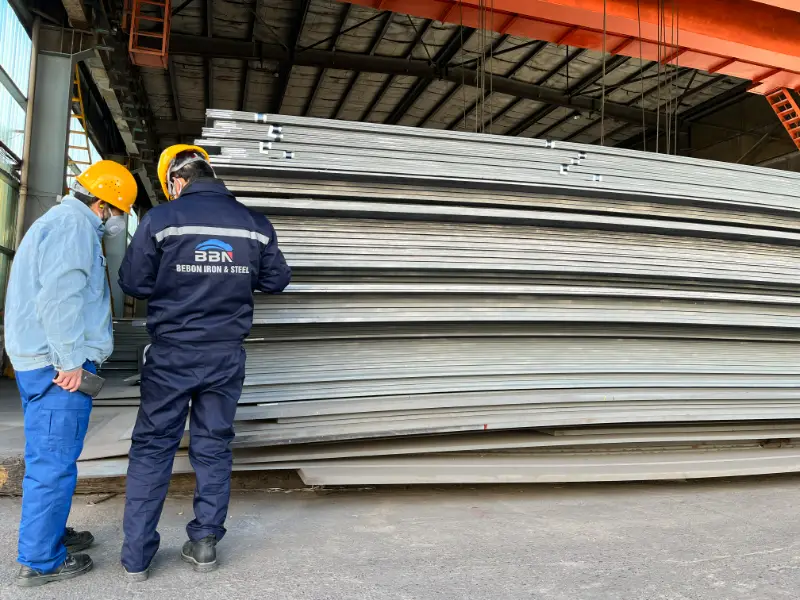
DNV Grade D36 Shipbuilding Steel Plate
DNV Grade D36 Shipbuilding Steel Plate: High-Strength, Excellent Weldability, & Superior Low-Temperature Toughness
Comprehensive data on DNV D36 shipbuilding steel: chemical composition, mechanical & thermal properties, international equivalents, and typical marine/offshore applications.
Hot rolling, normalizing rolling, thermo-mechanical controlled processing (TMCP)
- Phone : +8618037372205
- Email : [email protected]
- WhatsApp: Contact via Whtsapp
- WeChat: +8618037372205
DNV Grade D36 Shipbuilding Steel Plate Introduction
DNV Grade D36 is a high-strength structural steel plate certified by DNV (Det Norske Veritas) for shipbuilding and offshore structures. It is designed to meet the rigorous demands of ocean-going vessels and marine environments. With a minimum yield strength of 355 MPa and a tensile strength in the range of 490–620 MPa, D36 offers an excellent strength-to-weight ratio. The material is characterized by good weldability, reliable impact toughness at temperatures as low as -20°C, and suitability for cold forming. Typically supplied in normalized rolling or thermo-mechanically controlled process (TMCP) condition, D36 is widely used for hull plates, decks, and structural components. It is fully compliant with DNV rules and can be produced with tight thickness tolerances and superior surface quality, making it a preferred choice for both newbuilding and repair projects.
DNV Grade D36 Shipbuilding Steel Plate Chemical Composition
The chemical composition of DNV D36 steel is tightly controlled to ensure weldability, toughness, and strength. Carbon equivalent (CEV) is usually restricted to ≤0.38% to reduce hardenability and improve weldability. Micro-alloying elements (Nb, V, Ti) are added for grain refinement and precipitation strengthening.
| Element | Standard Value (%) | Remarks |
|---|---|---|
| C (Carbon) | ≤ 0.18 | Ladle analysis |
| Si (Silicon) | 0.10 – 0.50 | |
| Mn (Manganese) | 0.90 – 1.60 | |
| P (Phosphorus) | ≤ 0.035 | |
| S (Sulfur) | ≤ 0.035 | |
| Cr (Chromium) | ≤ 0.20 | |
| Ni (Nickel) | ≤ 0.40 | |
| Cu (Copper) | ≤ 0.35 | |
| Mo (Molybdenum) | ≤ 0.08 | |
| Al (Aluminum, total) | ≥ 0.015 | Acid-soluble; grain refining |
| Nb (Niobium) | ≤ 0.05 | |
| V (Vanadium) | ≤ 0.10 | |
| Ti (Titanium) | ≤ 0.02 | |
| N (Nitrogen) | ≤ 0.012 | If not fixated by sufficient Al or Ti |
| CEV (Carbon Equivalent) | ≤ 0.38 | CEV = C + Mn/6 + (Cr+Mo+V)/5 + (Ni+Cu)/15 |
DNV Grade D36 Shipbuilding Steel Plate Physical Properties
Physical properties are typical for low-alloy structural steel and may vary with temperature and processing. Values are valid at room temperature unless stated otherwise.
| Property | Typical value | Unit | Condition / Remarks |
|---|---|---|---|
| Density (ρ) | 7.85 | g/cm³ | 20 °C |
| Modulus of elasticity (E) | 205 | GPa | 20 °C |
| Shear modulus (G) | 80 | GPa | 20 °C |
| Poisson's ratio (ν) | 0.3 | — | 20 °C |
| Thermal expansion coefficient (α) | 11.5 – 12.5 | ×10⁻⁶ K⁻¹ | 20 – 100 °C |
| Thermal conductivity (λ) | 45 – 50 | W/(m·K) | 20 °C |
| Specific heat capacity (cp) | 460 – 480 | J/(kg·K) | 20 °C |
| Electrical resistivity (ρ_e) | 0.20 – 0.25 | μΩ·m | 20 °C |
DNV Grade D36 Shipbuilding Steel Plate Mechanical Properties
Tensile and impact properties are valid for plate thicknesses up to 50 mm unless otherwise agreed. Transverse properties apply where specified by the purchaser. Impact test temperature for grade D36 is -20 °C. The bend test uses a former diameter of 3t for grades with specified minimum yield ≥355 MPa.
| Property | Standard Requirement | Unit | Test Conditions |
|---|---|---|---|
| ReH (Upper yield strength) | ≥ 355 | MPa | t ≤ 50 mm, transverse or longitudinal |
| Rm (Tensile strength) | 490 – 620 | MPa | t ≤ 50 mm, transverse or longitudinal |
| A (Elongation after fracture) | ≥ 21 (longitudinal) | % | t ≤ 50 mm, gauge length 5.65√S₀ |
| A (Elongation after fracture) | ≥ 19 (transverse) | % | t ≤ 50 mm, gauge length 5.65√S₀ |
| Bend test (180°) | d = 3a | — | No cracks, specimen width = 3t |
| KV (Charpy V-notch impact energy) | ≥ 34 (longitudinal) | J | Test temperature -20 °C, average of three |
| KV (Charpy V-notch impact energy) | ≥ 24 (longitudinal, individual minimum) | J | Test temperature -20 °C |
DNV Grade D36 Shipbuilding Steel Plate Completely Equivalent Standards and Replaceable Grades
The following classification society grades are fully equivalent to DNV D36. Plates certified by any of these societies can generally be used interchangeably in shipbuilding, provided the applicable manufacturing and testing procedures are followed.
| Country / Region | Standard / Rule | Grade / Designation | Remarks |
|---|---|---|---|
| International / Norway | DNV GL Rules | D36 (NV D36) | Presented grade |
| USA | ABS Rules | D36 (ABS D36) | American Bureau of Shipping |
| United Kingdom | LR Rules | D36 (LR D36) | Lloyd's Register |
| France | BV Rules | D36 (BV D36) | Bureau Veritas |
| China | CCS Rules | D36 (CCS D36) | China Classification Society |
| Germany | DNV GL (former GL) | D36 (GL D36) | Now merged into DNV GL |
| Italy | RINA Rules | D36 (RINA D36) | Registro Italiano Navale |
| Japan | NK Rules | KD36 (NK KD36) | Nippon Kaiji Kyokai (ClassNK) |
| South Korea | KR Rules | RD36 (KR RD36) | Korean Register |
| Russia | RMRS Rules | D36 (RMRS D36) | Russian Maritime Register of Shipping |
| India | IRS Rules | D36 (IRS D36) | Indian Register of Shipping |
| International | IACS UR W11 | D36 | Unified requirement for normal and higher strength hull structural steels |
DNV Grade D36 Shipbuilding Steel Plate Application Introduction
DNV D36 is certified for critical structural applications in shipbuilding and offshore engineering. It is primarily used for load-bearing members that require high strength, good weldability, and reliable toughness at low temperatures. Common applications include:
- Main deck plates and hull shell plating
- Bottom and side longitudinal stiffeners
- Bulkheads, transverse frames, and web frames
- Offshore platform topside modules and jack-up rig components
Product Applications: Product carriers and chemical tankers, Bulk carriers and ore carriers, Container ships and Ro-Ro vessels, Offshore platform jacket structures, Floating production storage and offloading (FPSO) modules, Ship-to-ship lifting and mooring components
Processed into products: Hull plates (shell, deck, bottom), Transverse bulkheads and swash bulkheads, Stringers, floors, and girders, Hatch coamings and heavy pad eyes, Bracket plates and gussets, Crane pedestals and bollard foundations
Application industries: Shipbuilding (commercial and naval vessels), Offshore oil & gas, Marine engineering (port equipment, lock gates), Offshore renewable energy (wind turbine foundations, substations)
DNV Grade D36 Shipbuilding Steel Plate Similar / Alternative Materials with Close Properties
These materials share comparable strength, toughness, and weldability and may serve as alternatives in specific structural applications. Direct substitution requires re-validation of design and welding procedures under the applicable standard.
| Country / Region | Standard | Grade / Designation | Remarks |
|---|---|---|---|
| Europe | EN 10025-4 | S355M / S355ML | TMCP condition, similar yield (355 MPa) and impact toughness (ML at -50°C); often used in offshore structures |
| USA | ASTM A572 / A572M | Grade 50 [345] / Grade 50S [345S] | Slightly lower yield (345 MPa) but comparable tensile and weldability; structural, not marine-certified unless ordered to ASTM A131 |
| USA | ASTM A131 / A131M | DH36 | Equivalent shipbuilding grade with identical mechanical requirements; charpy at -20°C |
| International | ISO 630-3 | S355G10+M / S355G10+ML | Offshore structural steel, TMCP condition, yield 355 MPa, low temperature properties |
| China | GB/T 712 | DH36 | Marine steel equivalent to D36; charpy at -20°C |
| Japan | JIS G 3106 | SM490YB | Higher tensile (490-610 MPa) but lower yield (365 MPa); not always marine-certified |
Notes:
Welding: DNV D36 exhibits excellent weldability with all common processes (SMAW, SAW, GMAW). Preheating is generally not required for thicknesses below 30 mm; interpass temperature should follow approved welding procedures. Corrosion protection: As a non-alloyed/low-alloy steel, D36 requires protective coatings in marine environments. Cathodic protection may be used complementary. Forming: Hot or cold forming can be performed; radius limits should follow DNV guidelines to avoid strain-aging. Strain-aging steels may require prior normalizing or stress relieving. Certification: Each plate is supplied with a DNV inspection certificate 3.1 or 3.2 covering chemical and mechanical test results, traceable to the plate number.
- Share



