
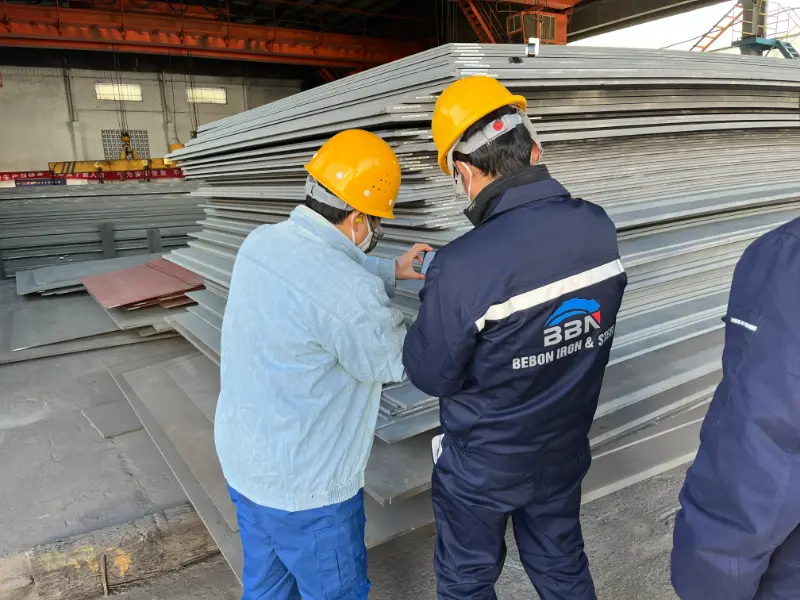
DNV Grade E36 Shipbuilding Steel Plate
DNV Grade E36 Shipbuilding Steel Plate: High-Strength Marine Structural Steel for Extreme Cold
Comprehensive material data for DNV Grade E36 shipbuilding steel plate, including chemical composition, mechanical properties, and thermal characteristics as per official classification society rules.
Normalizing (N), Thermo-Mechanical Control Process (TMCP) upon agreement, Quenching and Tempering (QT) upon agreement. Suitable for cutting, cold forming, and all major welding processes.
- Phone : +8618037372205
- Email : [email protected]
- WhatsApp: Contact via Whtsapp
- WeChat: +8618037372205
DNV Grade E36 Shipbuilding Steel Plate Introduction
DNV Grade E36 is a high-strength, normalized shipbuilding steel plate certified by DNV (Det Norske Veritas). As a fine-grain, fully killed steel with a minimum yield strength of 355 MPa, it is designed for critical structural components in shipbuilding and offshore engineering. Its primary feature is guaranteed impact toughness at low temperatures down to -40°C, ensuring resistance to brittle fracture in demanding cold-climate marine applications. The 'E' designation signifies its suitability for the most severe operating environments within the standard shipbuilding grades. This grade is widely used in hulls, superstructures, and offshore modules, where both high strength and excellent weldability are non-negotiable requirements.
DNV Grade E36 Shipbuilding Steel Plate Chemical Composition
The chemical composition of DNV E36 steel is strictly controlled to ensure a fine grain structure, high strength, and excellent low-temperature toughness. Carbon Equivalent (CEV) is limited to guarantee good weldability and must be calculated using the formula: CEV = C + Mn/6 + (Cr+Mo+V)/5 + (Ni+Cu)/15. All values are maximum limits unless otherwise stated.
| Element | Standard Value (Max, %) | Remarks |
|---|---|---|
| C | ≤ 0.18 | |
| Mn | 0.90 - 1.60 | For thickness t ≤ 12.5 mm, min. Mn may be reduced to 0.70% |
| Si | 0.10 - 0.50 | Fully killed steel |
| P | ≤ 0.025 | |
| S | ≤ 0.025 | |
| Als (Acid Soluble Al) | ≥ 0.015 | Or other sufficient grain-refining elements |
| Nb (Niobium) | 0.02 - 0.05 | Single or combined micro-alloying element |
| V (Vanadium) | 0.05 - 0.10 | Single or combined micro-alloying element |
| Ti (Titanium) | ≤ 0.02 | Optional grain-refining element |
| Cu (Copper) | ≤ 0.35 | |
| Cr (Chromium) | ≤ 0.20 | |
| Ni (Nickel) | ≤ 0.40 | |
| Mo (Molybdenum) | ≤ 0.08 | |
| N (Nitrogen) | ≤ 0.009 | For steels without nitrogen-fixing elements |
| CEV (Carbon Equivalent) | ≤ 0.38 | For all standard thicknesses |
DNV Grade E36 Shipbuilding Steel Plate Physical and Electrical Properties
The following data provides typical physical constants for a normalized C-Mn high-strength structural steel, applicable for general engineering calculations for a DNV E36 grade. These values are not mandatory for product certification but are essential for design analysis involving thermal loads, stiffness, and weight estimation. Properties may vary slightly depending on the exact chemical composition and manufacturing process. The density is a standard value for carbon steel.
| Property | Typical Value | Unit | Test Condition |
|---|---|---|---|
| Density (ρ) | 7.85 | g/cm³ | At 20°C |
| Modulus of Elasticity (E) | 210 | GPa | At 20°C |
| Shear Modulus (G) | 80.8 | GPa | At 20°C |
| Poisson's Ratio (ν) | 0.3 | - | At 20°C |
| Thermal Expansion Coefficient (α) | 12.0; 13.2; 14.1 | 10⁻⁶/K | At 20-100°C; 20-200°C; 20-400°C |
| Thermal Conductivity (λ) | 49.8; 46.4; 40.7 | W/(m·K) | At 20°C; 200°C; 400°C |
| Specific Heat Capacity (Cp) | 465; 515; 580 | J/(kg·K) | At 20°C; 200°C; 400°C |
| Electrical Resistivity (ρ_e) | 0.22 | Ω·mm²/m | At 20°C |
DNV Grade E36 Shipbuilding Steel Plate Mechanical Properties
The following mechanical properties are mandatory according to DNV rules for Grade E36 plates. Tests are performed on samples taken transverse to the rolling direction. Impact testing is mandatory at -40°C, differentiating this 'E' grade from the 'D' (-20°C) and 'A' (no impact test) grades. Properties apply to normalized or TMCP delivery conditions.
| Property | Standard Requirement Value | Unit | Test Condition / Specimen Direction |
|---|---|---|---|
| Upper Yield Strength (ReH) | ≥ 355 | MPa | Ambient temperature; For thickness t ≤ 100 mm; Transverse |
| Tensile Strength (Rm) | 490 - 630 | MPa | Ambient temperature; For thickness t ≤ 100 mm; Transverse |
| Elongation (A5) | ≥ 21 | % | Ambient temperature; Gauge length 5.65√So; Transverse for plates t ≥ 5 mm |
| Average Impact Energy (KV2) | ≥ 34 | J | -40°C; Charpy V-notch; Transverse; Minimum average of three tests |
| Individual Minimum Impact Energy (KV2) | ≥ 24 | J | -40°C; Charpy V-notch; Transverse; Single test piece value |
DNV Grade E36 Shipbuilding Steel Plate Complete Equivalent Material Standards and Substitutable Grade Designations
| Country / Region | Standard | Grade | Remarks |
|---|---|---|---|
| International | IACS UR W11 | EH36 | Base standard for all IACS member classification societies |
| USA | ASTM A131 / A131M | EH36 | American Bureau of Shipping (ABS) / Standard hull steel |
| UK | LR Rules | EH36 | Lloyd's Register equivalent |
| France | BV Rules | EH36 | Bureau Veritas equivalent |
| China | CCS Rules | EH36 | China Classification Society equivalent |
| Italy | RINA Rules | E36 | Registro Italiano Navale equivalent |
| Japan | NK (ClassNK) Rules | KE36 | Nippon Kaiji Kyokai equivalent |
| Germany/Norway | DNV GL (now DNV) Rules | E36 | The requested grade and standard |
| European Union | EN 10025-4 | S355ML | Thermomechanical rolled weldable fine grain structural steel |
DNV Grade E36 Shipbuilding Steel Plate Application Introduction
DNV E36 steel plate is a cornerstone material in modern shipbuilding and offshore construction. Its excellent combination of high strength, superior weldability, and guaranteed -40°C impact toughness makes it indispensable for structures operating in cold marine environments. It is specifically chosen for highly stressed parts of the hull and structural elements of offshore installations to provide resistance against brittle fracture under dynamic loads and low ambient temperatures.
Product Applications: Container ships, bulk carriers, oil tankers, and passenger vessels (Hull shell plating, strength decks), Liquefied Natural Gas (LNG) carrier secondary barrier structures, Jack-up drilling rig legs, spudcans, and cantilever beams, Offshore substation and converter platform main structures, Icebreaker and arctic vessel hulls
Processed into products: Main deck and bottom shell plating, Longitudinal stiffeners and web frames, Transverse bulkheads and deep girders, Bilge strakes and sheer strakes, Heavy-lift pad-eyes and crane pedestal mounts, Fatigue-critical connections and tubular joints in jacket foundations
Application industries: Shipbuilding and Ship Repair, Offshore Oil & Gas (Topside Modules, Jack-up Rig Components), Marine Renewable Energy (Offshore Wind Turbine Foundations), Port and Harbor Construction (Sheet Piling, Caissons), Heavy Civil Engineering in cold climates
DNV Grade E36 Shipbuilding Steel Plate Similar and Analogous Alternative Materials Analysis
| Country / Region | Standard | Grade | Remarks |
|---|---|---|---|
| European Union | EN 10025-3 | S355NL | Normalized fine-grain steel. Provides similar strength and low-temp toughness (-50°C) but is regulated for general structures, not specifically marine. DNV certification would be required for shipbuilding. |
| Russian Federation | GOST 5521 | E36 | Russian maritime shipbuilding steel standard. Chemistry and properties are comparable to DNV E36, suitable for cold climates. |
| Germany | DIN 17280 (Withdrawn) | TStE 355 | Historical normalized fine-grain structural steel with similar yield/tensile strength. A predecessor to modern S355NL grades. |
| Japan | JIS G 3106 | SM490YB | A weldable, high-strength structural steel. While minimum yield is 365 MPa at thinner gauges, the toughness guarantee differs by temperature class (B is 0°C). Not a direct equivalent for low-temperature E-grade without specific agreement. |
Notes:
Tolerance and Testing: All mechanical properties are verified on test pieces taken from coupons that have undergone simulated post-weld heat treatment (PWHT) if applicable. Weldability is evaluated by stringent CEV limits and may require qualification with specific welding consumables. Ultrasonic testing to class requirements (e.g., EN 10160 S2/E3 or equivalent) is standard for intermediate and high thicknesses. Through-thickness (Z-direction) properties as per Z25 or Z35 can be agreed upon to resist lamellar tearing.
- Share



