
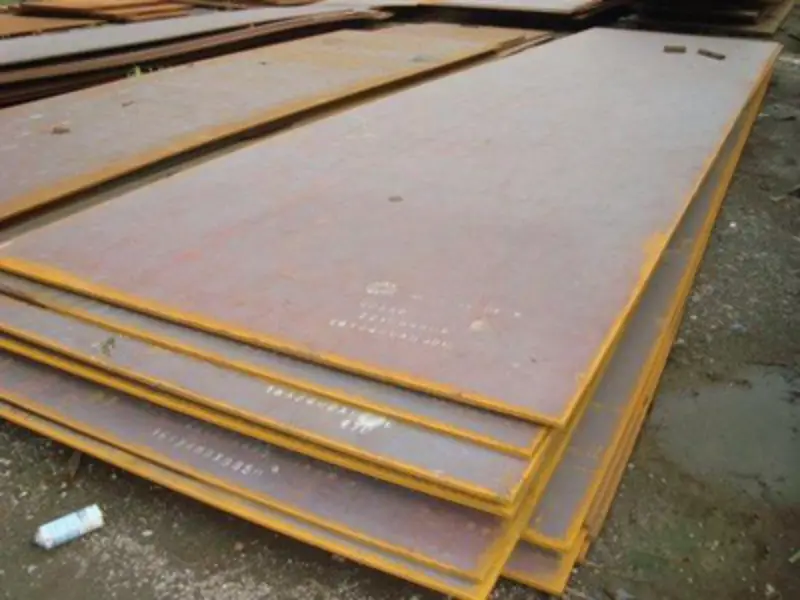
DNV Grade F36 Shipbuilding Steel Plate
DNV Grade F36 Shipbuilding Steel Plate: High-Strength Hull Structural Steel
Complete material data for DNV Grade F36 steel plate, including chemical composition, mechanical properties, thermal and electrical physical properties, international equivalents, and application guidance for marine engineering.
Hot rolling, normalizing, TMCP (Thermo-Mechanical Controlled Process), controlled rolling; subsequent welding, cutting, bending, and forming.
- Phone : +8618037372205
- Email : [email protected]
- WhatsApp: Contact via Whtsapp
- WeChat: +8618037372205
DNV Grade F36 Shipbuilding Steel Plate Introduction
DNV Grade F36 is a high-strength hull structural steel plate certified by DNV (Det Norske Veritas) for shipbuilding and offshore engineering. It offers a minimum yield strength of 355 MPa, excellent low-temperature toughness at -40°C, and good weldability. Key features:
- Fine-grain fully killed steel with controlled alloying (Nb, V, Ti, Al) for improved mechanical properties.
- Suitable for critical structural components such as hull shells, decks, and stiffeners in marine environments.
- Delivered in normalized, TMCP, or controlled-rolled condition as agreed.
- Complies with DNV Rules for Classification of Ships, Part 2, Chapter 1.
DNV Grade F36 Shipbuilding Steel Plate Chemical Composition
The chemical composition of DNV F36 is designed to ensure a fine-grain structure, high strength, and excellent low-temperature toughness. Except as otherwise agreed, the steel is fully killed and contains grain-refining elements such as Al, Nb, V, or Ti in suitable combinations. Maximum limits for residuals are set to maintain weldability and corrosion resistance. Notes:
- For thicknesses >100 mm, the chemical composition may be specially agreed.
- If only Al is used as grain refiner, the total Al content shall be at least 0.020%.
- The sum of Nb + V + Ti shall not exceed 0.12% unless otherwise agreed.
| Element | Standard Value (weight %) | Remarks |
|---|---|---|
| C (Carbon) | ≤ 0.16 | For thickness ≤ 100 mm |
| Si (Silicon) | ≤ 0.50 | |
| Mn (Manganese) | 0.90 – 1.60 | For thickness ≤ 50 mm; may be higher for thicker plates upon agreement |
| P (Phosphorus) | ≤ 0.025 | |
| S (Sulfur) | ≤ 0.025 | |
| Al (total) | ≥ 0.020 | If used as grain refiner, acid-soluble Al ≥ 0.015% |
| Nb (Niobium) | 0.02 – 0.05 | Grain-refining element |
| V (Vanadium) | 0.05 – 0.10 | Grain-refining element |
| Ti (Titanium) | 0.007 – 0.05 | Grain-refining element |
| Cu (Copper) | ≤ 0.35 | Residual element |
| Cr (Chromium) | ≤ 0.20 | Residual element |
| Ni (Nickel) | ≤ 0.40 | Residual element |
| Mo (Molybdenum) | ≤ 0.08 | Residual element |
| N (Nitrogen) | ≤ 0.009 | Unless Al content is sufficient to fix N |
DNV Grade F36 Shipbuilding Steel Plate Thermal and Electrical Physical Properties
The physical property values below are typical for carbon–manganese structural steels at room temperature (20°C) and serve as reference for design calculations. Actual values may vary slightly depending on the specific chemical composition and heat treatment condition. Important:
- Thermal expansion is given for the range 20–100°C and 20–200°C.
- Thermal conductivity depends on temperature; the value at 100°C is approximately 50 W/(m·K).
- Electrical resistivity is for standard carbon–manganese steel and may be influenced by alloying elements.
| Property | Typical Value | Unit | Condition / Temperature |
|---|---|---|---|
| Density (ρ) | 7850 | kg/m³ | At 20°C |
| Modulus of Elasticity (E) | 210 | GPa | At 20°C |
| Shear Modulus (G) | 80 | GPa | At 20°C, calculated from E and ν |
| Poisson's Ratio (ν) | 0.3 | - | At 20°C |
| Thermal Expansion Coefficient (α) | 11.7 × 10⁻⁶ | 1/K | 20–100°C |
| Thermal Expansion Coefficient (α) | 12.5 × 10⁻⁶ | 1/K | 20–200°C |
| Thermal Conductivity (λ) | 50 | W/(m·K) | At 100°C |
| Thermal Conductivity (λ) | 45 | W/(m·K) | At 200°C |
| Specific Heat Capacity | 460 | J/(kg·K) | At 20°C |
| Electrical Resistivity (ρe) | 0.16 – 0.25 | µΩ·m | At 20°C, typical for low-alloy carbon steel |
DNV Grade F36 Shipbuilding Steel Plate Mechanical Properties
Mechanical properties are determined on test specimens taken in the transverse direction, unless longitudinal testing is agreed for impact tests. The values are valid for plate thicknesses ≤100 mm. For thicknesses 100–150 mm, properties may be specially agreed. Testing conditions:
- Tensile test at ambient temperature.
- Charpy V-notch impact test at -40°C for Grade F, with an average minimum energy of 27 J (longitudinal).
- Bending test at 180°, with allowable crack formation criteria as per standard.
- Ultrasonic testing is normally required for thicknesses ≥6 mm as per DNV rules.
| Property | Requirement | Unit | Test Condition / Thickness (t) |
|---|---|---|---|
| Yield Strength (ReH) | ≥ 355 | MPa | t ≤ 100 mm |
| Tensile Strength (Rm) | 490 – 620 | MPa | t ≤ 100 mm |
| Elongation (A) | ≥ 21 | % | Gauge length 5.65√So (l = 200 mm or 50 mm), t ≤ 50 mm |
| Elongation (A) | ≥ 20 | % | 50 mm < t ≤ 70 mm |
| Elongation (A) | ≥ 19 | % | 70 mm < t ≤ 100 mm |
| Charpy Impact Energy (KV) | ≥ 27 (average), ≥ 20 (single) | J | Longitudinal, -40°C, V-notch, t ≥ 6 mm |
| Bend Test (180°) | No cracks | - | Bend diameter = 3 × thickness (t); for t ≤ 50 mm |
| Bend Test (180°) | No cracks | - | Bend diameter = 4 × thickness (t); for 50 < t ≤ 100 mm |
DNV Grade F36 Shipbuilding Steel Plate Fully Equivalent International Standards and Substitute Grades
The following classification society grades are technically identical or directly equivalent to DNV F36 with the same strength level (355 MPa) and -40°C impact requirement. They can be used as direct substitutes subject to the individual class society's approval.
| Country / Classification Society | Standard / Rules | Grade | Remarks |
|---|---|---|---|
| American Bureau of Shipping (ABS) | ABS Rules | EH36 | High-strength hull structural steel, -40°C |
| Lloyd's Register (LR) | LR Rules | EH36 | Equivalent strength and toughness class |
| Bureau Veritas (BV) | BV Rules | EH36 | Same as DNV F36 |
| China Classification Society (CCS) | CCS Rules | EH36 | Compatible grade E36 |
| Korean Register (KR) | KR Rules | EH36 | -40°C grade matching DNV F36 |
| ClassNK (NK) | NK Rules | EH36 | Direct equivalent |
| RINA (Italy) | RINA Rules | EH36 | Equivalent high-strength grade |
| Russian Maritime Register (RS) | RS Rules | EH36 | Same property profile |
| DNV GL (merged) | DNV GL Rules | F36 / EH36 | Both designations may coexist; EH36 from GL and F36 from DNV are merged under DNV GL |
DNV Grade F36 Shipbuilding Steel Plate Application Introduction
DNV Grade F36 is ideal for welded structures operating in cold marine environments. Its balanced composition allows efficient fabrication by standard shipyard processes. Application guidelines:
- Preheat and interpass temperature control is recommended for thick sections to avoid hydrogen cracking.
- Severe forming requires attention to not exceed the strain aging capacity; TMCP conditions may offer superior formability.
- The low-temperature notch toughness ensures safe service in sea temperatures down to -40°C design condition.
- This steel is often specified for the hull envelope and primary strength members of ice-class vessels.
Product Applications: Hull shells and bottom plates, Strength deck plating, Transverse and longitudinal bulkheads, Web frames and girders, Stiffeners and brackets, Ice strengthening plates (regions of heavy ice loads)
Processed into products: Double bottom sections, Side shell longitudinals, Hatch coamings and corner plates, Rudder horn and stern frame plates, Crane pedestals and heavy lift attachment plates, Offshore platform main deck and helideck sections
Application industries: Shipbuilding (merchant ships, naval vessels, icebreakers), Offshore oil and gas (jack-up rigs, semi-submersibles, FPSO hulls), Marine and port engineering (lock gates, caissons, quay walls), Renewable energy (offshore wind substructures)
DNV Grade F36 Shipbuilding Steel Plate Similar and Proximate Substitute Materials
The following grades have comparable strength (yield 355 MPa) but differ in impact test temperature or additional requirements. They can be considered as alternatives when service conditions allow.
| Country / Classification Society | Standard / Rules | Grade | Remarks / Comparison |
|---|---|---|---|
| DNV | DNV Rules | AH36 | Same strength, impact at 0°C; lower cold toughness, suitable for non-arctic structures |
| DNV | DNV Rules | DH36 | Same strength, impact at -20°C |
| DNV | DNV Rules | E36 | Same strength, impact at -40°C but with lower trace element limits; F36 is the fully killed fine-grain variant |
| DNV | DNV Rules | FH36 (or FV36) | Occasionally used for -40°C with very low sulfur and extra notch toughness; may be treated as identical in some cases |
| API / ISO | ISO 19902 / API 2W | API 2H Grade 42 / Grade 50 | Offshore structural steel; Grade 50 has 345–355 MPa yield, but different testing and delivery; requires project-specific approval |
| EN | EN 10025-4 | S355ML | Thermomechanical rolled fine-grain weldable structural steel with 355 MPa yield and optional -40°C impact (ML option) |
Notes:
- All data provided herein are based on the DNV Rules for Classification of Ships (2023 revision) and reflect minimum standard requirements. Actual mill certificates may show tighter chemistry and better mechanical properties.
- This material is typically supplied with inspection certificates (class A, B, or C) depending on testing scope.
- Ultrasonic testing per EN 10160 or DNV specification is normally required.
- Tolerances, surface condition, and additional Z-grade (through-thickness property) requirements are per EN 10029 / EN 10163 or the specific DNV supplementary rules.
- Welding consumables should be selected to match the strength level and to maintain -40°C toughness.
- Share



