
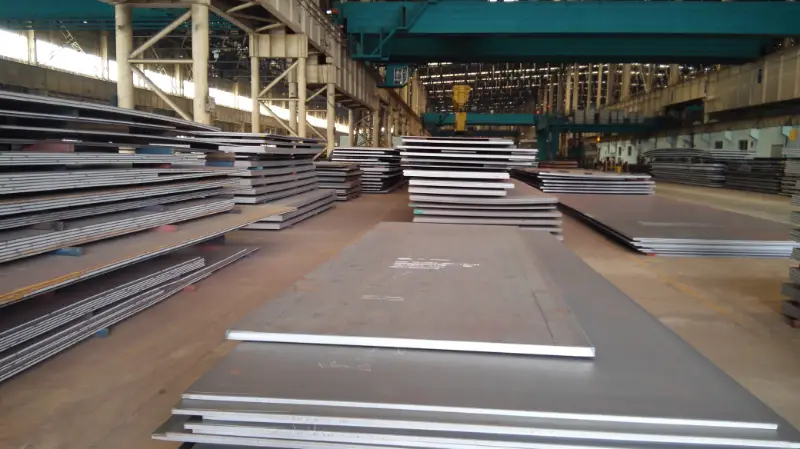
DNV Grade D32 Shipbuilding Steel Plate
DNV Grade D32 Shipbuilding Steel Plate: High-Strength Marine Structural Steel
Comprehensive material data for DNV Grade D32 shipbuilding steel plate, including chemical composition, mechanical and physical properties, equivalent grades, and application guidance.
Hot rolling, normalizing, thermo-mechanical controlled processing (TMCP), cutting, cold forming, welding
- Phone : +8618037372205
- Email : [email protected]
- WhatsApp: Contact via Whtsapp
- WeChat: +8618037372205
DNV Grade D32 Shipbuilding Steel Plate Introduction
DNV Grade D32 is a high-strength normalized shipbuilding structural steel plate in accordance with the rules of Det Norske Veritas (DNV). It is designed for marine applications requiring excellent notch toughness at low temperatures, with impact testing guaranteed at -20°C. The minimum yield strength is 315 MPa, which makes it suitable for critical hull structures, including decks, shells, and longitudinal strength members.
- Good weldability and formability
- Excellent low-temperature impact toughness
- Supply condition: normalized, controlled rolled, or thermo-mechanically rolled as agreed
- Widely used in shipbuilding and offshore structures
DNV Grade D32 Shipbuilding Steel Plate Chemical Composition
The chemical composition complies with DNV rules for grade D32. Maximum limits are specified unless a range is given. Fine grain elements such as Al, Nb, V, or Ti are added singly or in combination to ensure required mechanical properties and impact toughness.
| Element | Standard Value | Remarks |
|---|---|---|
| Carbon (C) | ≤ 0.18 | - |
| Silicon (Si) | 0.10 - 0.50 | - |
| Manganese (Mn) | 0.90 - 1.60 | - |
| Phosphorus (P) | ≤ 0.035 | - |
| Sulfur (S) | ≤ 0.035 | - |
| Aluminum (Al) (acid-soluble) | ≥ 0.015 | Grain refining, if added |
| Niobium (Nb) | ≤ 0.05 | May be added singly or in combination |
| Vanadium (V) | ≤ 0.10 | May be added singly or in combination |
| Titanium (Ti) | ≤ 0.02 | May be added singly or in combination |
| Nitrogen (N) | ≤ 0.009 | If Al, Nb, V, Ti are present |
| Copper (Cu) | ≤ 0.35 | - |
| Chromium (Cr) | ≤ 0.20 | - |
| Nickel (Ni) | ≤ 0.40 | - |
| Molybdenum (Mo) | ≤ 0.08 | - |
DNV Grade D32 Shipbuilding Steel Plate Thermal and Electrical Physical Properties
The following physical properties are typical for carbon-manganese structural steels similar to DNV D32. They are provided for engineering reference and are not part of the mandatory DNV specification. Density: ~7.85 g/cm³, modulus of elasticity: ~210 GPa, shear modulus: ~80 GPa, Poisson's ratio: 0.3, coefficient of thermal expansion: ~12 x 10⁻⁶/K (at 20-100°C), thermal conductivity: ~50 W/(m·K) (at 20°C), specific heat capacity: ~460 J/(kg·K), electrical resistivity: ~0.20 μΩ·m (at 20°C).
| Property | Typical Value | Unit | Test Condition |
|---|---|---|---|
| Density (ρ) | 7.85 | g/cm³ | At 20°C |
| Modulus of elasticity (E) | 210 | GPa | At 20°C |
| Shear modulus (G) | 81 | GPa | Calculated from E and ν |
| Poisson's ratio (ν) | 0.30 | - | - |
| Coefficient of thermal expansion (α) | 12.0 | x10⁻⁶/K | 20-100°C |
| Thermal conductivity (λ) | 50 | W/(m·K) | At 20°C |
| Specific heat capacity (cp) | 460 | J/(kg·K) | At 20°C |
| Electrical resistivity (ρe) | 0.20 | μΩ·m | At 20°C |
DNV Grade D32 Shipbuilding Steel Plate Mechanical Properties
Mechanical properties are specified according to DNV rules for plates, strips, and wide flats. Tensile testing is performed in the transverse direction for plates. Yield strength (ReH): minimum 315 MPa for thicknesses up to 100 mm. Tensile strength (Rm): 440 - 570 MPa. Elongation (A5): minimum 22% for thicknesses ≤ 50 mm, based on gauge length 5.65√So. Impact energy (KV): longitudinal test, -20°C, values vary with thickness.
| Property | Standard Requirement | Unit | Test Condition |
|---|---|---|---|
| Yield strength (ReH) | ≥ 315 | MPa | Thickness ≤ 100 mm (transverse) |
| Tensile strength (Rm) | 440 - 570 | MPa | Thickness ≤ 100 mm (transverse) |
| Elongation (A5) | ≥ 22 | % | Thickness ≤ 50 mm, L0=5.65√So |
| Elongation (A5) | ≥ 21 | % | Thickness > 50 mm (transverse) |
| Bend test (D=mandrel diameter, a=sample thickness) | D = 3a, 180° no cracks | - | Thickness ≤ 50 mm |
| Bend test | D = 4a, 180° no cracks | - | Thickness > 50 mm |
| Impact energy (KV2) | ≥ 31 | J | Thickness ≤ 50 mm, longitudinal, -20°C |
| Impact energy (KV2) | ≥ 38 | J | Thickness > 50-70 mm, longitudinal, -20°C |
| Impact energy (KV2) | ≥ 46 | J | Thickness > 70-100 mm, longitudinal, -20°C |
DNV Grade D32 Shipbuilding Steel Plate Fully Equivalent Standards and Replaceable Grades
| Country/Region | Standard | Grade | Remarks |
|---|---|---|---|
| International (IACS) | DNV | D32 | Original classification society standard |
| USA | ABS (American Bureau of Shipping) | DH32 | Equivalent in ABS rules |
| UK | LR (Lloyd's Register) | DH32 | Equivalent in LR rules |
| France | BV (Bureau Veritas) | DH32 | Equivalent in BV rules |
| China | CCS (China Classification Society) | DH32 | Equivalent in CCS rules |
| Japan | NK (ClassNK) | KD32 | Equivalent in NK rules (K for toughness grade equivalent to -20°C) |
| Italy | RINA | DH32 | Equivalent in RINA rules |
| Germany | DNV GL (now DNV) | D32 | Same as DNV (after merger, still DNV D32) |
DNV Grade D32 Shipbuilding Steel Plate Application Introduction
DNV D32 steel plates are extensively used in the marine industry where high strength and guaranteed low-temperature toughness are necessary. Their good weldability and formability allow the construction of complex structural components. Typical delivery in normalized or TMCP condition facilitates efficient fabrication. Industries:
- Shipbuilding
- Offshore oil and gas exploration
- Marine engineering
- Port and harbor structures
Products:
- Cargo ships, bulk carriers, tankers, container vessels
- Offshore platforms (jackets, topside modules)
- FPSO hulls and marine structures
- Ice-class vessels and Arctic service ships
Typical components:
- Main deck and strength deck plating
- Shell plating (side and bottom)
- Longitudinal and transverse bulkheads
- Structural stiffeners, webs, and frames
- Hatch coamings and coaming stays
Product Applications: Cargo ships, bulk carriers, tankers, Offshore platforms and FPSOs, Ice-class vessels, Marine structural modules
Processed into products: Main deck plates, Shell plating (side and bottom), Bulkheads, Stiffeners and frames, Hatch coamings, Transverse webs
Application industries: Shipbuilding, Offshore oil and gas, Marine engineering, Port and harbor construction
DNV Grade D32 Shipbuilding Steel Plate Similar/Alternative Materials with Close Performance
| Country/Region | Standard | Grade | Remarks |
|---|---|---|---|
| International | DNV | E32 | Higher toughness (impact at -40°C), otherwise same strength |
| International | DNV | A32 | Standard toughness (impact at 0°C), same strength |
| International | DNV | D36 | Higher yield strength (min 355 MPa), similar low-temperature toughness |
| International | DNV | AH36 | Higher strength and standard toughness, for less severe temperature |
| International | EN 10025-4 / EU 155 | S355ML / S355G10+M | Thermo-mechanically rolled structural steels with similar strength, toughness, and weldability; marine applications may require additional certification. |
Notes:
Thickness tolerances and surface conditions are in accordance with DNV rules. The steel is suitable for cold forming and welding. Preheating before welding may be required depending on thickness and hydrogen control. Ultrasonic testing can be specified as an additional requirement. For specific applications (e.g., ice strengthening), impact test values may be higher than the base requirements. Always consult the latest DNV rules and material certificate for final specification compliance.
- Share



