
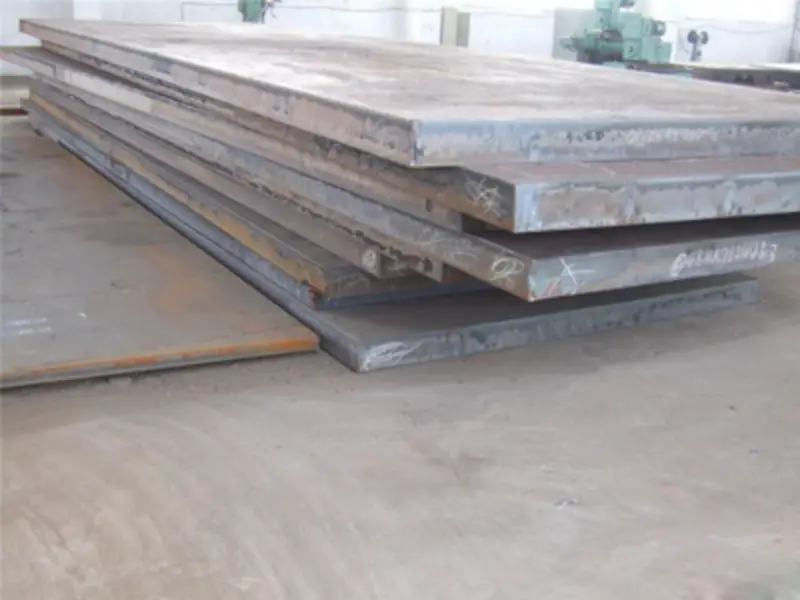
DNV Grade E32 Shipbuilding Steel Plate
DNV Grade E32 Shipbuilding Steel Plate - Comprehensive Material Data & Equivalents
Detailed technical data for DNV Grade E32 high-strength hull structural steel: chemical composition, mechanical and thermal properties, international equivalents, and application guide.
Hot rolling, TMCP, normalizing; weldable by conventional methods (SMAW, SAW, GMAW/FCAW) with appropriate preheat and consumables
- Phone : +8618037372205
- Email : [email protected]
- WhatsApp: Contact via Whtsapp
- WeChat: +8618037372205
DNV Grade E32 Shipbuilding Steel Plate Introduction
DNV Grade E32 is a normalized or thermo-mechanically controlled rolled (TMCP) high-strength structural steel plate primarily used in shipbuilding and offshore structures. It offers a minimum yield strength of 315 MPa and guaranteed impact toughness at -40 °C, making it suitable for low-temperature environments. The steel exhibits good weldability, formability, and excellent notch toughness, complying with the DNV GL rules for classification of ships. With a controlled fine-grain microstructure and optional microalloying (Nb, V, Ti), E32 ensures reliable performance under dynamic loading and harsh marine conditions.
DNV Grade E32 Shipbuilding Steel Plate Chemical Composition
The following table reflects the maximum or typical ranges as specified in DNV rules for E32. All elements are weight percent. The steel is fully killed with aluminium and optionally microalloyed with Nb, V or Ti to achieve fine grain size and strength. The carbon equivalent (CEV = C + Mn/6 + (Cr+Mo+V)/5 + (Ni+Cu)/15) is normally limited to ≤ 0.38 to ensure good weldability.
| Element | Specified Value (max. or range) | Remarks |
|---|---|---|
| Carbon (C) | ≤ 0.18 | |
| Manganese (Mn) | 0.90 – 1.60 | |
| Silicon (Si) | 0.10 – 0.50 | |
| Phosphorus (P) | ≤ 0.035 | |
| Sulfur (S) | ≤ 0.035 | |
| Aluminium (Altotal) | ≥ 0.015 (acid soluble ≥ 0.015) | |
| Niobium (Nb) | ≤ 0.05 (optional) | |
| Vanadium (V) | ≤ 0.10 (optional) | |
| Titanium (Ti) | ≤ 0.02 (optional) | |
| Copper (Cu) | ≤ 0.35 | |
| Chromium (Cr) | ≤ 0.20 | |
| Nickel (Ni) | ≤ 0.40 | |
| Molybdenum (Mo) | ≤ 0.08 | |
| Nitrogen (N) | ≤ 0.012 (if not Al-killed) | |
| Carbon equivalent (CEV) | ≤ 0.38 (typical, agreed if required) |
DNV Grade E32 Shipbuilding Steel Plate Thermal and Electrical Physical Properties
The thermo-physical properties listed are typical values for normalized/controlled-rolled C-Mn structural steels similar to E32. These values are provided for engineering calculations; they are not mandatory specification requirements and may vary slightly with exact composition and heat treatment. Data compiled from recognized literature for medium-carbon steels with density around 7.85 g/cm³.
| Property | Typical Value | Unit | Test Condition |
|---|---|---|---|
| Density (ρ) | 7850 (±50) | kg/m³ | 20 °C |
| Young's modulus (E) | 205 – 210 | GPa | 20 °C |
| Shear modulus (G) | 79 – 81 | GPa | Estimated from E and ν |
| Poisson's ratio (ν) | 0.28 – 0.30 | — | 20 °C |
| Thermal expansion coefficient (α) | 11.8 – 12.2 × 10⁻⁶ | K-1 | 20 – 100 °C |
| Thermal expansion coefficient (α) | 12.8 – 13.2 × 10⁻⁶ | K-1 | 20 – 200 °C |
| Thermal expansion coefficient (α) | 13.8 – 14.2 × 10⁻⁶ | K-1 | 20 – 400 °C |
| Thermal conductivity (λ) | 48 – 54 | W/(m·K) | 20 °C |
| Specific heat capacity (cp) | 460 – 510 | J/(kg·K) | 20 – 100 °C |
| Electrical resistivity (ρe) | 0.16 – 0.23 | μΩ·m | 20 °C |
DNV Grade E32 Shipbuilding Steel Plate Mechanical Properties
Mechanical properties are determined in accordance with DNV rule requirements. Tensile tests and impact tests are performed on specimens taken in the transverse or longitudinal direction as agreed. The values below are minimum requirements for thickness ranges commonly supplied. Impact test temperature is -40 °C (E-grade). Elongation is related to a gauge length of 5.65√S0 (ISO 6892-1 standard specimen).
| Property | Required Value | Unit | Test Condition / Thickness |
|---|---|---|---|
| Upper yield strength (ReH) | ≥ 315 | MPa | t ≤ 50 mm, transverse |
| Upper yield strength (ReH) | ≥ 295 | MPa | 50 < t ≤ 70 mm |
| Upper yield strength (ReH) | ≥ 285 | MPa | 70 < t ≤ 100 mm |
| Tensile strength (Rm) | 440 – 590 | MPa | t ≤ 100 mm, transverse |
| Elongation (A5) | ≥ 22 | % | t ≤ 50 mm, longitudinal |
| Elongation (A5) | ≥ 21 | % | 50 < t ≤ 70 mm |
| Elongation (A5) | ≥ 20 | % | 70 < t ≤ 100 mm |
| Charpy V-notch impact energy (KV2) | ≥ 34 (average) / ≥ 24 (single) | J | -40 °C, t ≤ 50 mm, longitudinal |
| Charpy V-notch impact energy (KV2) | ≥ 27 (average) / ≥ 20 (single) | J | -40 °C, t ≤ 50 mm, transverse (if agreed) |
| Bend test (180°) | d = 3a | — | t ≤ 25 mm, no cracks |
DNV Grade E32 Shipbuilding Steel Plate Fully Equivalent Material Standards and Substitute Grades
| Country / Region | Standard / Classification Society | Grade | Remarks |
|---|---|---|---|
| International | DNV (Det Norske Veritas) | E32 | Original grade; impact -40 °C |
| International | Lloyd's Register (LR) | EH32 | Same strength and toughness class |
| International | Bureau Veritas (BV) | EH32 | Identical technical delivery conditions |
| International | American Bureau of Shipping (ABS) | EH32 | Impact test -40 °C, yield ≥315 MPa |
| International | China Classification Society (CCS) | EH32 | Equivalent to CCS high-strength hull steel |
| International | ClassNK (Nippon Kaiji Kyokai) | KE32 | Japanese equivalent, -40 °C |
| International | RINA (Registro Italiano Navale) | EH32 | Same application range |
| International | Korean Register (KR) | EH32 | KM equivalent for high-strength hull |
| International | Russian Maritime Register (RS) | EH32 | Equivalent in RS rules |
| Europe | EN 10025-4 | S355ML (or S355M) | Thermo-mechanically rolled, impact -50 °C (ML) / -20 °C (M). S355ML closest, with adapted impact test temperature |
DNV Grade E32 Shipbuilding Steel Plate Application Introduction
DNV Grade E32 is designed for critical structural components in the shipbuilding and offshore industry, particularly where low-temperature toughness is essential. Its combination of strength, ductility and guaranteed impact properties at -40 °C makes it a preferred choice for vessels operating in cold climates and ice-class ships. The steel is easily weldable with standard procedures and can be formed by cold or hot working.
Product Applications: Hull shell plates (side, bottom, and deck), Longitudinal and transverse stiffeners, frames, Bulkheads and watertight doors, Hatch covers and coamings, Deckhouses and accommodation modules, Foundations for heavy machinery and deck equipment, Offshore platform decks and module support frames, Helicopter decks
Processed into products: Welded stiffened panels, T-beams and angle profiles (fabricated from plate), Box girder sections for crane pedestals, Tubular nodes and joints for jacket structures, Bottom and side longitudinals, Web frames and stringers
Application industries: Shipbuilding (commercial, naval, and ice-class vessels), Offshore oil & gas platforms (topsides, jack-up rigs), Marine engineering and harbour structures, Renewable energy (offshore wind substructures, transition pieces), Pressure vessels and storage tanks (when approved for low-temperature service), Structural steelwork for Arctic and cold-region infrastructure
DNV Grade E32 Shipbuilding Steel Plate Similar / Alternative Materials for Comparison
| Country / Region | Standard / Classification Society | Grade | Remarks |
|---|---|---|---|
| International | DNV | AH32 | Higher impact temperature (0 °C); same strength |
| International | DNV | DH32 | Impact -20 °C; same strength, suitable for less severe conditions |
| International | DNV | EH36 | Higher yield strength (≥355 MPa), same -40 °C toughness; use for higher loads |
| International | DNV | E36 | Minimum yield 355 MPa at -40 °C; direct upgrade for strength |
| Europe | EN 10025-3 | S355N/NL | Normalized, impact -20 °C (N) / -50 °C (NL); strength similar, toughness comparison depends on delivery condition |
| Europe | EN 10225 | S355G10+N | Offshore structural steel, normalised, comparable weldability and toughness |
Notes:
Welding guide: Preheating is generally not required for plate thicknesses up to 30 mm. For thicker sections and highly restrained joints, a minimum preheat of 50–75 °C is recommended. Use low-hydrogen welding consumables matching the strength level (e.g., AWS E7018, E71T-1M). Post-weld heat treatment (PWHT) is normally not necessary. Surface condition: The steel is supplied with a descaled or shot-blasted surface; shop primer can be applied on demand. Certification: Plates are delivered with DNV certificates 3.2, including chemical analysis, tensile, impact and bend test reports. Tolerances: Thickness, width and length tolerances according to EN 10029 (or as agreed). Special requirements: Z-grade through-thickness property (Z25, Z35) or ultrasonic testing to EN 10160 (class S2, E2) can be ordered for critical applications.
- Share



