
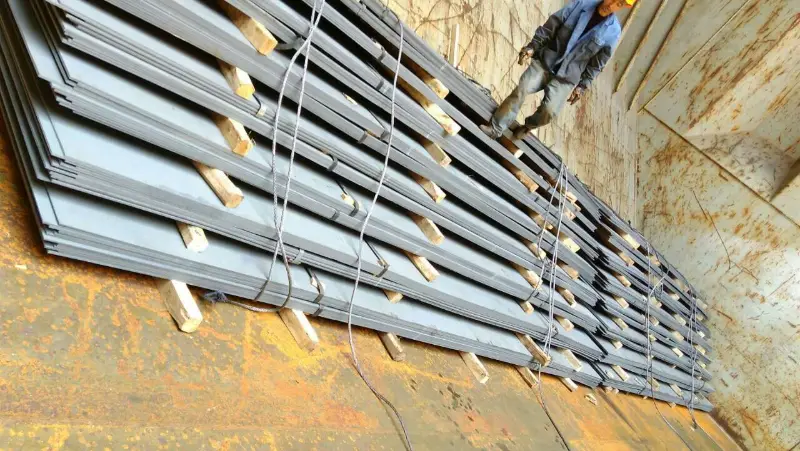
DNV Grade F32 Shipbuilding Steel Plate
DNV Grade F32 Shipbuilding Steel Plate: High-Strength Marine Structural Steel with 0°C Impact Toughness
Analysis of DNV Grade F32 shipbuilding steel plate covering chemical composition, mechanical properties, physical data, equivalent international standards, and applications in marine engineering.
Hot rolling, cutting, cold forming, welding, machining, shot blasting & priming
- Phone : +8618037372205
- Email : [email protected]
- WhatsApp: Contact via Whtsapp
- WeChat: +8618037372205
DNV Grade F32 Shipbuilding Steel Plate Introduction
DNV Grade F32 is a high-strength shipbuilding structural steel certified by DNV (Det Norske Veritas, now DNV GL). It falls under the category of normalized or TMCP (thermo-mechanical controlled process) hull plates with a minimum specified yield strength of 315 MPa. Its chemical composition is strictly controlled to ensure good toughness at low temperatures, with impact testing carried out at 0°C (F grade). The steel exhibits excellent weldability, moderate cold formability, and sufficient corrosion resistance for marine environments. Key applications include hull frames, decks, bulkheads, and offshore platform components.
- Delivery condition: Normalized, TMCP, or as-rolled with impact test verification.
- Available thickness range typically from 6 mm to 150 mm.
- Equivalent grades found across major classification societies (ABS, LR, BV, etc.).
DNV Grade F32 Shipbuilding Steel Plate Chemical Composition
Chemical composition limits according to DNV Rules Pt.2 Ch.2 for product analysis. Values are maximum unless a range is given. Refinement elements (Nb, V, Ti) may be added singularly or in combination to achieve fine grain structure.
- For thicknesses ≤12.5 mm, the Mn lower limit may be reduced by 0.2%.
- Al content refers to acid-soluble aluminium.
| Element | Standard Value | Remarks |
|---|---|---|
| Carbon (C) | ≤ 0.16 | Thickness ≤100 mm |
| Silicon (Si) | 0.10 – 0.50 | Typical range |
| Manganese (Mn) | 0.90 – 1.60 | May be adjusted for thinner products |
| Phosphorus (P) | ≤ 0.025 | Stringent low-P requirement |
| Sulfur (S) | ≤ 0.025 | Stringent low-S requirement |
| Chromium (Cr) | ≤ 0.20 | Residual tolerance |
| Nickel (Ni) | ≤ 0.40 | Residual tolerance |
| Molybdenum (Mo) | ≤ 0.08 | Residual tolerance |
| Copper (Cu) | ≤ 0.35 | Residual tolerance |
| Aluminium (Al) | ≥ 0.015 (acid sol.) | Minimum for fine grain practice |
| Niobium (Nb) | ≤ 0.05 | Optional microalloy |
| Vanadium (V) | ≤ 0.10 | Optional microalloy |
| Titanium (Ti) | ≤ 0.02 | Optional microalloy |
| Nb+V+Ti | ≤ 0.12 | When used in combination |
| Nitrogen (N) | ≤ 0.009 | Required when Al is present |
DNV Grade F32 Shipbuilding Steel Plate Thermal and Electrical Physical Properties
The listed physical properties are typical for carbon-manganese shipbuilding steels at room temperature unless noted. Actual values may vary slightly depending on production parameters and thickness. These data are not mandatory specification requirements but provide engineering guidance.
- Thermal expansion is an average over the indicated temperature range.
- Electrical resistivity is for standard composition at 20°C.
| Property | Typical Value | Unit | Test Condition |
|---|---|---|---|
| Density (ρ) | 7.85 | g/cm³ | 20°C |
| Modulus of Elasticity (E) | 205 | GPa | 20°C |
| Shear Modulus (G) | 80 | GPa | 20°C (calculated from E and ν) |
| Poisson's Ratio (ν) | 0.3 | — | Room temperature |
| Thermal Expansion Coefficient (α) | 12.0 × 10⁻⁶ | 1/K | 20 – 100°C |
| Thermal Expansion Coefficient (α) | 12.5 × 10⁻⁶ | 1/K | 20 – 200°C |
| Thermal Expansion Coefficient (α) | 13.0 × 10⁻⁶ | 1/K | 20 – 400°C |
| Thermal Conductivity (λ) | 51 | W/(m·K) | 100°C |
| Specific Heat Capacity | 460 – 480 | J/(kg·K) | 20°C |
| Electrical Resistivity (ρₑ) | 0.18 × 10⁻⁶ | Ω·m | 20°C |
DNV Grade F32 Shipbuilding Steel Plate Mechanical Properties
Tensile and impact properties are verified on specimens taken transverse to the rolling direction unless otherwise agreed. Yield strength is expressed as ReH (upper yield) for products ≤16 mm; for thicknesses >16 mm, 0.2% proof strength (Rp0.2) may be used.
- Bend test mandrel diameter depends on thickness.
- Impact test temperature for F grade is 0°C.
| Property | Standard Value | Unit | Test Condition |
|---|---|---|---|
| Yield Strength (ReH / Rp0.2) | ≥ 315 | MPa | Thickness ≤ 100 mm |
| Tensile Strength (Rm) | 440 – 590 | MPa | Thickness ≤ 100 mm |
| Elongation (A5) | ≥ 22 | % | Gauge length 5.65√S₀, transverse |
| Bend Test (180°) – t ≤ 25 mm | d = 3t | — | No cracks |
| Bend Test (180°) – t > 25 mm | d = 4t | — | No cracks |
| Charpy Impact (KV), longitudinal, t ≤ 50 mm | ≥ 31 | J | 0°C |
| Charpy Impact (KV), longitudinal, t > 50 mm | ≥ 22 | J | 0°C |
| Charpy Impact (KV), transverse, all thicknesses | ≥ 22 | J | 0°C |
DNV Grade F32 Shipbuilding Steel Plate Completely Equivalent Material Standards and Substitute Grades
| Country / Region | Standard / Classification Society | Grade | Remarks |
|---|---|---|---|
| International | American Bureau of Shipping (ABS) | ABS Grade F32 | Identical technical requirements |
| International | Lloyd's Register (LR) | LR Grade F32 | Identical technical requirements |
| International | Bureau Veritas (BV) | BV Grade F32 | Identical technical requirements |
| International | Registro Italiano Navale (RINA) | RINA Grade F32 | Identical technical requirements |
| International | Nippon Kaiji Kyokai (ClassNK) | NK Grade F32 | Identical technical requirements |
| International | Korean Register (KR) | KR Grade F32 | Identical technical requirements |
| International | China Classification Society (CCS) | CCS F32 | Identical technical requirements |
| International | Russian Maritime Register of Shipping (RS) | RS F32 | Identical technical requirements |
| International | Indian Register of Shipping (IRS) | IRS F32 | Identical technical requirements |
DNV Grade F32 Shipbuilding Steel Plate Application Introduction
DNV F32 steel is specifically designed for ship and offshore structures where high strength and reliable low-temperature toughness are required. The grade is commonly specified for critical hull parts and marine components subjected to moderate operating temperatures down to 0°C. It is widely used in both commercial and naval shipbuilding.
- Typical fabrication involves: welding with appropriate low-hydrogen consumables, flame or plasma cutting, and cold forming (where bending radius manual permits).
- Surface preparation: Shop primer or protective coating is applied to resist marine corrosion.
Product Applications: Hull shell plates and stiffeners, Strength decks and transverse bulkheads, Structural elements of hatch covers and coamings, Offshore platform decks and helidecks, Booms and masts of deck cranes
Processed into products: Longitudinal and transverse frames, Bottom and side shell plates, Girder webs and flanges, Brackets and panel reinforcements, Connecting plates between structural modules
Application industries: Commercial Shipbuilding (bulk carriers, tankers, container ships), Naval Shipbuilding (frigates, auxiliary vessels), Offshore Oil & Gas Platforms (jacket legs, modules), Renewable Energy (offshore wind turbine foundations), Heavy Machinery and Crane Manufacturing
DNV Grade F32 Shipbuilding Steel Plate Similar or Alternative Materials with Comparable Performance
| Country / Region | Standard | Grade | Remarks |
|---|---|---|---|
| Norway / Europe | DNV Rules | NV D32 | Same strength class, impact temperature -20°C (better toughness) |
| Norway / Europe | DNV Rules | NV E32 | Same strength class, impact temperature -40°C (excellent toughness) |
| Norway / Europe | DNV Rules | NV A32 | Same strength class, impact temperature 0°C or not specified (less stringent) |
| Europe | EN 10025-4 | S355ML (1.8834) | Yield strength 355 MPa, similar weldability and toughness; often used in offshore but not fully interchangeable with ship class grades. |
| Europe | EN 10025-3 | S355N / S355NL | Normalized structural steel; 355 MPa yield; not certified by marine class but may serve as alternative with additional testing. |
| USA | ASTM A131 | Grade DH32 | Similar strength, impact test -20°C; equivalent to DNV D32, not exactly F32. |
Notes:
Welding: Preheat may be required for thicknesses above 30 mm to avoid hydrogen cracking. Low-hydrogen welding process recommended.
Forging: Not typical for ship plates; mainly supplied as flat rolled product.
Heat treatment: Normalizing or TMCP conditions already deliver the required properties; post-weld heat treatment seldom practiced.
Inspection: Ultrasonic testing as per DNV standards is often required for critical applications. Dimensional tolerances in accordance with DNV Pt.2 Ch.2 or as agreed.
- Share



