
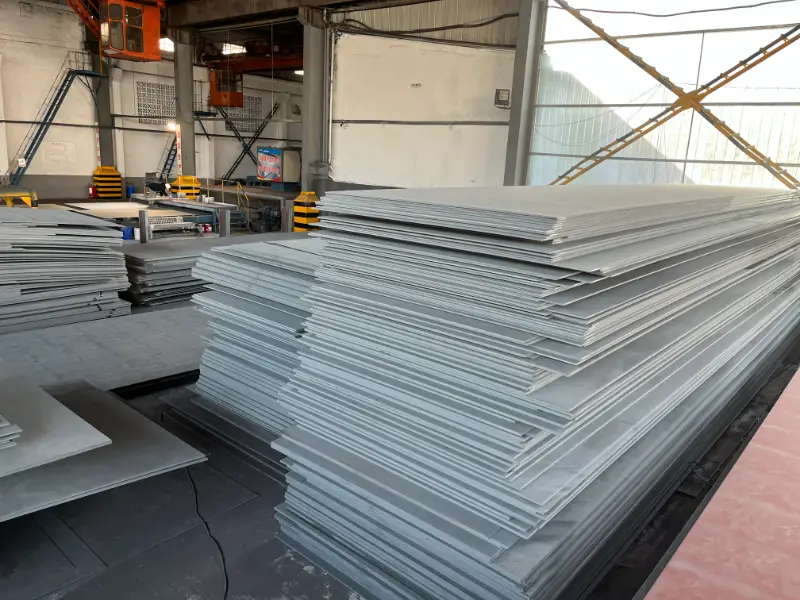
DNV Grade A32 Shipbuilding Steel Plate
Comprehensive Material Data for DNV Grade A32 Shipbuilding Steel Plate
Complete technical data sheet for DNV Grade A32 shipbuilding steel plate covering chemical composition, mechanical properties, thermal and electrical properties, international equivalents, and application guidance.
Suitable for welding, bending, forming, cutting (flame, plasma, laser), and machining
- Phone : +8618037372205
- Email : [email protected]
- WhatsApp: Contact via Whtsapp
- WeChat: +8618037372205
DNV Grade A32 Shipbuilding Steel Plate Introduction
DNV Grade A32 is a high-strength hull structural steel plate certified by Det Norske Veritas (DNV). It belongs to the normalized/thermomechanical rolled fine-grained steel series with a minimum yield strength of 315 MPa. Characterized by excellent weldability, good toughness at 0°C, and reliable strength, it is widely used in the construction of ship hulls, offshore platforms, and marine equipment. The controlled chemical composition, especially the microalloying elements (Nb, V, Al), ensures consistent mechanical properties and improved corrosion fatigue performance in seawater environments. Suitable thicknesses range from 6 mm to 100 mm, with delivery conditions typically normalized or thermomechanical rolled. DNV A32 steel meets the requirements of the International Association of Classification Societies (IACS) and is interchangeable with other major classification society grades such as ABS AH32 and LR AH32.
DNV Grade A32 Shipbuilding Steel Plate Chemical Composition
Chemical requirements according to DNV Rules for Classification of Ships, Part 2, Chapter 2. The steel is fully killed and fine-grained treated. Microalloying elements such as niobium and vanadium are added to achieve the required strength and toughness. Carbon equivalent (CEV) is controlled to ensure good weldability, typically CEV ≤ 0.38%.
| Element | Standard Value (%) | Remarks |
|---|---|---|
| Carbon (C) | ≤ 0.18 | Ladle analysis |
| Silicon (Si) | ≤ 0.50 | |
| Manganese (Mn) | 0.90 – 1.60 | |
| Phosphorus (P) | ≤ 0.030 | |
| Sulfur (S) | ≤ 0.030 | |
| Chromium (Cr) | ≤ 0.20 | |
| Nickel (Ni) | ≤ 0.40 | |
| Molybdenum (Mo) | ≤ 0.08 | |
| Copper (Cu) | ≤ 0.35 | |
| Aluminium (Al) acid soluble | ≥ 0.015 | Minimum total Al if not acid soluble |
| Niobium (Nb) | 0.02 – 0.05 | |
| Vanadium (V) | 0.05 – 0.10 | |
| Titanium (Ti) | ≤ 0.02 | |
| Nitrogen (N) | ≤ 0.009 | If aluminium is present |
DNV Grade A32 Shipbuilding Steel Plate Thermal and Electrical Physical Properties
Physical properties are not specified in DNV Rules but are typical for low‑carbon‑manganese microalloyed structural steels similar to S355 grades. These values are valid at room temperature unless otherwise indicated and may be used for design and simulation purposes.
| Property | Typical Value | Unit | Test Condition |
|---|---|---|---|
| Density (ρ) | 7850 | kg/m³ | 20°C |
| Elastic modulus (E) | 205 | GPa | 20°C |
| Shear modulus (G) | 80 | GPa | 20°C |
| Poisson's ratio (ν) | 0.3 | – | 20°C |
| Thermal expansion coefficient (α) | 12.0 × 10⁻⁶ | K⁻¹ | 20–100°C |
| Thermal expansion coefficient (α) | 12.8 × 10⁻⁶ | K⁻¹ | 20–200°C |
| Thermal conductivity (λ) | 50 | W/(m·K) | 20°C |
| Specific heat capacity (c) | 460 | J/(kg·K) | 20°C |
| Electrical resistivity (ρₑ) | 0.22 × 10⁻⁶ | Ω·m | 20°C |
DNV Grade A32 Shipbuilding Steel Plate Mechanical Properties
Mechanical properties as specified by DNV Rules. Tensile testing is performed at ambient temperature on transverse or longitudinal specimens depending on the product standard. Impact toughness (Charpy V‑notch) is verified at 0°C for grade A32. The bend test is a 180° bend over a former diameter equal to 3 times the plate thickness (3a). All values apply to plate thickness ≤ 100 mm unless otherwise noted.
| Property | Standard Requirement | Unit | Test Condition |
|---|---|---|---|
| Yield strength (ReH) | ≥ 315 | MPa | Transverse, ambient temperature, t ≤ 100 mm |
| Tensile strength (Rm) | 440 – 590 | MPa | Transverse, ambient temperature |
| Elongation (A) | ≥ 22 | % | Gauge length 5.65√So, longitudinal, t ≤ 50 mm |
| Elongation (A) | ≥ 22 | % | Gauge length 5.65√So, longitudinal, 50 < t ≤ 100 mm |
| Bend test (180°) | d = 3a (t ≤ 50 mm) | – | No cracks or defects |
| Bend test (180°) | d = 3a (50 < t ≤ 100 mm) | – | No cracks or defects |
| Charpy impact energy (KV, longitudinal) | ≥ 34 (average) / 27 (individual) | J | At 0°C, 10×10 mm specimen, t ≤ 50 mm |
| Charpy impact energy (KV, longitudinal) | ≥ 24 (average) / 17 (individual) | J | At 0°C, 50 < t ≤ 70 mm |
| Charpy impact energy (KV, longitudinal) | ≥ 20 (average) / 14 (individual) | J | At 0°C, 70 < t ≤ 100 mm |
DNV Grade A32 Shipbuilding Steel Plate Exact Equivalent Materials and Replaceable Grades
| Country / Region | Standard | Grade | Remarks |
|---|---|---|---|
| International (IACS) | IACS UR W11 | AH32 | All major classification societies recognize this common grade |
| USA / ABS | ABS Rules | AH32 | Identical requirements |
| France / BV | BV Rules | AH32 | Identical requirements |
| China / CCS | CCS Rules | AH32 | Identical requirements |
| UK / LR | LR Rules | AH32 | Identical requirements |
| Japan / NK | NK Rules | AH32 | Identical requirements |
| Italy / RINA | RINA Rules | AH32 | Identical requirements |
| South Korea / KR | KR Rules | AH32 | Identical requirements |
| Russia / RS | RS Rules | AH32 | Identical requirements |
DNV Grade A32 Shipbuilding Steel Plate Application Introduction
DNV Grade A32 is extensively used in marine environments where a good balance of strength, weldability, and toughness is essential. The 0°C impact test temperature makes it suitable for structures exposed to moderate low temperatures. Typical applications include main hull plates, decks, bulkheads, and stiffening members. Because of its availability in wide thick plates, it is also used for heavy offshore components such as jacket legs and helideck supports.
Product Applications: Hull shell plates and bottom plates, Deck plating and web frames, Bulkheads and watertight doors, Longitudinal stiffeners and stringers, Helideck support structures, Offshore module primary steel
Processed into products: Ship main deck and sheer strake sections, Bottom shell plates with doubler pads, Cargo hold corrugated bulkheads, Transverse web frames and floors, Offshore jacket braces and nodes, Transition pieces for monopile foundations
Application industries: Shipbuilding (commercial and naval vessels), Offshore oil & gas platforms (jackets, topsides), Renewable offshore energy (wind turbine foundations), Marine engineering and port structures, Barges and floating docks
DNV Grade A32 Shipbuilding Steel Plate Similar or Alternative Steel Grades
| Country / Region | Standard | Grade | Remarks |
|---|---|---|---|
| European Union | EN 10025-2 | S355J0 | Similar strength (yield ≥ 355 MPa, 0°C impact 27 J), but no dedicated shipbuilding certification |
| European Union | EN 10025-2 | S355J2 | Better low‑temperature toughness (‑20°C) than A32; may be used in non‑classified marine structures |
| China | GB/T 712 | AH32 | Chinese standard for hull structural steel, equivalent to IACS AH32 |
| USA | ASTM A131 / A131M | AH32 | ASTM specification for structural steel for ships, identical requirements |
| International | ISO 630-2 | S315G1+M/ S315G2+M | Fe 315 strength level with impact testing at 0°C or -20°C; not specifically ship‑certified but comparable |
Notes:
- Carbon equivalent (CEV) is usually limited to ≤ 0.38% for improved weldability; the formula is CEV = C + Mn/6 + (Cr+Mo+V)/5 + (Ni+Cu)/15.
- For thicknesses above 50 mm, supplementary impact testing may be required by the purchaser.
- Ultrasonic testing (UT) to EN 10160 or equivalent is often specified for critical structural applications.
- Normalized rolling or thermomechanical rolling is mandatory for thicknesses above certain limits (e.g., t > 30 mm).
- Preheating and post‑weld heat treatment recommendations should follow DNV welding guidelines or Class‑approved welding consumables.
- Share



