
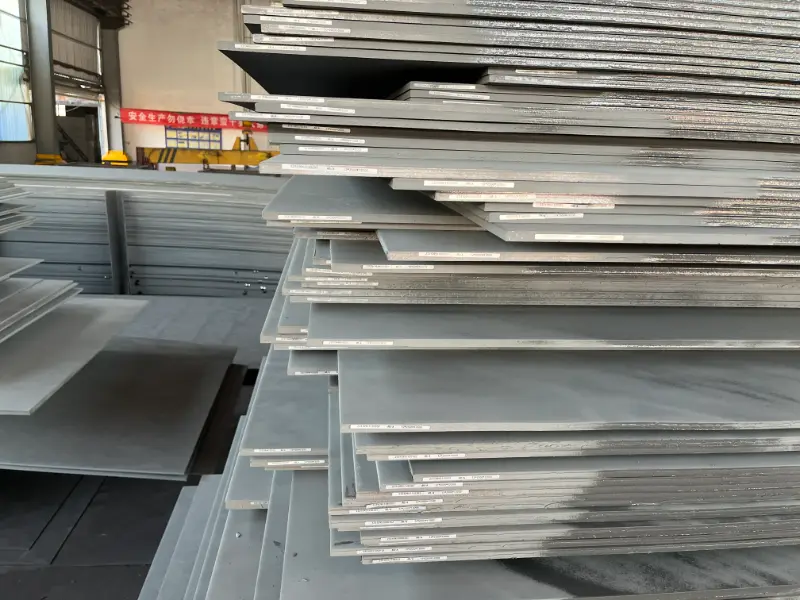
DNV Grade E Shipbuilding Steel Plate
DNV Grade E Shipbuilding Steel Plate: Composition, Properties and International Equivalents
Comprehensive material data sheet for DNV Grade E normal-strength hull structural steel. Includes chemical composition, mechanical and physical properties, fully equivalent classification society grades, similar substitute steels, and typical applications in shipbuilding and offshore structures.
Hot rolling, controlled rolling, normalizing, thermo-mechanical controlled processing (TMCP)
- Phone : +8618037372205
- Email : [email protected]
- WhatsApp: Contact via Whtsapp
- WeChat: +8618037372205
DNV Grade E Shipbuilding Steel Plate Introduction
DNV Grade E is a normal-strength hull structural steel governed by the DNV classification rules, primarily used in ship and offshore structure construction. It ensures reliable toughness at 0°C, making it suitable for moderate climate conditions. The steel is characterized by a minimum yield strength of 235 MPa for thicknesses up to 50 mm, with excellent weldability and formability. Its chemical composition is carefully controlled, with micro-alloying and grain refinement elements such as aluminium to guarantee fine-grain structure and consistent impact properties. Grade E can be supplied in normalized or thermo-mechanically controlled processed (TMCP) condition, subject to full classification society inspection.
DNV Grade E Shipbuilding Steel Plate Chemical Composition
The chemical composition of DNV Grade E ensures optimum balance between strength, toughness and weldability. Maximum limits for carbon, phosphorus and sulfur are strictly controlled, while manganese provides the required strength. Aluminium is added for grain refinement. Residual elements like copper, chromium, nickel and molybdenum are kept low to maintain consistent properties and avoid hardenability issues during welding. Carbon equivalent typically does not exceed 0.38%.
| Element | Specified Value | Remarks |
|---|---|---|
| C | ≤0.18 | mass % |
| Si | 0.10 – 0.50 | mass % |
| Mn | 0.70 – 1.50 | mass % |
| P | ≤0.035 | mass % |
| S | ≤0.035 | mass % |
| Al (total) | ≥0.015 | when used for grain refinement |
| Cu | ≤0.20 | residual element |
| Cr | ≤0.20 | residual element |
| Ni | ≤0.40 | residual element |
| Mo | ≤0.08 | residual element |
| Ceq | ≤0.38 | carbon equivalent, according to DNV formula |
DNV Grade E Shipbuilding Steel Plate Thermal and Electrical Physical Properties
The following physical properties are typical for hot-rolled carbon-manganese structural steels and can be used for general engineering calculations for DNV Grade E. Slight variations may occur depending on the exact heat treatment condition, rolling direction and test temperature. Values are given at room temperature unless specified otherwise.
| Property | Typical Value | Unit | Test Condition |
|---|---|---|---|
| Density (ρ) | 7.85 | g/cm³ | at 20°C |
| Elastic modulus (E) | 200 | GPa | at 20°C |
| Shear modulus (G) | 80 | GPa | at 20°C, derived from E and ν |
| Poisson's ratio (ν) | 0.3 | – | at 20°C |
| Thermal expansion coefficient (α) | 11.5 × 10⁻⁶ | K⁻¹ | between 0°C and 100°C |
| Thermal conductivity (λ) | 52 | W/(m·K) | at 20°C |
| Specific heat capacity (cp) | 460 | J/(kg·K) | at 20°C |
| Electrical resistivity (ρe) | 0.16 × 10⁻⁶ | Ω·m | at 20°C |
DNV Grade E Shipbuilding Steel Plate Mechanical Properties
The mechanical properties of DNV Grade E are verified by tensile testing at room temperature and Charpy V-notch impact testing at 0°C. The values vary with plate thickness. Bend tests (through-thickness or face-bend) are also required for thicker plates. All tests are performed on samples taken in the longitudinal direction unless otherwise agreed. Impact energy requirements apply to full-size specimens (10×10 mm); lower values permitted for sub-size specimens according to DNV rules.
| Property | Required Value | Unit | Test Condition |
|---|---|---|---|
| Yield strength (ReH) | ≥235 | MPa | Thickness ≤50 mm |
| Yield strength (ReH) | ≥225 | MPa | 50 < Thickness ≤70 mm |
| Yield strength (ReH) | ≥215 | MPa | 70 < Thickness ≤100 mm |
| Tensile strength (Rm) | 400 – 520 | MPa | All thicknesses |
| Elongation (A5) | ≥22 | % | Thickness ≤50 mm, gauge 5.65√So |
| Elongation (A5) | ≥21 | % | 50 < Thickness ≤70 mm |
| Elongation (A5) | ≥20 | % | 70 < Thickness ≤100 mm |
| Impact energy (KV2) | ≥27 | J | 0°C, longitudinal, full-size specimen |
| Bend test (angle 180°) | No cracks | – | Thickness ≤25 mm, former diameter = 3×thickness |
| Bend test (angle 180°) | No cracks | – | 25 < Thickness ≤50 mm, former diameter = 4×thickness |
DNV Grade E Shipbuilding Steel Plate Fully Equivalent Grades from Other Classification Societies
| Country / Region | Standard | Grade | Remarks |
|---|---|---|---|
| USA | ABS Rules for Building and Classing Steel Vessels | ABS Grade E | Fully equivalent normal-strength hull steel |
| France / International | BV Rules for the Classification of Steel Ships | BV Grade E | Fully equivalent |
| UK | LR Rules and Regulations for the Classification of Ships | LR Grade E | Fully equivalent |
| China | CCS Rules for Classification of Sea-going Steel Ships | CCS Grade E | Fully equivalent |
| Japan | NK Rules for the Survey and Construction of Steel Ships | NK Grade E | Fully equivalent |
| Italy | RINA Rules for the Classification of Ships | RINA Grade E | Fully equivalent |
| Korea | KR Rules for the Classification of Steel Ships | KR Grade E | Fully equivalent |
DNV Grade E Shipbuilding Steel Plate Application Introduction
DNV Grade E steel is designed for welded structures in shipbuilding and offshore engineering where good notch toughness at 0°C is required together with moderate strength. It can be formed, bent, and welded using standard shipyard procedures. This grade is typically selected for large hull plates, stiffening elements, and structural members that are subject to dynamic loading and require guaranteed low-temperature toughness.
Product Applications: Hull shell plates, Deck plating, Transverse and longitudinal bulkheads, Superstructures and deckhouses, Flat bars and bulb profiles for stiffeners
Processed into products: Shell frames and web frames, Girders and stringers, Floors and transverse beams, Bilge keels, Rudder horns, Hatch coaming stays
Application industries: Shipbuilding (commercial vessels, naval ships), Offshore oil & gas platforms and FPSOs, Marine renewable energy structures (wind turbine foundations), Port and harbour construction (piling, fenders), Heavy machinery and structural engineering
DNV Grade E Shipbuilding Steel Plate Materials with Comparable Chemical and Mechanical Properties
| Country / Region | Standard | Grade | Remarks |
|---|---|---|---|
| International | ASTM A131 / A131M | A131 Grade E | Comparable shipbuilding steel under ASTM; similar strength and toughness at 0°C |
| European Union | EN 10025-2:2019 | S235JR | Similar yield/tensile strength, but not class-approved for marine service and no guaranteed charpy at 0°C without additional options |
| Japan | JIS G 3101:2020 | SS400 | Similar strength range, typically used for general structures, without classification society certification |
| China | GB/T 700-2006 | Q235B | Equivalent carbon steel grade with similar yield point; requires additional impact test at 0°C for substitution |
Notes:
DNV Grade E plates must be produced under a DNV-approved manufacturing process and are subject to detailed survey during production, testing, and marking. Ultrasonic testing according to DNV Class requirements is often mandatory. For welded structures exposed to low seawater temperatures, additional low-temperature impact testing or enhanced CTOD testing may be required by design. All material should be accompanied by DNV certificates valid at the time of supply. Surface condition and tolerances shall meet DNV specification unless otherwise agreed.
- Share



