
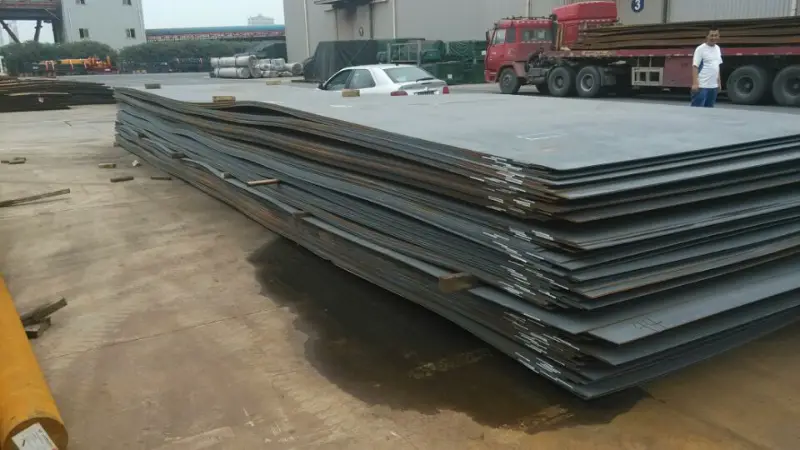
DNV Grade D Shipbuilding Steel
DNV Grade D Shipbuilding Steel - Ordinary Strength Hull Structural Steel for Cold Applications
DNV Grade D is an ordinary strength normalized shipbuilding steel specified by DNV (Det Norske Veritas). It offers a minimum yield strength of 235 MPa and excellent notch toughness at -20°C, making it ideal for critical hull structures in cold waters.
Hot rolling, controlled rolling, normalizing, normalizing rolling; suitable for cutting, cold forming, welding, bending, and typical shipyard fabrication processes
- Phone : +8618037372205
- Email : [email protected]
- WhatsApp: Contact via Whtsapp
- WeChat: +8618037372205
DNV Grade D Shipbuilding Steel Introduction
DNV Grade D is a hull structural steel plate designed for shipbuilding in accordance with Det Norske Veritas (DNV) rules. As an ordinary strength steel, it ensures a minimum yield strength of 235 MPa and tensile strength between 400–520 MPa. Key features include fine-grain fully killed steelmaking, good weldability, and guaranteed Charpy V-notch impact energy of at least 27 J at -20°C (longitudinal). This grade is widely accepted by all major classification societies under the IACS Unified Requirement W11. It is typically supplied in normalized condition for thicknesses above 25 mm, ensuring uniform mechanical properties. Main applications are in hull plates, bulkheads, decks, and offshore structural components where reliable low-temperature toughness is required.
DNV Grade D Shipbuilding Steel Chemical Composition
The chemical composition conforms to DNV rules for ordinary strength Grade D. The steel is fully killed and fine-grain treated with aluminum or other grain-refining elements.
- Carbon is limited to 0.21% max to maintain good weldability.
- Manganese provides strength and counters sulfur; content is at least 0.60% or 2.5×C if carbon exceeds 0.18%.
- Silicon is not strictly required but is usually ≤0.50% for deoxidation.
- Phosphorus and Sulfur are held to low levels for improved toughness.
- Residual elements (Cr, Ni, Mo, Cu) have maximum limits to avoid hard spots and to maintain consistent weldability.
| Element | Ladle Analysis (%) | Remarks |
|---|---|---|
| Carbon (C) | ≤ 0.21 | Max. For thickness > 25 mm, often aimed ≤ 0.18 for ductility. |
| Manganese (Mn) | ≥ 0.60 (or ≥ 2.5×C if C > 0.18) | Min. content ensures adequate strength and deoxidization. |
| Silicon (Si) | ≤ 0.50 | Deoxidation element; typical 0.10–0.35 when used. |
| Phosphorus (P) | ≤ 0.035 | Max, for base toughness. |
| Sulfur (S) | ≤ 0.035 | Max, for lamellar tearing resistance. |
| Aluminum (Al, acid soluble) | ≥ 0.015 (or other grain refining element) | Indicates fully killed, fine-grain practice. |
| Nitrogen (N) | ≤ 0.009 (if not Al treated) | Typically limited when Al is used. |
| Chromium (Cr) | ≤ 0.20 | Residual; may be higher if by agreement. |
| Nickel (Ni) | ≤ 0.40 | Residual; can be up to 0.50 in some rules. |
| Molybdenum (Mo) | ≤ 0.08 | Residual; typical max. |
| Copper (Cu) | ≤ 0.35 | Residual; may be up to 0.50 for some applications. |
| Others (Nb, V, Ti) | Microalloying may be used | For grain refinement if not using Al; total Nb+V+Ti ≤ 0.12% (if not agreed otherwise). |
DNV Grade D Shipbuilding Steel Physical Properties
Physical data are typical for carbon-manganese structural steels; values may vary slightly with production.
- Density is approximately 7.85 g/cm³.
- Elastic modulus is about 205 GPa, decreasing at elevated temperatures.
- Thermal expansion coefficient around 11.5×10⁻⁶/K (20–100°C).
- Thermal conductivity is moderate, ~50 W/(m·K).
- Specific heat capacity is ~460 J/(kg·K).
- Electrical resistivity ~0.15×10⁻⁶ Ω·m.
| Property | Typical Value | Unit | Test Condition |
|---|---|---|---|
| Density (ρ) | 7.85 | g/cm³ | Room temperature |
| Elastic Modulus (E) | 205 | GPa | Room temperature, tension |
| Shear Modulus (G) | 80 | GPa | Room temperature, estimated |
| Poisson's Ratio (ν) | 0.3 | – | Room temperature, elastic range |
| Thermal Expansion Coefficient (α) | 11.5 ×10⁻⁶ | K⁻¹ | 20 – 100°C |
| Thermal Conductivity (λ) | 50 | W/(m·K) | Room temperature |
| Specific Heat Capacity (cp) | 460 | J/(kg·K) | Room temperature |
| Electrical Resistivity (ρe) | 0.15 | ×10⁻⁶ Ω·m | Room temperature |
DNV Grade D Shipbuilding Steel Mechanical Properties
Mechanical properties are verified at room temperature on longitudinal samples. Impact tests are carried out at -20°C.
- Yield strength minimum 235 MPa for all thicknesses up to 100 mm.
- Tensile strength ranges from 400 to 520 MPa.
- Elongation depends on thickness: minimum 22% for t ≤ 50 mm on gauge length L0=5.65√S0.
- Charpy V-notch impact energy ≥ 27 J average for longitudinal specimens (t ≤ 50 mm), with a minimum of 20 J for one individual.
- For thickness > 50 mm, impact values may be slightly reduced per DNV rules; typical requirement remains 27 J longitudinal.
| Property | Standard Requirement | Unit | Test Condition |
|---|---|---|---|
| Yield Strength (ReH) | ≥ 235 | MPa | Room temperature, transverse or longitudinal (t ≤ 100 mm) |
| Tensile Strength (Rm) | 400 – 520 | MPa | Room temperature |
| Elongation (A, 5.65√S0) | ≥ 22 (t ≤ 50 mm) | % | Longitudinal, gauge 200 mm (or proportional) |
| Elongation (A, 5.65√S0) | ≥ 21 (50 < t ≤ 70 mm) | % | Longitudinal |
| Elongation (A, 5.65√S0) | ≥ 20 (70 < t ≤ 100 mm) | % | Longitudinal |
| Charpy V-notch Impact (KV) | ≥ 27 (average of 3, ≥ 20 single) | J | Longitudinal, -20°C, t ≤ 50 mm |
| Charpy V-notch Impact (KV) | ≥ 24 (average of 3) | J | Transverse, -20°C, t ≤ 50 mm (typical, often specified as 20 J min) |
| Bend Test (Diameter) | D = 1.5t (for t ≤ 25 mm), D = 2t (t > 25 mm) | – | 180° cold bend, no cracks, testing often waived if impact values met |
DNV Grade D Shipbuilding Steel Equivalent Material Standards and Substitute Grades
| Country/Region | Standard | Grade/Designation | Remarks |
|---|---|---|---|
| International | IACS UR W11 | D | Unified requirement for all IACS members; directly equivalent. |
| China | CCS Rules for Classification of Sea-going Steel Ships | D | Identical chemical and mechanical requirements. |
| United Kingdom | LR Rules for the Manufacture, Testing and Certification of Materials | D | Lloyd's Register Grade D. |
| USA | ABS Rules for Materials and Welding | D (or ABS Grade D) | American Bureau of Shipping. |
| Japan | NK (ClassNK) Rules for the Survey and Construction of Steel Ships | D (or NK Grade D) | Nippon Kaiji Kyokai. |
| France | BV Rules for the Classification of Steel Ships | D (or BV Grade D) | Bureau Veritas. |
| Germany | DNV GL Rules (formerly GL) | D (or GL-D) | Now merged with DNV. |
| Korea | KR Rules for the Classification of Steel Ships | D (or KR Grade D) | Korean Register. |
| Italy | RINA Rules for the Classification of Ships | D (or RINA Grade D) | Registro Italiano Navale. |
| Russia | RMRS Rules for the Classification and Construction of Sea-Going Ships | D (or RS Grade D) | Russian Maritime Register of Shipping. |
DNV Grade D Shipbuilding Steel Application Introduction
DNV Grade D shipbuilding steel is engineered for cold-temperature structural applications. It is extensively used in shipyards and offshore fabrication. Beneficial features include:
- Excellent weldability with standard shipbuilding consumables.
- Guaranteed notch toughness at -20°C for safety in cold seas.
- Uniform properties after normalization for thicknesses up to 100 mm.
- Acceptance by all major classification societies under IACS UR W11.
Product Applications: Hull plates (bottom, side, deck), Bulkhead plates, Stiffeners, girders, frames, Hatch covers and coamings, Rudder and stern frame components, Offshore structural tubular joints, Wind turbine substructures (transition pieces, monopiles if certified)
Processed into products: Rolled plates cut and fabricated into shaped panels, Welded box girders and T-sections, Bent shell frames and brackets, Mooring equipment foundations, Pipeline end manifolds (PLETs), Skid beams and grillages for offshore modules
Application industries: Commercial and naval shipbuilding, Offshore oil & gas platforms (jackets, topsides, flare booms) – when DNV certified, Marine equipment and port machinery, Ice-class vessel construction (often used as backing for low-temperature structures), Bridge and civil engineering (if project specifications accept shipbuilding grades)
DNV Grade D Shipbuilding Steel Similar or Neighbouring Grades for Reference
| Country/Region | Standard | Grade | Remarks |
|---|---|---|---|
| IACS | UR W11 | A | Ordinary strength, no impact test required; used for non-critical structural parts. Similar strength but without low-temp toughness guarantee. |
| IACS | UR W11 | B | Ordinary strength, impact at 0°C; slightly better toughness than A but not as low-temperature as D. |
| IACS | UR W11 | E | Ordinary strength, impact at -40°C; superior toughness for very cold environment, otherwise same strength as D. |
| IACS | UR W11 | AH32/DH32/EH32 | Higher strength (yield ≥ 315 MPa), similar toughness designations (A, D, E for test temperatures). DH32 could replace D where higher strength allows weight reduction, but careful welding procedure needed. |
| Europe | EN 10025-2 | S235J2+N | Structural steel with minimum yield 235 MPa, impact at -20°C. Not ship-specific but similar mechanicals. Lacks full IACS certification; may be used for non-marine applications. |
| Europe | EN 10025-3 | S235N | Normalized fine-grain structural steel; close to D in composition and toughness but impact test at -20°C transverse 27 J. Not a direct shipbuilding substitute unless agreed. |
Notes:
DNV Grade D is always supplied with inspection certificates (3.1 or 3.2 according to EN 10204). Impact test specimens are taken longitudinally as per DNV rules; for thicker products (t > 50 mm) impact energy requirements may be reduced by 5 J per additional 25 mm thickness. Normalizing is mandatory for thicknesses above 25 mm unless otherwise approved. The steel may be supplied with a shot-blasted and primed surface. Ultrasonic testing can be ordered against EN 10160 or specific acceptance criteria. The product is typically not intended for service temperatures below -20°C design temperature; for lower service temperatures Grade E or FH grades should be considered.
- Share



