
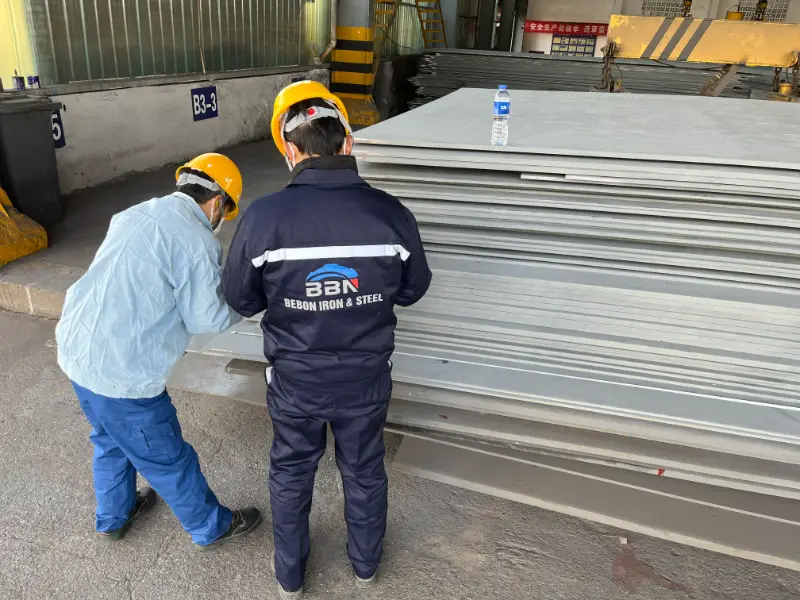
DNV Grade B Shipbuilding Steel Plate
DNV Grade B Shipbuilding Steel Plate - Complete Material Datasheet
Comprehensive technical data for DNV Grade B shipbuilding steel plate covering chemical composition, mechanical and physical properties, international equivalents, similar materials, and application guidance.
Hot rolling, normalized rolling, thermo-mechanical controlled processing (TMCP)
- Phone : +8618037372205
- Email : [email protected]
- WhatsApp: Contact via Whtsapp
- WeChat: +8618037372205
DNV Grade B Shipbuilding Steel Plate Introduction
DNV Grade B is a normal-strength hull structural steel governed by the DNV classification society rules. It is primarily used in the construction of ships and offshore structures. The steel is characterized by a minimum yield strength of 235 MPa, good weldability, and guaranteed low-temperature impact toughness at 0 °C. Its chemical composition is carefully controlled to ensure reliable mechanical performance and weldability, with a maximum carbon equivalent (CEV) of 0.36% for thicknesses up to 50 mm. The steel is typically supplied in the normalized or thermo-mechanically rolled condition. DNV Grade B is fully interchangeable with Grade B steels of other IACS classification societies.
DNV Grade B Shipbuilding Steel Plate Chemical Composition
The chemical composition of DNV Grade B is strictly regulated to achieve the required mechanical properties and weldability. Carbon content is limited to 0.21% max, and the carbon equivalent (CEV) must not exceed 0.36% for thickness ≤50 mm. Aluminium is usually added as a grain refiner (minimum 0.015% acid-soluble Al). Residual elements such as Cu, Cr, Ni, and Mo are controlled to maintain toughness. The values shown are based on DNV Rules Part 2, Chapter 2, Table 2.1 for normal-strength hull structural steels.
| Element | Value (wt.%) | Remarks |
|---|---|---|
| C | ≤0.21 | Maximum |
| Si | 0.15 – 0.50 | Range |
| Mn | 0.80 – 1.40 | Range (also min. 2.5×C if applicable) |
| P | ≤0.035 | Maximum |
| S | ≤0.035 | Maximum |
| Al (acid soluble) | ≥0.015 | Minimum, aluminum killed fine grain practice |
| Cu | ≤0.35 | Maximum |
| Cr | ≤0.20 | Maximum |
| Ni | ≤0.40 | Maximum |
| Mo | ≤0.08 | Maximum |
| N | ≤0.009 | Maximum (if Al fine grain, otherwise 0.012) |
| CEV | ≤0.36 | Carbon equivalent = C+Mn/6+(Cr+Mo+V)/5+(Ni+Cu)/15 |
DNV Grade B Shipbuilding Steel Plate Thermal and Electrical Properties
The following physical properties are representative of a low-carbon structural steel like DNV Grade B. Density is taken as 7850 kg/m³. Elastic modulus and shear modulus are standard for structural steels. Thermal expansion is approximately 12.0×10⁻⁶/K between 20 °C and 100 °C. Thermal conductivity and specific heat capacity govern heat transfer during fabrication. Electrical resistivity is around 0.18 μΩ·m at room temperature. These values are not part of the delivery specification but are useful for design calculations.
| Property | Typical Value | Unit | Test Condition |
|---|---|---|---|
| Density (ρ) | 7850 | kg/m³ | 20 °C |
| Elastic modulus (E) | 210 | GPa | 20 °C |
| Shear modulus (G) | 81 | GPa | 20 °C |
| Poisson's ratio (ν) | 0.3 | – | 20 °C |
| Coefficient of thermal expansion (α) | 12.0×10⁻⁶ | /K | 20–100 °C |
| Thermal conductivity (λ) | 50.7 | W/(m·K) | 20 °C |
| Specific heat capacity | 486 | J/(kg·K) | 20 °C |
| Electrical resistivity (ρ_e) | 0.18×10⁻⁶ | Ω·m | 20 °C |
DNV Grade B Shipbuilding Steel Plate Mechanical Properties
The mechanical properties of DNV Grade B are determined on test specimens taken from the finished product. Tensile testing is performed in the longitudinal direction. Yield strength is guaranteed at or above 235 MPa, and tensile strength falls in the 400–520 MPa range. Elongation on a proportional gauge length (A5) must be at least 22% for longitudinal samples. Charpy V-notch impact tests at 0 °C require minimum energy of 27 J (longitudinal) and 20 J (transverse). A bend test with a mandrel diameter of 3 times the specimen thickness ensures ductility without cracking.
| Property | Required Value | Unit | Test Condition |
|---|---|---|---|
| ReH (Upper yield strength) | ≥235 | MPa | Thickness ≤50 mm, longitudinal specimen |
| Rm (Tensile strength) | 400 – 520 | MPa | Thickness ≤50 mm, longitudinal |
| A5 (Elongation after fracture) | ≥22 | % | Proportional gauge length 5.65√S0, longitudinal |
| KV (Impact energy) | ≥27 | J | Charpy V-notch, 0 °C, longitudinal |
| KV (Impact energy) | ≥20 | J | Charpy V-notch, 0 °C, transverse |
| Bend test | No cracks | – | 180°, mandrel diameter d=3a (a = specimen thickness) |
DNV Grade B Shipbuilding Steel Plate Fully Equivalent Material Standards and Substitute Grades
| Country/Region | Standard | Grade | Remarks |
|---|---|---|---|
| International (IACS) | UR W11 | Grade B | Unified Requirements for Normal-Strength Hull Structural Steel |
| Lloyd's Register | LR Rules | Grade B | Equivalent to DNV Grade B |
| American Bureau of Shipping | ABS Rules | Grade B | Equivalent to DNV Grade B |
| Bureau Veritas | BV Rules | Grade B | Equivalent to DNV Grade B |
| China Classification Society | CCS Rules | Grade B | Equivalent to DNV Grade B |
| Korean Register | KR Rules | Grade B | Equivalent to DNV Grade B |
| Nippon Kaiji Kyokai | NK Rules | Grade B | Equivalent to DNV Grade B |
| Registro Italiano Navale | RINA Rules | Grade B | Equivalent to DNV Grade B |
| Russian Maritime Register | RS Rules | Grade B | Equivalent to DNV Grade B |
DNV Grade B Shipbuilding Steel Plate Application Introduction
DNV Grade B steel plates are extensively employed in the marine and offshore industries. Their balanced combination of strength, ductility, and low-temperature toughness makes them suitable for a wide variety of structural components. The material can be efficiently processed by cutting, bending, welding, and forming operations, typical for shipyards and heavy fabrication shops.
Product Applications: Hull plates for ships and barges, Deck plating, Longitudinal and transverse bulkheads, Stiffeners and frames, Structural members of offshore platforms and jack-up rigs
Processed into products: Ship hull shells and inner bottom plating, Strength decks and main deck plates, Watertight and oiltight bulkheads, Web frames and floor plates, Brackets and stiffening ribs, Structural columns and braces for offshore topsides
Application industries: Shipbuilding, Offshore engineering, Marine equipment manufacturing, Port and harbor machinery, Heavy structural fabrication
DNV Grade B Shipbuilding Steel Plate Similar Property Steel Grades for Cross-Reference
| Country/Region | Standard | Grade | Remarks |
|---|---|---|---|
| European Union | EN 10025-2 | S235J0 | Nominal yield 235 MPa, impact at 0 °C 27 J; not automatically certified by DNV |
| USA | ASTM A131 | Grade B | Marine steel with similar properties, different classification society |
| Japan | JIS G3106 | SM400B | Comparable strength and impact at 0 °C, used for general welded structures |
| International | ISO 630-2 | S235B | Similar mechanical and impact requirements, verify classification certification |
Notes:
For thicknesses above 50 mm, normalizing or thermo-mechanical controlled processing (TMCP) may be required to meet the prescribed toughness. The carbon equivalent (CEV) must not exceed 0.36% for thickness ≤50 mm. When placing an order, the classification society, grade, impact test temperature, and any supplementary requirements (such as through-thickness properties, ultrasonic testing, or specific finish condition) should be clearly specified. DNV Grade B plates are typically delivered in the normalized or controlled rolled condition, and documentation (3.2 certificate) attesting to DNV survey is provided.
- Share



