
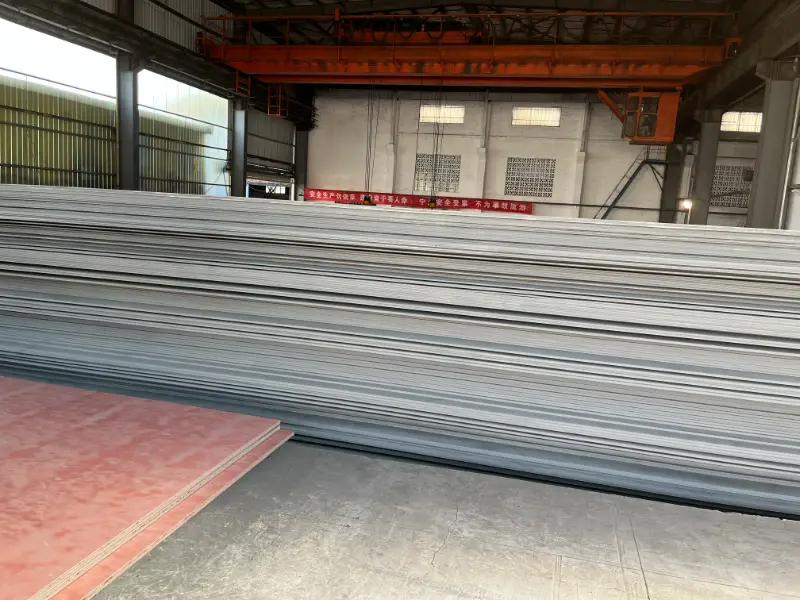
DNV Grade A Shipbuilding Steel Plate
DNV Grade A Shipbuilding Steel Plate: Properties, Equivalents & Applications
Complete material data for DNV Grade A steel: chemical composition, mechanical & thermal properties, international equivalents, and usage in shipbuilding.
Welding, cold forming, cutting, bending, machining
- Phone : +8618037372205
- Email : [email protected]
- WhatsApp: Contact via Whtsapp
- WeChat: +8618037372205
DNV Grade A Shipbuilding Steel Plate Introduction
DNV Grade A is a normal strength shipbuilding structural steel specified by Det Norske Veritas (DNV) classification society, primarily used for hull structures and marine applications. It is produced in the as-rolled, normalized, or thermomechanically controlled processed (TMCP) condition, offering good weldability and moderate strength. Typical applications include shell plates, decks, bulkheads, and stiffeners for various vessel types. The steel meets strict requirements for notch toughness at 0°C, ensuring reliable performance in cold sea environments. Its chemical composition is controlled to provide a fine-grained microstructure with sufficient ductility, meeting the unified requirements of the International Association of Classification Societies (IACS).
DNV Grade A Shipbuilding Steel Plate Chemical Composition
Based on DNV rules, the composition is limited to ensure weldability and toughness. Manganese content is tied to carbon to achieve required mechanical properties. Fine grain practice (e.g., aluminum addition) is common but not mandatory for Grade A.
| Chemical Element | Standard Value | Remarks |
|---|---|---|
| Carbon, C | ≤0.21 | |
| Manganese, Mn | ≥ 2.5 × C | Minimum, dependent on carbon content |
| Silicon, Si | ≤0.50 | Often 0.10–0.35 in practice |
| Phosphorus, P | ≤0.035 | |
| Sulfur, S | ≤0.035 | |
| Residuals (Cu, Cr, Ni, Mo) | Reported | Trace amounts allowed |
DNV Grade A Shipbuilding Steel Plate Thermal and Electrical Physical Properties
Values are representative for carbon steel at room temperature and can vary with actual chemistry and processing. Thermal expansion and conductivity are essential for structural design and welding.
| Property | Typical Value | Unit | Test Condition |
|---|---|---|---|
| Density (ρ) | 7850 | kg/m³ | 20°C |
| Elastic Modulus (E) | 200 | GPa | 20°C |
| Shear Modulus (G) | 80 | GPa | 20°C |
| Poisson's Ratio (ν) | 0.3 | - | 20°C |
| Coefficient of Thermal Expansion (α) | 12.0 – 12.5 | 10⁻⁶/K | 20–100°C up to 20–200°C |
| Thermal Conductivity (λ) | 51.9 | W/(m·K) | 20°C |
| Specific Heat Capacity | 486 | J/(kg·K) | 20°C |
| Electrical Resistivity (ρ_e) | 0.142 | 10⁻⁶ Ω·m | 20°C |
DNV Grade A Shipbuilding Steel Plate Mechanical Properties
Values apply to plate thickness ≤ 50 mm in as-rolled or normalized condition. Impact test temperature is 0°C (unless otherwise agreed). Bend test demonstrates ductility without cracking.
| Property | Specified Value | Unit | Test Condition |
|---|---|---|---|
| Yield Strength (ReH) | ≥235 | MPa | Thickness ≤ 50 mm, transverse |
| Tensile Strength (Rm) | 400 – 520 | MPa | Transverse |
| Elongation (A) | ≥22 | % | Gauge length 5.65√S0 |
| Charpy Impact (KV) | ≥27 | J | At 0°C, longitudinal or transverse |
| Bend Test | No cracks | - | 180° over former of 3× thickness |
DNV Grade A Shipbuilding Steel Plate Direct Equivalent Standards and Substitutable Grades
| Country/Region | Standard | Grade | Remarks |
|---|---|---|---|
| IACS | UR W11 | Grade A | Unified requirement for normal strength hull structural steel |
| USA | ABS Rules | ABS Grade A | American Bureau of Shipping – identical requirements |
| UK | Lloyd's Register (LR) | LR Grade A | Identical mechanical and chemical limits |
| France | Bureau Veritas (BV) | BV Grade A | Fully equivalent |
| China | China Classification Society (CCS) | CCS Grade A | Fully equivalent |
| Japan | Nippon Kaiji Kyokai (NK) | NK Grade A | Fully equivalent |
| Korea | Korean Register (KR) | KR Grade A | Fully equivalent |
| Italy | RINA | RINA Grade A | Fully equivalent |
| Germany | DNV (also Germanischer Lloyd) | GL Grade A | Under unified IACS standard |
DNV Grade A Shipbuilding Steel Plate Application Introduction
DNV Grade A steel is designed for marine and offshore environments where moderate strength and good toughness at low temperatures are required. Typical uses include:
- Hull shell plating for ships, barges, and floating structures
- Decks, bulkheads, and superstructures
- Stiffeners, brackets, and web frames
- Offshore topside modules and platform secondary structures
Product Applications: Ship hull plates, Deck plates, Bulkhead plates, Structural sections (angles, channels, bulb flats), Stiffeners and T-bars
Processed into products: Shell plates (bottom, side, bilge), Main deck and stringer plates, Transverse bulkheads, Longitudinal stiffeners, Frames and brackets, Hatch coamings, Accommodation modules
Application industries: Shipbuilding, Offshore Oil & Gas, Marine Engineering, Port & Harbor Equipment, Barge Construction
DNV Grade A Shipbuilding Steel Plate Similar/Commercially Comparable Material Recommendations
| Country/Region | Standard | Grade | Remarks |
|---|---|---|---|
| USA | ASTM A36/A36M | A36 | Similar yield strength but no guaranteed impact toughness; often used in general structural applications |
| Europe | EN 10025-2 | S235JR | Minimum yield 235 MPa, impact 27J at +20°C; not identical to Grade A 0°C requirement |
| Japan | JIS G3101 | SS400 | Yield 235 MPa min, no specified impact test; common general structural steel |
| China | GB/T 700 | Q235B | Yield 235 MPa, impact 27J at +20°C; widely used in construction |
| International | ISO 630-1 | S235B | Similar to S235JR with specified Charpy requirements |
Notes:
For thicknesses above 30 mm, preheating (typically 100-150°C) and low-hydrogen welding procedures are recommended to avoid cold cracking. The steel is readily weldable by all common methods (SMAW, SAW, GMAW, FCAW). Classification societies require mill test certificates and marking with grade, heat number, and inspector's stamp. Not intended for low-temperature service below 0°C without separate notch toughness qualification.
- Share



