
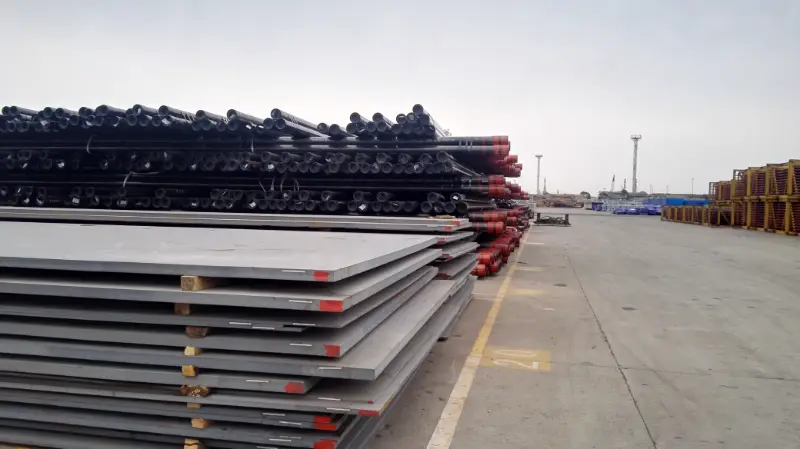
LR Grade FH69 Shipbuilding Steel Plate
LR Grade FH69 Shipbuilding Steel Plate: High-Strength Quenched & Tempered Marine Steel (690 MPa Yield)
Comprehensive datasheet for LR Grade FH69 extra high strength shipbuilding steel plate including chemical composition, mechanical and physical properties, international equivalents, and applications.
Hot rolling, quenching and tempering, cutting, welding, forming
- Phone : +8618037372205
- Email : [email protected]
- WhatsApp: Contact via Whtsapp
- WeChat: +8618037372205
LR Grade FH69 Shipbuilding Steel Plate Introduction
LR Grade FH69 is an extra-high-strength quenched and tempered steel plate for shipbuilding and offshore structures, certified by Lloyd's Register. It offers a minimum yield strength of 690 MPa and excellent low-temperature toughness down to -60°C, making it suitable for critical structural components in harsh marine environments.
Key features:
- Minimum yield strength 690 MPa, tensile strength 770-940 MPa.
- Good weldability with appropriate preheating and consumables.
- Charpy V-notch impact energy ≥69 J at -60°C (longitudinal).
- Supplied in quenched and tempered condition.
- Complies with Lloyd's Register Rules for Materials and Welding.
LR Grade FH69 Shipbuilding Steel Plate Chemical Composition
Chemical composition according to Lloyd's Register Rules for FH69 steel plates. All values are maximum unless a range is indicated.
- Carbon Equivalent (CEV) typically ≤ 0.52% for thicknesses ≤ 50 mm, ensuring good weldability.
- Fine grain practice with aluminium and microalloying elements (Nb, V, Ti) is mandatory.
| Element | Requirement (wt%) | Remarks |
|---|---|---|
| Carbon (C) | ≤0.20 | Ladle analysis |
| Silicon (Si) | 0.10 – 0.55 | Ladle analysis |
| Manganese (Mn) | 0.70 – 1.60 | Ladle analysis |
| Phosphorus (P) | ≤0.025 | Ladle analysis |
| Sulfur (S) | ≤0.025 | Ladle analysis |
| Copper (Cu) | ≤0.35 | Ladle analysis |
| Chromium (Cr) | ≤0.20 | Ladle analysis |
| Nickel (Ni) | ≤0.40 | Ladle analysis |
| Molybdenum (Mo) | ≤0.08 | Ladle analysis |
| Niobium (Nb) | 0.02 – 0.05 | Ladle analysis |
| Vanadium (V) | 0.05 – 0.10 | Ladle analysis |
| Titanium (Ti) | ≤0.02 | Ladle analysis |
| Aluminium (Al) total | ≥0.015 | Acid soluble or total, for grain refinement |
| Nitrogen (N) | ≤0.012 | Unless sufficient amount of Al is present |
LR Grade FH69 Shipbuilding Steel Plate Thermal, Electrical & Physical Properties
Physical properties are not mandated by the material standard but represent typical values for a low-alloy quenched and tempered steel. These values can be used for engineering design calculations.
- Density, elastic moduli, and thermal expansion are comparable to other HSLA steels.
- Values are valid at room temperature unless stated otherwise.
| Property | Typical Value | Unit | Test Condition / Remarks |
|---|---|---|---|
| Density (ρ) | 7850 | kg/m³ | Room temperature |
| Young's Modulus (E) | 205 – 210 | GPa | Room temperature |
| Shear Modulus (G) | ≈80 | GPa | Room temperature |
| Poisson's Ratio (ν) | 0.30 | — | Room temperature |
| Thermal Expansion Coefficient (α) | 11.5 × 10⁻⁶ | /K | 20 – 100 °C |
| Thermal Expansion Coefficient (α) | 12.0 × 10⁻⁶ | /K | 20 – 200 °C |
| Thermal Conductivity (λ) | ≈45 | W/(m·K) | Room temperature |
| Specific Heat Capacity | ≈460 | J/(kg·K) | Room temperature |
| Electrical Resistivity (ρₑ) | 0.25 × 10⁻⁶ | Ω·m | Room temperature |
LR Grade FH69 Shipbuilding Steel Plate Mechanical Properties
Mechanical properties as specified by Lloyd's Register for FH69 quenched and tempered steel plates.
- Tensile test at room temperature (transverse test pieces).
- Impact test on longitudinal Charpy V-notch specimens at -60 °C.
- Bend test: 180° over a former with diameter 3× thickness (t ≤ 25 mm).
Values are typical minimum requirements, subject to actual thickness and product form.
| Property | Required Value | Unit | Test Condition |
|---|---|---|---|
| Yield Strength (ReH) | ≥690 | MPa | Room temperature, t ≤ 50 mm |
| Yield Strength (ReH) | ≥670 | MPa | Room temperature, 50 < t ≤ 100 mm |
| Tensile Strength (Rm) | 770 – 940 | MPa | Room temperature, t ≤ 100 mm |
| Elongation (A) | ≥14 | % | Gauge length 5.65√So, t ≤ 50 mm |
| Elongation (A) | ≥14 | % | 50 < t ≤ 100 mm |
| Charpy Impact Energy (KV2, longitudinal) | ≥69 | J | At -60 °C, average of 3 tests |
| Charpy Impact Energy (KV2, longitudinal) | ≥52 | J | At -60 °C, individual minimum |
| Bend Test (180°) | No cracks | — | D = 3a (a = specimen thickness) for t ≤ 25 mm |
LR Grade FH69 Shipbuilding Steel Plate Completely Equivalent Grades – LR FH69 Identical Material from Other Classification Societies
| Country/Region | Standard / Rule | Grade | Remarks |
|---|---|---|---|
| Norway/Germany | DNV GL Rules | FH69 | Identical requirements; also known as VL FH69 |
| USA | ABS Rules | FH69 | American Bureau of Shipping, same yield and toughness |
| France | BV Rules | FH69 | Bureau Veritas, fully equivalent |
| China | CCS Rules | FH69 | China Classification Society, identical specification |
| South Korea | KR Rules | FH69 | Korean Register, identical mechanical and impact requirements |
| Japan | NK Rules | FH69 | Nippon Kaiji Kyokai (ClassNK), equivalent grade |
| Italy | RINA Rules | FH69 | Registro Italiano Navale, same grade |
| Russia | RS Rules | FH69 | Russian Maritime Register, equivalent FH69 |
LR Grade FH69 Shipbuilding Steel Plate Application Introduction
LR FH69 is primarily used in marine and offshore engineering where high strength combined with excellent low-temperature toughness is essential. The quenched and tempered microstructure provides a superior strength-to-weight ratio, enabling lighter structures without compromising safety or fatigue resistance.
Welding: Preheating (typically 75-150°C) and low-hydrogen processes are recommended. Post-weld heat treatment may be required for thick sections.
Product Applications: Hull envelope, stiffeners, and decks of high-stress vessels (container ships, LNG carriers), Legs of self-elevating platforms (jack-up rigs), Turret structures and moon pool areas of floating production units, Load-bearing nodes of offshore jacket structures, Booms and pedestals of heavy-lift cranes, High-pressure subsea storage tanks
Processed into products: Ship frames, brackets, and girders in areas of high bending moment, Attachments for towing and lifting pins, Skid beams for offshore module load-out, Forged or cut flanges for structural connections, Mooring system components, Reinforcement pads and doubler plates on high-stress hull openings
Application industries: Shipbuilding (commercial and naval), Offshore oil & gas platforms (jack-up rigs, semisubmersibles), Offshore wind foundation structures, Heavy-duty crane and lifting equipment, Pressure vessels and storage tanks in marine environments, Heavy civil engineering projects exposed to extreme weather
LR Grade FH69 Shipbuilding Steel Plate Similar Grades from Other Standards
| Country/Region | Standard | Grade | Remarks |
|---|---|---|---|
| Europe | EN 10025-6 | S690Q / S690QL / S690QL1 | Structural steel with similar strength and low-temperature toughness; CEV and testing temperature may differ. |
| USA | ASTM A514 / A517 | Grade Q (or modified) | High yield strength quenched and tempered plate, 690 MPa class; impact test temperature not necessarily -60°C. |
| Japan | JIS G 3128 | SHY685 / SHY685N / SHY685NS | High yield strength steel for welded structures, 685 MPa class; toughness requirements similar. |
| China | GB/T 16270 | Q690D / Q690E | High strength structural steel plates, quenched and tempered; impact temperatures may correspond to -20°C and -40°C. |
| ISO | ISO 4950-3 | S690QL | Similar composition and properties, international standard. |
Notes:
Supplementary requirements: FH69 may be ordered with through-thickness tensile properties (Z-quality), ultrasonic testing to class A or B, and CTOD testing for critical applications. The product thickness normally does not exceed 100 mm in the quenched and tempered condition. For welded structures, the use of matching or slightly undermatching welding consumables is recommended to ensure joint toughness.
- Share



