
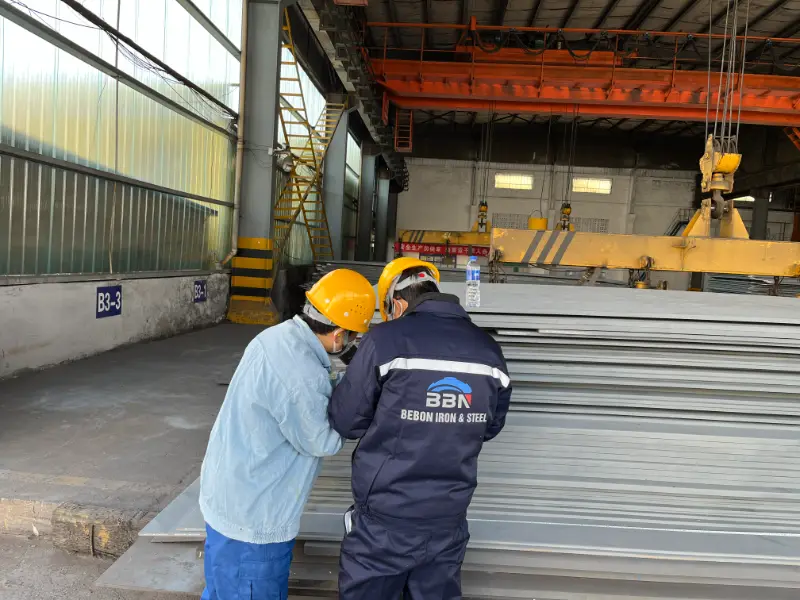
LR Grade FH62 Shipbuilding Steel Plate
LR Grade FH62 Shipbuilding Steel Plate: 620 MPa Yield Strength for Arctic & Marine Structures
Comprehensive datasheet for LR Grade FH62 extra-high-strength quenched and tempered steel for shipbuilding and offshore structures, including chemical composition, mechanical properties at -60°C, thermal properties, and international equivalents.
Hot rolling, quenching and tempering (Q+T), cutting, cold forming, welding, machining
- Phone : +8618037372205
- Email : [email protected]
- WhatsApp: Contact via Whtsapp
- WeChat: +8618037372205
LR Grade FH62 Shipbuilding Steel Plate Introduction
LR Grade FH62 is an extra-high-strength, weldable structural steel plate with a minimum specified yield strength of 620 MPa, specifically designed for ship and offshore structural applications where low-temperature toughness is critical. Certified by Lloyd's Register, the 'F' designation indicates fine-grain practice and guaranteed impact properties down to -60°C. It is supplied in the quenched and tempered (Q+T) condition, offering an excellent balance of high strength, good ductility, and reliable notch toughness. The steel is produced using low-carbon microalloyed metallurgy (typically Nb, V, Ti) and controlled processing to achieve a fine-grained microstructure.
- Yield strength ≥ 620 MPa for thicknesses ≤ 50 mm
- Charpy V‑notch impact energy ≥ 27 J at -60°C (longitudinal)
- Good weldability with appropriate low-hydrogen procedures
- Suitable for critical structural members in harsh marine environments
LR Grade FH62 Shipbuilding Steel Plate Chemical Composition
Typical limits as specified by Lloyd's Register for grade FH62. Fine-grain practice is achieved through microalloying with Nb, V, Ti and controlled aluminium/nitrogen ratio. Low carbon equivalent ensures good weldability when using appropriate low-hydrogen consumables and preheat/interpass temperature control.
| Element | Content (%) | Notes |
|---|---|---|
| Carbon (C) | ≤ 0.20 | Low carbon for weldability |
| Silicon (Si) | ≤ 0.55 | Deoxidiser, contributes to strength |
| Manganese (Mn) | ≤ 1.70 | Primary solid-solution strengthener |
| Phosphorus (P) | ≤ 0.025 | Controlled for toughness |
| Sulfur (S) | ≤ 0.025 | Controlled for toughness and through-thickness properties |
| Aluminium (Al, total) | ≥ 0.015 | Grain refinement and deoxidation |
| Niobium (Nb) | ≤ 0.05 | Grain refiner and precipitation strengthener |
| Vanadium (V) | ≤ 0.12 | Precipitation strengthener |
| Titanium (Ti) | ≤ 0.05 | Grain refiner, nitrogen scavenger |
| Nitrogen (N) | ≤ 0.015 | Controlled for toughness |
| Chromium (Cr) | ≤ 0.50 | Optional alloy, improves hardenability |
| Nickel (Ni) | ≤ 0.50 | Optional, enhances low-temperature toughness |
| Molybdenum (Mo) | ≤ 0.50 | Optional, improves hardenability and temper resistance |
| Copper (Cu) | ≤ 0.50 | Residual element, limited for weldability |
LR Grade FH62 Shipbuilding Steel Plate Physical and Thermal Properties
The values listed are typical for low-alloy quenched and tempered structural steels of this strength class. They are provided as general engineering guidance rather than specified requirements. Actual values can vary slightly depending on exact chemical composition and heat-treatment parameters.
| Property | Typical Value | Unit | Test Condition / Temperature |
|---|---|---|---|
| Density (ρ) | 7850 | kg/m³ | 20°C |
| Modulus of elasticity (E) | 205 - 210 | GPa | Ambient |
| Shear modulus (G) | ≈ 80 | GPa | Ambient |
| Poisson's ratio (ν) | 0.3 | – | Ambient |
| Thermal expansion coefficient (α) | 11.5 – 12.5 × 10⁻⁶ | /K | 20 – 100°C |
| Thermal expansion coefficient (α) | 12.5 – 13.5 × 10⁻⁶ | /K | 20 – 200°C |
| Thermal conductivity (λ) | 35 – 45 | W/(m·K) | 20°C |
| Specific heat capacity (cₚ) | 460 – 480 | J/(kg·K) | 20°C |
| Electrical resistivity (ρₑ) | 0.20 – 0.25 × 10⁻⁶ | Ω·m | 20°C |
LR Grade FH62 Shipbuilding Steel Plate Mechanical Properties
Properties are valid for plate thickness ≤ 50 mm in the quenched and tempered condition, tested in accordance with LR test requirements. Tensile testing is performed at room temperature; impact testing is at the specified low temperature. Bending test uses a mandrel diameter related to the plate thickness (t).
| Property | Value | Unit | Test Condition |
|---|---|---|---|
| Minimum yield strength (ReH) | 620 | MPa | t ≤ 50 mm, transverse |
| Minimum yield strength (ReH) | 580 | MPa | 50 < t ≤ 100 mm, transverse |
| Tensile strength (Rm) | 720 - 890 | MPa | t ≤ 50 mm |
| Tensile strength (Rm) | 700 - 870 | MPa | 50 < t ≤ 100 mm |
| Elongation after fracture (A5) | ≥ 14 | % | Gauge length 5.65√S₀, longitudinal |
| Elongation after fracture (A5) | ≥ 12 | % | Gauge length 5.65√S₀, transverse |
| Charpy V‑notch impact energy (KV₂) | ≥ 27 | J | -60 °C, longitudinal, average of 3 specimens |
| Charpy V‑notch impact energy (KV₂) | ≥ 19 | J | -60 °C, longitudinal, individual value |
| Charpy V‑notch impact energy (KV₂) | ≥ 20 | J | -60 °C, transverse, average of 3 specimens |
| Charpy V‑notch impact energy (KV₂) | ≥ 14 | J | -60 °C, transverse, individual value |
| Bend test (bending angle 180°) | d = 3 t | – | Mandrel diameter, t = plate thickness |
LR Grade FH62 Shipbuilding Steel Plate Completely Equivalent Material Standards and Substitutable Grades
| Country/Region | Standard | Grade | Remarks |
|---|---|---|---|
| Europe | EN 10225 | S620Q / S620QL1 | Structural steels for offshore structures, Q&T condition, Charpy at -40°C / -60°C (QL1) |
| Norway / DNV | DNV Rules | E620 | Offshore standard, yield 620 MPa, -40°C impact (E); E620 with -60°C test possible |
| France / BV | BV Rules | E620 | Marine & offshore, high strength steel |
| USA / ABS | ABS Rules | EQ62 | Higher strength quenched and tempered steel for ships and offshore units |
| China / CCS | CCS Rules | E620 | High strength ship and offshore structural steel |
LR Grade FH62 Shipbuilding Steel Plate Application Introduction
LR Grade FH62 is engineered for critical structural components that demand high load-bearing capacity and exceptional toughness at very low temperatures. Its 620 MPa minimum yield strength allows weight reduction compared to conventional shipbuilding steels, while the guaranteed -60°C impact properties make it suitable for ice-going vessels and Arctic offshore installations. The steel is readily weldable with low-hydrogen practices and can be formed and machined using standard workshop methods, although its high strength requires appropriate tooling and capacity.
Product Applications: Hull plates for Arctic cargo ships and icebreakers, Deck plating and bulkheads in VLCC and large container ships, Structural nodes and joint cans for offshore jacket legs, Padeye and lifting lug assemblies, Fatigue-critical welded beams and girders in crane structures
Processed into products: Ship shell plating and strength decks, Bracket plates and stiffener webs, Crane pedestal base rings and slewing rings, Transition piece flanges for wind turbine towers, Heavy-lift spreader bars and equalizing beams, Weld-on padeyes and towing brackets
Application industries: Shipbuilding (ice-class vessels, FPSO hulls, naval auxiliaries), Offshore oil & gas (jacket structures, topside modules, flare booms), Marine & heavy lifting (crane pedestals, A‑frames, winch foundations), Renewable offshore energy (transition pieces, monopile docking platforms), Port & harbour infrastructure (heavy-duty fender panels, dock gates)
LR Grade FH62 Shipbuilding Steel Plate Near/Similar Alternative Materials
| Country/Region | Standard | Grade | Remarks |
|---|---|---|---|
| Europe | EN 10025-6 | S690Q / S690QL1 | 690 MPa yield, higher strength, may require careful design review for substitution |
| USA | ASTM A514 / A517 | Grade F / Grade H | 690 MPa yield, quenched and tempered, commonly used in structural and pressure vessel applications |
| Japan | JIS G 3128 | SHY685 / SHY685N | Tensile strength 780-930 MPa, similar application but higher strength level |
| International | API 2W | Grade 50 / Grade 60 | Proprietary grades; Grade 60 yield ~414-585 MPa, lower than FH62 but sometimes used with thickness adjustment |
| Europe | EN 10025-6 | S620Q (S620MC) | Hot-rolled thermomechanical S620MC can offer similar strength but may have different toughness and processing requirements |
Notes:
- Welding: Low-hydrogen welding processes (SMAW with basic electrodes, SAW, GMAW) are mandatory. Preheat and interpass temperatures typically 75–150°C depending on plate thickness and combined thickness; post-weld heat treatment is generally not required for thicknesses below 50 mm but may be specified for highly restrained joints.
- Through-thickness properties: Where Z‑direction loading is anticipated, LR FH62 can be ordered with specified through-thickness tensile reduction of area (e.g., Z25, Z35) according to LR rules.
- Corrosion allowance: In seawater immersion or splash zones, a suitable corrosion protection system (coating, cathodic protection) and an appropriate corrosion allowance must be applied.
- Certification: Every plate is supplied with Lloyd's Register inspection certificate 3.1 or 3.2 as per EN 10204, confirming compliance with chemical composition, mechanical tests, and any additional customer requirements.
- Share



