
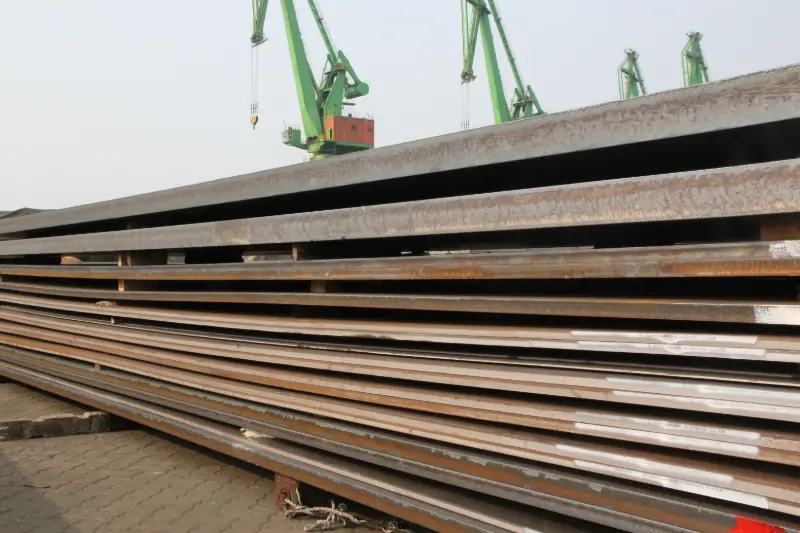
LR Grade EH62 Shipbuilding Steel Plate
LR Grade EH62 Shipbuilding Steel Plate - Ultra-High Strength Quenched & Tempered Marine Steel
Comprehensive data on LR EH62 shipbuilding plate: chemical composition, mechanical and thermal properties, international equivalents, and applications for offshore and marine engineering.
Hot rolling followed by quenching and tempering; suitable for cold forming (with limitations), machining, and welding with appropriate preheating and consumables.
- Phone : +8618037372205
- Email : [email protected]
- WhatsApp: Contact via Whtsapp
- WeChat: +8618037372205
LR Grade EH62 Shipbuilding Steel Plate Introduction
LR Grade EH62 is an ultra-high strength, quenched and tempered (Q&T) shipbuilding steel plate certified by Lloyd's Register. It offers a minimum yield strength of 620 MPa, excellent low-temperature toughness, and good weldability. This steel is designed for critical structural components in large vessels and offshore platforms operating in harsh environments, ensuring high load-bearing capacity and safety at sub-zero temperatures. Its combination of high strength and ductility reduces structural weight without compromising integrity.
LR Grade EH62 Shipbuilding Steel Plate Chemical Composition
The chemical composition is controlled to attain high strength and excellent toughness. Maximum limits for carbon, manganese, silicon, phosphorus, sulfur, chromium, nickel, molybdenum, copper, aluminum, niobium, vanadium, titanium, and nitrogen are specified. Fine grain practice is mandatory (Al total ≥ 0.015% or equivalent). Carbon equivalent (CEV) is typically limited to ≤ 0.55% for weldability.
| Element | Maximum Value (%) | Notes |
|---|---|---|
| Carbon (C) | 0.18 | Ladle analysis; typical target 0.14-0.18 |
| Silicon (Si) | 0.50 | May be lowered for improved toughness |
| Manganese (Mn) | 1.00 – 1.60 | Full range; higher Mn for strength |
| Phosphorus (P) | 0.025 | Lower P improves ductility and toughness |
| Sulfur (S) | 0.025 | Low S for resistance to lamellar tearing |
| Chromium (Cr) | 0.25 | Optional addition; may be increased up to 0.40 in some variants |
| Nickel (Ni) | 0.40 | Improves low-temperature toughness |
| Molybdenum (Mo) | 0.08 | Contributes to strength and temper resistance |
| Copper (Cu) | 0.30 | Residual element; may also improve corrosion resistance |
| Aluminum (Al, total) | 0.015 min | Grain refining element; acid soluble Al or total Al |
| Niobium (Nb) | 0.05 | Grain refiner and precipitation strengthener |
| Vanadium (V) | 0.10 | Precipitation strengthener |
| Titanium (Ti) | 0.02 | Grain refiner; protects boron if added |
| Nitrogen (N) | 0.012 | Normally kept low; Ti or Al bind nitrogen |
LR Grade EH62 Shipbuilding Steel Plate Physical and Thermal Properties
Physical properties are typical for low-alloy quenched and tempered steel and may vary with heat treatment and composition. Values are provided at room temperature unless otherwise noted. Density, elastic moduli, thermal expansion, thermal conductivity, specific heat, and electrical resistivity are used for design and welding simulations.
| Property | Typical Value | Unit | Test Condition |
|---|---|---|---|
| Density (ρ) | 7850 | kg/m³ | At 20°C |
| Elastic Modulus (E) | 205 | GPa | At 20°C; decreases with temperature |
| Shear Modulus (G) | 80 | GPa | Calculated from E and Poisson's ratio |
| Poisson's Ratio (ν) | 0.28 | — | Within elastic range |
| Thermal Expansion Coefficient (α) | 12.0 | x10⁻⁶ /K | 20–100°C; 13.5 at 20–300°C |
| Thermal Conductivity (λ) | 42 | W/(m·K) | At 20°C; reduces at higher temperatures |
| Specific Heat Capacity (c) | 460 | J/(kg·K) | At 20°C; increases with temperature |
| Electrical Resistivity (ρe) | 0.25 | μΩ·m | At 20°C |
LR Grade EH62 Shipbuilding Steel Plate Mechanical Properties
Mechanical properties are required in the transverse direction for plate thicknesses ≤ 100 mm. Yield strength (ReH), tensile strength (Rm), elongation (A), Charpy V-notch impact (KV) at -40°C, and bend test are verified. Values depend on thickness; the table represents the most demanding range (t ≤ 50 mm). Impact energy is an average of three specimens, with one individual minimum permitted.
| Property | Required Value | Unit | Condition / Remarks |
|---|---|---|---|
| Yield Strength (ReH) | ≥ 620 | MPa | t ≤ 50 mm; 580 MPa for 50 < t ≤ 70 mm; 540 MPa for 70 < t ≤ 100 mm |
| Tensile Strength (Rm) | 720 – 890 | MPa | t ≤ 50 mm; upper limit may be 940 MPa for thickness ≤ 25 mm |
| Elongation (A, 5.65√So) | ≥ 15 | % | t ≤ 50 mm; gauge length L0 = 5.65√So, transverse specimen |
| Charpy V-notch Impact (KV, -40°C) | ≥ 41 (average) / ≥ 28 (single) | J | Longitudinal; for EH grade, -40°C test temperature; transverse values are 70% of longitudinal |
| Bend Test (Diameter d, t = specimen thickness) | 180° bending over d = 3t | — | For t ≤ 25 mm; d = 4t for 25 < t ≤ 50 mm; no cracks or defects allowed |
LR Grade EH62 Shipbuilding Steel Plate Completely Equivalent Material Standards and Designations
| Country / Region | Standard / Rule | Grade | Remarks |
|---|---|---|---|
| International | IACS UR W11 (for reference) | EH620 | Basis for classification societies |
| DNV (Norway/Germany) | DNV Rules Pt.2 Ch.2 | E620 | Yield strength 620 MPa, -40°C impact |
| Bureau Veritas (France) | BV Rules Pt.2 Ch.1 | E620 | Identical to LR EH62 requirements |
| American Bureau of Shipping | ABS Rules Pt.2 Ch.1 | E62 | Equivalent designation; also EH62 in some editions |
| ClassNK (Japan) | NK Rules Pt.K | KE62 | Corresponds to -40°C grade |
| Korean Register | KR Rules Pt.2 Ch.1 | RE62 | Same tensile class |
| China Classification Society | CCS Rules Pt.2 Ch.1 | E620 | Matches LR EH62 |
LR Grade EH62 Shipbuilding Steel Plate Application Introduction
LR EH62 steel is intended for highly stressed welded structures in the shipbuilding and offshore industries. Its combination of strength, toughness at -40°C, and fabrication friendliness makes it suitable for weight-critical designs. It can be processed by welding, bending, and machining, provided preheating and post-weld heat treatment are applied according to certified procedures. Surface protection in corrosive marine environments is recommended.
Product Applications: Main deck plates and sheer strakes of ultra-large container ships, Hatch coamings and supports, Components of heavy-lift floating cranes (boom chords, pedestal boxes), Ice belt plating for icebreakers and Arctic vessels, Column and brace sections of semi-submersible rigs
Processed into products: Longitudinal stiffeners and girders in bending zones, Welded T-joints, cruciform joints in deck and bottom structures, Crane pedestals and slewing rings, Padeyes and shackle plates for lifting operations, Reinforcement inserts and doubling plates at bollard and fairlead foundations
Application industries: Shipbuilding (merchant ships, naval vessels, ice-class ships), Offshore oil & gas platforms (jacket legs, topsides, nodes), Marine heavy-lift and crane structures, Port and harbor equipment (ship-to-shore cranes, container handling), Renewable energy (offshore wind turbine foundations, transition pieces)
LR Grade EH62 Shipbuilding Steel Plate Similar or Performance-Proximate Alternative Materials
| Country / Region | Standard / Rule | Grade | Remarks |
|---|---|---|---|
| International | LR Rules | EH56 | Yield ≥ 560 MPa, same low-temperature toughness; slightly lower strength |
| International | LR Rules | FH62 | Yield ≥ 620 MPa but for -60°C impact; superior toughness, higher cost |
| USA | ASTM A514 / A517 | Grade Q | Quenched & tempered steel, Rm 760-895 MPa, 620 MPa min yield, but not ship-classified; may need approval |
| Europe | EN 10025-6 | S620Q | Structural steel, ReH ≥ 620 MPa, impact at -40°C; similar strength but not marine certified by default |
Notes:
- Material must be supplied in the quenched and tempered condition, with hardness typically not exceeding 325 HBW.
- Welding consumables should match the strength and toughness level; low-hydrogen processes are mandatory.
- Preheating (often 100–150°C) and interpass temperature control are required based on plate thickness and carbon equivalent.
- For thicknesses above 50 mm, ultrasonic testing is routinely specified.
- Compliance with the International Code on Intact Stability (for ships) or specific offshore structural standards (e.g., NORSOK, API) may impose additional requirements on through-thickness properties (Z-grade) and CTOD testing.
- Share



