
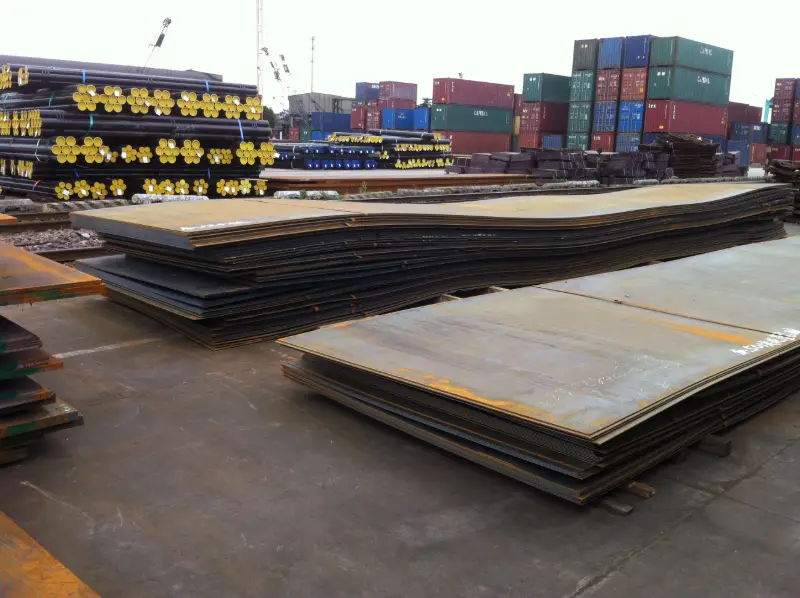
LR Grade DH62 Shipbuilding Steel
LR Grade DH62 Shipbuilding Steel: High-Strength Performance for Demanding Marine Structures
Complete technical data for LR Grade DH62 shipbuilding steel plate. Includes chemical composition, mechanical and thermal properties, international equivalents, and application guidance for offshore and marine engineering.
Thermomechanical Controlled Rolling (TMCP), Quenching and Tempering (QT), Normalizing
- Phone : +8618037372205
- Email : [email protected]
- WhatsApp: Contact via Whtsapp
- WeChat: +8618037372205
LR Grade DH62 Shipbuilding Steel Introduction
LR Grade DH62 is a high-strength shipbuilding structural steel plate certified by Lloyd's Register (LR), designed for offshore and marine applications where superior strength and low-temperature toughness are essential. It belongs to the 620 MPa yield strength category, combining excellent weldability with good formability and resistance to brittle fracture at -20 °C. This grade is typically supplied in the thermomechanically controlled rolled (TMCP) or quenched and tempered (QT) condition, ensuring a fine-grained microstructure that meets stringent safety standards. DH62 is widely used in critical structural components such as hull girders, decks, and heavy offshore platform elements, offering reliable performance under dynamic loads and in harsh marine environments.
LR Grade DH62 Shipbuilding Steel Chemical Composition
The chemical composition is defined in the LR material specification. Typical limits are based on ladle analysis. Carbon equivalent (Ceq) is controlled to ensure good weldability. All values are maximum unless a range is specified.
| Element | Value (%) | Remarks |
|---|---|---|
| C | ≤ 0.18 | Ladle analysis |
| Si | ≤ 0.55 | |
| Mn | 1.00 – 1.60 | |
| P | ≤ 0.025 | |
| S | ≤ 0.025 | |
| Al (total) | ≥ 0.015 | Minimum |
| Nb | ≤ 0.05 | |
| V | ≤ 0.10 | |
| Ti | ≤ 0.20 | Often restricted lower for TMCP |
| Cu | ≤ 0.35 | |
| Cr | ≤ 0.30 | |
| Ni | ≤ 0.80 | |
| Mo | ≤ 0.30 | |
| N | ≤ 0.012 | If sufficient Al and other binders are present |
| Ceq | ≤ 0.45 | Ceq = C + Mn/6 + (Cr+Mo+V)/5 + (Ni+Cu)/15 |
LR Grade DH62 Shipbuilding Steel Thermal and Electrical Physical Properties
The following physical properties are typical for low-alloy structural steels of this class and are provided for design guidance. They are not mandatory according to LR material specifications but are representative of DH62 in the normalized, TMCP, or QT condition at room temperature unless otherwise noted.
| Property | Typical Value | Unit | Condition / Remarks |
|---|---|---|---|
| Density (ρ) | 7.85 | g/cm³ | Room temperature |
| Modulus of Elasticity (E) | 205 | GPa | Room temperature |
| Shear Modulus (G) | 80 | GPa | Room temperature |
| Poisson's Ratio (ν) | 0.30 | Room temperature | |
| Thermal Expansion Coefficient (α) | 12.2 | 10⁻⁶/K | 20–100 °C |
| Thermal Expansion Coefficient (α) | 13.0 | 10⁻⁶/K | 20–200 °C |
| Thermal Conductivity (λ) | 50 | W/(m·K) | Room temperature |
| Specific Heat Capacity (c) | 460 | J/(kg·K) | Room temperature |
| Electrical Resistivity (ρₑ) | 0.23 | µΩ·m | Room temperature |
LR Grade DH62 Shipbuilding Steel Mechanical Properties
Mechanical properties apply to the delivery condition specified on the LR certificate. The values are minimum unless stated otherwise. Impact tests are Charpy V-notch, longitudinal specimen orientation. For thicknesses >50 mm, yield strength may be slightly reduced per LR rules.
| Property | Required Value | Unit | Test Condition |
|---|---|---|---|
| Yield Strength (ReH) | ≥ 620 | MPa | Thickness ≤ 50 mm, transverse or longitudinal |
| Yield Strength (ReH) | ≥ 610 | MPa | Thickness 50 < t ≤ 70 mm |
| Yield Strength (ReH) | ≥ 590 | MPa | Thickness 70 < t ≤ 85 mm |
| Tensile Strength (Rm) | 720 – 890 | MPa | Thickness ≤ 50 mm |
| Tensile Strength (Rm) | 700 – 890 | MPa | Thickness 50 < t ≤ 70 mm |
| Tensile Strength (Rm) | 690 – 890 | MPa | Thickness 70 < t ≤ 85 mm |
| Elongation (A) | ≥ 15 | % | 5d gauge length; thickness ≤ 50 mm |
| Elongation (A) | ≥ 14 | % | 5d gauge length; thickness 50 < t ≤ 70 mm |
| Elongation (A) | ≥ 14 | % | 5d gauge length; thickness 70 < t ≤ 85 mm |
| Charpy Impact (KV) at -20 °C | ≥ 34 (avg.), ≥ 24 (ind.) | J | Longitudinal, V-notch, D-grade temperature |
| Bend Test (180°) | d = 4a (t ≤ 50 mm) | Mandrel diameter; specimen width ≥ 40 mm |
LR Grade DH62 Shipbuilding Steel Fully Equivalent Materials and Substitution Grades
DH62 is part of the IACS (International Association of Classification Societies) unified requirements for high-strength hull structural steel. Equivalent grades from other classification societies are identical in chemical and mechanical requirements and may be used interchangeably with LR DH62, subject to rule concurrence from the respective society.
| Country / Region | Standard | Grade | Remarks |
|---|---|---|---|
| International | IACS UR W11 | DH620 | Unified requirement basis for all IACS members |
| USA | ABS Rules | DH62 | American Bureau of Shipping |
| Norway / Germany | DNV Rules | NV DH62 | Det Norske Veritas |
| France | BV Rules | DH62 | Bureau Veritas |
| China | CCS Rules | DH62 | China Classification Society |
| Japan | NK Rules | KDH62 | Nippon Kaiji Kyokai (ClassNK) |
| Italy | RINA Rules | DH62 | Registro Italiano Navale |
| South Korea | KR Rules | DH62 | Korean Register |
LR Grade DH62 Shipbuilding Steel Application Introduction
LR Grade DH62 is engineered for critical load-bearing applications in marine and offshore environments. Its combination of high strength, excellent low-temperature toughness, and good weldability makes it suitable for heavy fabrication subjected to dynamic forces, fatigue, and exposed conditions. Typical processing includes water jet cutting, plasma cutting, forming, and later welding according to approved procedures. The steel is often used in thicknesses between 10 and 85 mm, with the majority of applications in the lower thickness range for weight-sensitive structures.
Product Applications: Hull plates and shell plating, Deck stringers and main deck plating, Strengthened bottom plating for ice-class vessels, Offshore platform topsides and jacket braces, Heavy crane booms and pedestals, Legs of self-elevating platforms (jack-ups)
Processed into products: Longitudinal stiffeners and transverse web frames, Hatch covers and coamings, Watertight bulkheads, Foundation plates for heavy machinery, Fatigue-sensitive nodes in tubular structures, Transition pieces in wind turbine monopiles
Application industries: Shipbuilding (commercial, naval, and special-purpose vessels), Offshore oil and gas exploration platforms, Renewable energy (offshore wind turbine foundations, substructures), Marine and coastal engineering (jetties, quay walls, lock gates), Heavy lifting equipment for port and marine use
LR Grade DH62 Shipbuilding Steel Similar or Comparable Steel Grades
These grades offer comparable yield strength (around 620 MPa) and low-temperature toughness but may differ in chemical composition limits, delivery conditions, or specific certification requirements. They are commonly used in structural applications where classification society approval is not mandatory or where an alternative standard is accepted.
| Country / Region | Standard | Grade | Remarks |
|---|---|---|---|
| Europe | EN 10225 | S620G1+M / S620G1+Q | Structural steel for offshore structures; similar yield and impact toughness |
| Europe | EN 10225 | S620G2+M / S620G2+Q | Higher Ni content variant; toughness down to -40 °C |
| USA | ASTM A514 | Grade Q | Quenched and tempered alloy steel plate; yield 690 MPa, similar weldability with preheat |
| USA | ASTM A709 | Grade HPS 100W | High-performance steel for bridges; 690 MPa yield, not a direct shipbuilding substitute |
| International | ISO 4950-3 | S620Q | Quenched and tempered structural steel; mechanical properties close to DH62 |
| Japan | JIS G 3128 | SHY685 | High yield strength steel for welded structures; 620-685 MPa class |
Notes:
- All data are based on the latest edition of the Lloyd's Register Rules for Materials (Chapter 3, Section 1) and IACS UR W11 Rev.6, ensuring compliance with international standards.
- In the as-delivered condition, the steel is typically supplied with LR certification and marked with grade, heat number, and inspector's stamp. Test certificates (3.1 or 3.2 according to EN 10204) are issued for each lot.
- For improved weldability, preheating may be recommended depending on the carbon equivalent and plate thickness. Consult the LR welding guidelines for the applicable consumables.
- DH62 can be ordered with additional requirements such as through-thickness properties (Z35 according to EN 10164), ultrasonic testing, or enhanced chemical restrictions for specific service conditions.
- Share



