
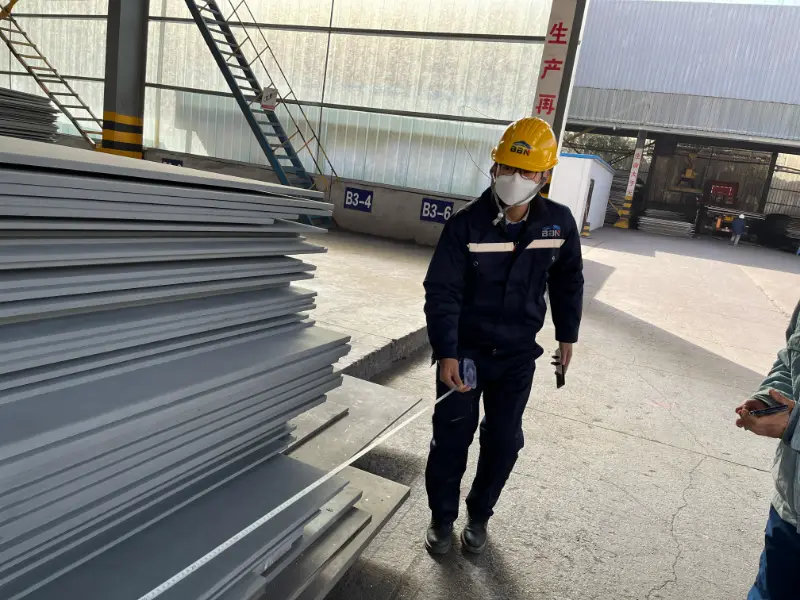
DNV Grade E40 Shipbuilding Steel Plate
DNV Grade E40 Shipbuilding Steel Plate – High-Strength Low-Temperature Structural Material
Comprehensive data sheet for DNV Grade E40 shipbuilding steel: chemical composition, mechanical and physical properties, international equivalents, and application guidance for marine and offshore structures.
Hot rolling, controlled rolling, normalizing, TMCP, quenching and tempering
- Phone : +8618037372205
- Email : [email protected]
- WhatsApp: Contact via Whtsapp
- WeChat: +8618037372205
DNV Grade E40 Shipbuilding Steel Plate Introduction
DNV Grade E40 is a high-strength, normalized or thermo-mechanically controlled processed (TMCP) shipbuilding steel plate defined by the DNV rules for classification of ships. It is designed for primary hull structures exposed to severe service conditions and low temperatures. With a minimum yield strength of 390 MPa and excellent notch toughness at -40°C, this grade is widely used in offshore platforms, icebreakers, and large container vessels. The steel exhibits good weldability, formability, and resistance to brittle fracture, ensuring long-term structural integrity. Typical delivery conditions include normalized, TMCP, or quenched and tempered states. Plate dimensions range from 6 mm to 100 mm in thickness, with widths up to 4500 mm. The material complies with international classification society standards, making it globally accepted for shipbuilding and marine engineering projects.
DNV Grade E40 Shipbuilding Steel Plate Chemical Composition
The chemical composition conforms to DNV rules for E40 high-strength shipbuilding steel. Element limits ensure high yield strength, excellent weldability, and low-temperature toughness. Al, Nb, and V are present as grain-refining elements. Maximum carbon equivalent (CEV) is usually specified to guarantee weldability, typically ≤ 0.43% for TMCP and ≤ 0.45% for normalized delivery.
| Element | Standard Value (≤ 50 mm) | Remarks |
|---|---|---|
| Carbon (C) | ≤ 0.18% | Ladle analysis; higher values may be permitted for thicker plates with agreement |
| Silicon (Si) | ≤ 0.50% | |
| Manganese (Mn) | 0.90 – 1.60% | Maximum depends on C content and CEV |
| Phosphorus (P) | ≤ 0.025% | Killed steel production |
| Sulfur (S) | ≤ 0.025% | |
| Aluminum (Al) | ≥ 0.015% (acid soluble) | Grain refining; total Al or Al/N ratio restrictions may apply |
| Niobium (Nb) | 0.02 – 0.05% | Microalloying for strength and toughness |
| Vanadium (V) | 0.05 – 0.10% | Optional; may be replaced by Nb or Ti |
| Titanium (Ti) | ≤ 0.02% | For inclusion shape control and grain refinement |
| Copper (Cu) | ≤ 0.35% | May be added for corrosion resistance |
| Chromium (Cr) | ≤ 0.20% | Residual element limit |
| Nickel (Ni) | ≤ 0.40% | Can be higher with agreement for thick plates |
| Molybdenum (Mo) | ≤ 0.08% | Residual limit |
| Nitrogen (N) | ≤ 0.009% | For aluminum-killed steel; higher if bound by Al, Nb, V |
DNV Grade E40 Shipbuilding Steel Plate Physical Properties
These properties are based on general low-carbon microalloyed steel data, as DNV Grade E40 standards do not specify physical values. They are suitable for engineering calculations and thermal stress analysis. Values may vary slightly depending on exact processing and composition.
| Property | Typical Value | Unit | Condition / Comment |
|---|---|---|---|
| Density (ρ) | 7.85 | g/cm³ | Room temperature |
| Modulus of Elasticity (E) | 205 | GPa | Room temperature |
| Shear Modulus (G) | 80 | GPa | Calculated from E and ν |
| Poisson's Ratio (ν) | 0.3 | - | Elastic range |
| Thermal Expansion Coefficient (α) | 11.5 | 10⁻⁶ / K | Between 20°C and 100°C |
| Thermal Conductivity (λ) | 45 | W/(m·K) | At 100°C; approximate |
| Specific Heat Capacity (cₚ) | 460 | J/(kg·K) | Room temperature |
| Electrical Resistivity (ρₑ) | 0.25 | μΩ·m | At 20°C |
DNV Grade E40 Shipbuilding Steel Plate Mechanical Properties
All mechanical tests are performed according to DNV standards. Properties are valid for thickness ≤ 50 mm. Yield strength is specified as minimum upper yield (ReH). Charpy V-notch impact test is conducted at -40°C in longitudinal direction; transverse values are typically ≥ 27 J. Bend test ensures formability without cracking.
| Property | Requirement (Typical) | Unit | Test Condition / Remarks |
|---|---|---|---|
| Yield Strength (ReH, min) | 390 | MPa | Ambient temperature; for plates up to 50 mm thick |
| Tensile Strength (Rm) | 510 – 650 | MPa | Mandatory range |
| Elongation (A, min) | 20 | % | Gauge length 5.65√S₀; for thickness ≤ 50 mm |
| Charpy V-notch Impact Energy (KV, min, longitudinal) | 31 | J | Tested at -40°C; three specimen average, single min 22 J |
| Charpy V-notch Impact Energy (KV, min, transverse) | 27 | J | At -40°C; when specified |
| Bend Test (bend angle 180°) | No cracks | - | Mandrel diameter = 3 × thickness (t ≤ 25 mm); 4 × thickness (25 < t ≤ 50 mm) |
DNV Grade E40 Shipbuilding Steel Plate Exactly Equivalent Material Standards and Recommended Substitutes
| Country / Region | Standard | Grade | Remarks |
|---|---|---|---|
| International (IACS) | DNV Rules | E40 | Target material |
| USA / Americas | ABS Rules | EH40 | Identical requirements, same impact temperature |
| UK / Lloyd's Register | LR Rules | EH40 | Direct equivalent |
| France / Bureau Veritas | BV Rules | EH40 | Same strength and toughness |
| China / CCS | CCS Rules | EH40 | Interchangeable for shipbuilding |
| Italy / RINA | RINA Rules | EH40 | Same criteria |
| Japan / Nippon Kaiji Kyokai | NK Rules | KE40 | Equivalent high-strength ship steel |
| South Korea / KR | KR Rules | REH40 | Matches E40 fully |
| Russia / RS | RS Rules | E40 | Recognized as equivalent |
DNV Grade E40 Shipbuilding Steel Plate Application Introduction
DNV Grade E40 is primarily used in shipbuilding and offshore structures where high strength and resistance to brittle fracture at low temperatures are essential. Its balanced composition allows for efficient welding and forming, making it suitable for critical load-bearing components.
Product Applications: Main deck plating and shell plates, Bottom and side longitudinals, Bilge keels and rudder parts, Deck girders and bulkhead stiffeners, Hatch coamings and crane pedestals, Jacket legs and brace members
Processed into products: Welded hull sections, Transverse web frames, Stringers and stiffeners, Cutouts for doors and manholes in strength decks, Fatigue-critical nodes in offshore structures, Brackets and tripping supports
Application industries: Shipbuilding (merchant ships, naval vessels, icebreakers), Offshore oil and gas platforms, Marine engineering (jack-up rigs, semi-submersibles), Port and harbor infrastructure, Renewable offshore wind (transition pieces, foundations)
DNV Grade E40 Shipbuilding Steel Plate Similar and Alternative Material Recommendations
The following grades are close in strength but differ in minimum service temperature or chemistry. They can be considered when a lower or higher toughness level is acceptable.
| Country / Region | Standard | Grade | Remarks |
|---|---|---|---|
| DNV (Norway) | DNV Rules | DH40 | Same strength, impact test at -20°C instead of -40°C |
| DNV (Norway) | DNV Rules | FH40 | Higher toughness; impact at -60°C, suitable for Arctic use |
| DNV (Norway) | DNV Rules | E36 | Lower yield strength (355 MPa), less stringent strength requirements |
| EN 10025-4 (Europe) | EN 10025-4 | S420ML / S420MLO | Thermo-mechanically rolled, similar strength but not for ship classification |
| ASTM (USA) | ASTM A131 / A131M | EH40 | Identical to DNV EH40 but under ASTM classification system |
Notes:
Supplementary information:
- Delivery condition is normally Normalized (N) or Thermo-mechanically rolled (TMCP); for thicknesses above 50 mm, TMCP with or without accelerated cooling is common. Quenched and tempered (Q+T) variants can be supplied under agreement.
- The CEV (Carbon Equivalent Value) is typically controlled: for TMCP CEV ≤ 0.43%, for Normalized CEV ≤ 0.45% (plate thickness ≤ 50 mm). This guarantees good weldability without preheating under normal conditions.
- Ultrasonic testing per DNV requirements (Class I or II) is mandatory for plates ≥ 10 mm thickness. Other NDE can be performed as per project specification.
- Material certificates (type 3.1 or 3.2) according to EN 10204 are issued by DNV surveyors.
- Share



