
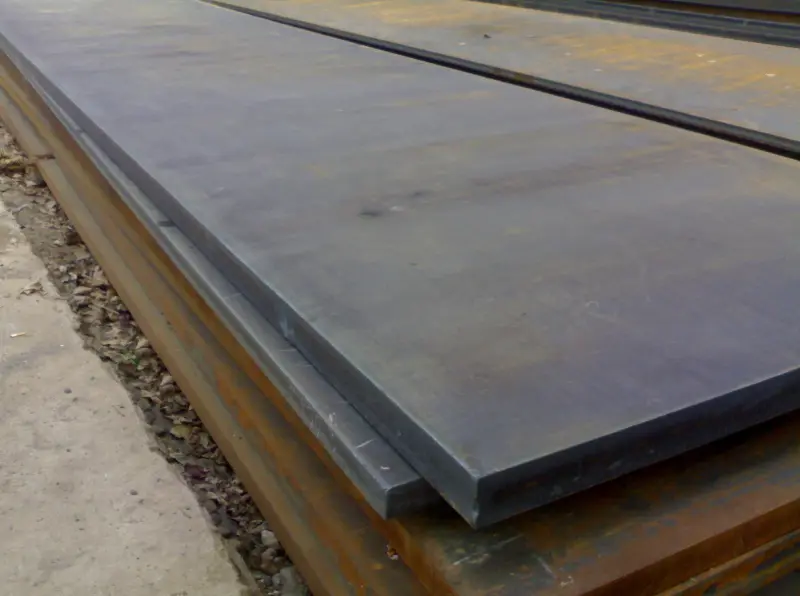
DNV Grade F40 Shipbuilding Steel Plate
DNV Grade F40 High-Strength Shipbuilding Steel Plate: Properties, Equivalents & Applications
Detailed material data for DNV Grade F40 shipbuilding steel plate, including chemical composition, mechanical properties at low temperatures, thermal and electrical physical properties, international equivalents, and application guidance for marine and offshore structures.
Hot rolling, normalizing, quenching & tempering, controlled rolling, thermo-mechanical control process (TMCP)
- Phone : +8618037372205
- Email : [email protected]
- WhatsApp: Contact via Whtsapp
- WeChat: +8618037372205
DNV Grade F40 Shipbuilding Steel Plate Introduction
DNV Grade F40 is a high-strength quenched and tempered or normalized structural steel for shipbuilding and offshore structures, certified by the DNV GL classification society (now DNV). It offers a minimum yield strength of 390 MPa and excellent toughness at temperatures down to -60 °C, indicated by the 'F' (cryogenic) designation. Key characteristics:
- High yield and tensile strength for weight-saving design
- Exceptional low-temperature impact toughness
- Good weldability with controlled carbon equivalent
- Fine grain structure through microalloying elements
The steel is predominantly supplied as hot-rolled plates and used in critical structural components of ice-class vessels, offshore platforms, and polar engineering projects.
DNV Grade F40 Shipbuilding Steel Plate Chemical Composition
The chemical composition meets DNV rules for Grade F40. The steel is microalloyed with niobium, vanadium, titanium, or aluminum to achieve fine grain size and high strength. Carbon equivalent (CEV) is generally limited to ensure weldability. Notes:
- Values shown are maximum unless a range is given.
- The sum of Nb, V, and Ti may be restricted.
- Fine grain practice is mandatory.
| Element | Standard Value (Max, %) | Remarks |
|---|---|---|
| Carbon (C) | 0.16 | For plate thickness ≤ 50 mm |
| Carbon (C) | 0.18 | For plate thickness 50–100 mm |
| Manganese (Mn) | 0.90 – 1.60 | Min–max range |
| Silicon (Si) | 0.50 | Maximum |
| Phosphorus (P) | 0.025 | Maximum |
| Sulfur (S) | 0.025 | Maximum |
| Aluminum (Al, acid-soluble) | ≥ 0.015 | Min for fine grain practice |
| Niobium (Nb) | 0.02 – 0.05 | Optional microalloying |
| Vanadium (V) | 0.05 – 0.10 | Optional microalloying |
| Titanium (Ti) | 0.000 – 0.02 | Optional microalloying |
| Copper (Cu) | 0.35 | Maximum when specified |
| Chromium (Cr) | 0.20 | Maximum when specified |
| Nickel (Ni) | 0.40 | Maximum when specified |
| Molybdenum (Mo) | 0.08 | Maximum when specified |
| Nitrogen (N) | 0.009 | Maximum when not combined with nitride formers |
| CEV | Typ. ≤ 0.39 | Carbon equivalent, for guidance |
DNV Grade F40 Shipbuilding Steel Plate Thermal and Electrical Physical Properties
The following physical properties are typical for this grade of shipbuilding steel and are not mandatory per DNV rules. These values may vary slightly with heat treatment condition and composition. Units: density in kg/dm³; elastic moduli in GPa; thermal expansion coefficient in 10⁻⁶/K; thermal conductivity in W/(m·K); specific heat capacity in J/(kg·K); electrical resistivity in Ω·mm²/m.
| Property | Typical Value | Unit | Test Condition / Remarks |
|---|---|---|---|
| Density (ρ) | 7.85 | kg/dm³ | At room temperature |
| Elastic Modulus (E) | 205 | GPa | At 20 °C |
| Shear Modulus (G) | 80 | GPa | At 20 °C |
| Poisson's Ratio (ν) | 0.29 | - | At 20 °C |
| Thermal Expansion (α), 20–100 °C | 12.0 | 10⁻⁶/K | Linear, mean coefficient |
| Thermal Expansion (α), 20–200 °C | 12.5 | 10⁻⁶/K | Linear, mean coefficient |
| Thermal Expansion (α), 20–300 °C | 13.0 | 10⁻⁶/K | Linear, mean coefficient |
| Thermal Conductivity (λ) | 45 | W/(m·K) | At 20 °C, typical for steel |
| Specific Heat Capacity (cp) | 460 – 500 | J/(kg·K) | At 20 °C |
| Electrical Resistivity (ρe) | 0.25 | Ω·mm²/m | At 20 °C |
DNV Grade F40 Shipbuilding Steel Plate Mechanical Properties
Mechanical property requirements per DNV rules for Grade F40. All values are minimum unless noted. The impact test temperature is -60 °C (F-grade). Plate thickness-dependent tensile properties:
- Thickness ≤ 50 mm: YS 390 MPa, TS 510–650 MPa, Elong. 20%
- Thickness 50–70 mm: YS 370 MPa, TS 510–650 MPa, Elong. 19%
- Thickness 70–100 mm: YS 350 MPa, TS 490–630 MPa, Elong. 19%
Impact energy values are guaranteed at -60 °C.
| Property | Standard Value | Unit | Test Condition |
|---|---|---|---|
| Yield Strength (ReH) | 390 | MPa | t ≤ 50 mm |
| Yield Strength (ReH) | 370 | MPa | 50 < t ≤ 70 mm |
| Yield Strength (ReH) | 350 | MPa | 70 < t ≤ 100 mm |
| Tensile Strength (Rm) | 510 – 650 | MPa | t ≤ 100 mm |
| Tensile Strength (Rm) | 490 – 630 | MPa | 70 < t ≤ 100 mm (if applicable) |
| Elongation (A, 5.65√S0) | 20 | % | t ≤ 50 mm |
| Elongation (A, 5.65√S0) | 19 | % | t > 50 mm |
| Impact Energy (KV, transverse) | 24 (average) / 17 (single) | J | -60 °C |
| Bend Test (180°) | No cracks | - | Bend diameter 3 × t (t = plate thickness) |
DNV Grade F40 Shipbuilding Steel Plate Completely Equivalent Materials – DNV Grade F40 and International Replacements
| Country/Region | Standard | Grade | Remarks |
|---|---|---|---|
| International (Norway) | DNV Rules | F40 | Original grade |
| International (UK) | Lloyd's Register (LR) Rules | EH40 | Fully equivalent; impact at -60 °C |
| International (USA) | ABS Rules | EH40 | Fully equivalent; ABS EH40 |
| International (France) | Bureau Veritas (BV) Rules | EH40 | Fully equivalent; BV EH40 |
| International (Italy) | RINA Rules | EH40 | RINA EH40 equivalent to F40 |
| International (Japan) | Nippon Kaiji Kyokai (ClassNK) Rules | KE40 | Equivalent grade; impact at -60 °C |
DNV Grade F40 Shipbuilding Steel Plate Application Introduction
DNV F40 steel is intended for demanding marine and offshore structures where high strength combined with excellent low-temperature toughness is crucial. Its -60 °C impact guarantee makes it suitable for arctic and ice-class vessels. Typical fabrication processes include cutting, forming, and welding. Preheating and precise heat input control are recommended due to the tempered condition. Typical applications:
Product Applications: Hull structural members (shell, deck, longitudinals), Ice belt plating, Offshore module support frames and nodes, Crane pedestals and heavy-lift structures, Jack-up rig legs and spudcans, Mooring equipment foundations
Processed into products: Hull plates and stiffeners, Bottom and side shell sections in high-stress regions, Heavy-duty brackets and girders, Cold-formed or welded T-, L-, and H-sections for primary structures, Machined bushings and pins on marine cranes (after proper heat treatment), Flanges and pressure-containing parts designed to DNV requirements
Application industries: Shipbuilding and repair, Offshore oil & gas platforms, Ice-class vessel construction, Port and heavy-lift crane manufacturing, Wind turbine installation vessels (WTIV), Polar research and Antarctic supply vessels
DNV Grade F40 Shipbuilding Steel Plate Similar / Alternative Grades with Comparable Properties
| Country/Region | Standard | Grade | Remarks |
|---|---|---|---|
| International | DNV Rules | F36 (EH36) | Similar cryogenic toughness (F) but lower strength: YS 355 MPa, TS 490–620 MPa; may be used where 390 MPa strength is not essential. |
| International | DNV Rules | FH40 (TMCP delivery) | Similar strength (YS 390 MPa) but often delivered with improved weldability via TMCP; also provides cryogenic toughness at -60 °C. |
| International | API 2W / 2MT1 | Grade 60 / 2W-60 | Offshore structural steel with YS 414 MPa (60 ksi); close in strength; may match toughness requirements suitable for cold climate but need individual certification for marine classification. |
| Europe | EN 10025-6 | S460Q/QL1 | Quenched & tempered steel with YS ≥ 460 MPa and good low-temperature toughness, but chemistry and certification must align with ship rules; S460MLO (EN 10225) may be closer for offshore. |
Notes:
- All mechanical properties are guaranteed for the as-delivered condition (Q&T, TMCP, etc.).
- Weldability: DNV F40 can be welded using low-hydrogen processes. Preheating (approx. 100–150 °C) may be required depending on thickness and carbon equivalent. Post-weld heat treatment is generally not required but may be specified for thick sections.
- Ultrasonic testing (UT) is often required according to EN 10160 or equivalent; the material is normally supplied with class S2E2 or better.
- Certification: The steel is supplied with DNV type approval and EN 10204 3.1 inspection certificates. Additional testing (CTOD, NDT, etc.) can be agreed upon order.
- Share



