
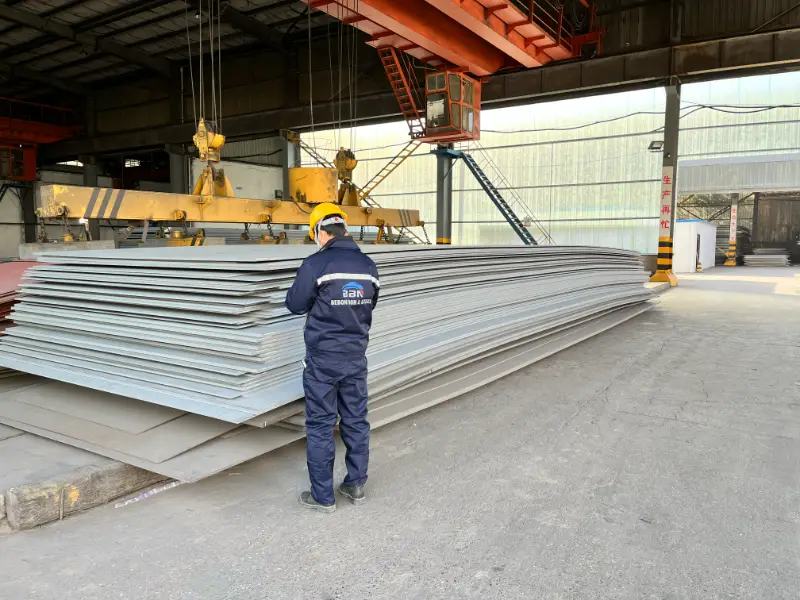
DNV Grade A420 Shipbuilding Steel
DNV Grade A420 Shipbuilding Steel: Properties, Equivalents & Applications
Comprehensive technical data for DNV A420 shipbuilding steel plate, including chemical composition, mechanical properties, thermal and electrical characteristics, international equivalents, and application guidance.
Hot rolling, normalizing, TMCP (thermo-mechanical controlled processing)
- Phone : +8618037372205
- Email : [email protected]
- WhatsApp: Contact via Whtsapp
- WeChat: +8618037372205
DNV Grade A420 Shipbuilding Steel Introduction
DNV Grade A420 is a high-strength shipbuilding steel plate governed by DNV classification rules. It offers a minimum yield strength of 420 MPa and is designated as A-grade, indicating Charpy impact testing at 0°C. The steel is typically produced by thermo-mechanical controlled processing (TMCP) or normalizing, which yields a fine-grained microstructure for excellent toughness and weldability. It is widely employed in hull structures, offshore platforms, and marine engineering components that demand a high strength-to-weight ratio and reliable low-temperature performance. The standard delivery condition is normalized or TMCP, with plate thicknesses available up to 100 mm.
DNV Grade A420 Shipbuilding Steel Chemical Composition
Chemical composition conforms to DNV rules for high-strength shipbuilding steels. All values are maximum unless a range is indicated. The steel is fully killed and fine-grain treated, with micro-alloying additions (Nb, V, Ti) to enhance strength and toughness. Carbon equivalent (CEV) limits ensure good weldability.
| Element | Standard Value (wt.%) | Remarks |
|---|---|---|
| Carbon (C) | ≤ 0.18 | Ladle analysis |
| Silicon (Si) | ≤ 0.50 | |
| Manganese (Mn) | 0.90 – 1.60 | Ladle analysis range |
| Phosphorus (P) | ≤ 0.025 | |
| Sulfur (S) | ≤ 0.025 | |
| Aluminum (Al) | ≥ 0.015 (total) | Grain refining element |
| Niobium (Nb) | ≤ 0.05 | Micro-alloying |
| Vanadium (V) | ≤ 0.10 | Micro-alloying |
| Titanium (Ti) | ≤ 0.02 | Micro-alloying |
| Copper (Cu) | ≤ 0.25 | Residual element |
| Chromium (Cr) | ≤ 0.25 | Residual |
| Nickel (Ni) | ≤ 0.25 | Residual |
| Molybdenum (Mo) | ≤ 0.08 | Residual |
| Nitrogen (N) | ≤ 0.012 | If applicable |
| Carbon Equivalent (CEV) | ≤ 0.40 (t ≤ 50 mm) | CEV = C + Mn/6 + (Cr+Mo+V)/5 + (Ni+Cu)/15 |
| Carbon Equivalent (CEV) | ≤ 0.42 (50 < t ≤ 100 mm) | For thicker plates |
DNV Grade A420 Shipbuilding Steel Thermal and Electrical Properties
Physical properties are representative for structural steels of this type and may vary slightly with processing and temperature. These values serve as design guidelines for thermal and electrical calculations.
| Property | Typical Value | Unit | Test Condition |
|---|---|---|---|
| Density (ρ) | 7.85 | g/cm³ | 20°C |
| Elastic Modulus (E) | 205 | GPa | Ambient |
| Shear Modulus (G) | 80 | GPa | Ambient |
| Poisson's Ratio (ν) | 0.3 | — | — |
| Thermal Expansion (α) | 12.0 × 10⁻⁶ | /K | 20–100°C |
| Thermal Conductivity (λ) | 48 | W/(m·K) | 25°C |
| Specific Heat Capacity | 470 | J/(kg·K) | 25–100°C |
| Electrical Resistivity (ρe) | 0.20 | μΩ·m | 20°C |
DNV Grade A420 Shipbuilding Steel Mechanical Properties
Mechanical properties are based on DNV requirements for Grade A420. Transverse specimens are used unless otherwise stated. Impact testing is performed at 0°C for Grade A. Elongation values refer to longitudinal test pieces with gauge length 5.65√S0. Bending tests are 180° and must show no cracks.
| Property | Standard Requirement | Unit | Test Condition / Thickness |
|---|---|---|---|
| Yield Strength (ReH) | ≥ 420 | MPa | t ≤ 100 mm, transverse |
| Tensile Strength (Rm) | 530 – 680 | MPa | t ≤ 100 mm |
| Elongation (A) | ≥ 18 | % | t ≤ 50 mm, longitudinal |
| Elongation (A) | ≥ 19 | % | 50 < t ≤ 90 mm, longitudinal |
| Elongation (A) | ≥ 20 | % | 90 < t ≤ 100 mm, longitudinal |
| Charpy V‑notch (KV₂) | ≥ 34 (longitudinal) | J | 0°C, t ≤ 50 mm |
| Charpy V‑notch (KV₂) | ≥ 24 (transverse) | J | 0°C, t ≤ 50 mm |
| Charpy V‑notch (KV₂) | ≥ 34 (longitudinal) | J | 0°C, 50 < t ≤ 100 mm |
| Bend Test | d = 3a, 180° | — | t ≤ 30 mm, no cracks |
| Bend Test | d = 4a, 180° | — | 30 < t ≤ 50 mm, no cracks |
DNV Grade A420 Shipbuilding Steel Fully Equivalent Material Standards and Alternative Grades
| Country/Region | Standard | Grade | Remarks |
|---|---|---|---|
| International (IACS) | IACS UR W11 | AH420 | Impact test at 0°C |
| Norway | DNV | DNV A420 | Base specification |
| USA | ABS | ABS AH42 | Equivalent, 0°C impact |
| UK | Lloyd's Register | LR AH42 | Equivalent, 0°C impact |
| France | Bureau Veritas | BV AH42 | Equivalent, 0°C impact |
| China | CCS | CCS AH42 | Equivalent, 0°C impact |
| Japan | ClassNK | NK KA42 | Equivalent, 0°C impact |
| South Korea | Korean Register | KR AH42 | Equivalent, 0°C impact |
| Italy | RINA | RINA AH42 | Equivalent, 0°C impact |
DNV Grade A420 Shipbuilding Steel Application Introduction
DNV A420 steel is designed for demanding marine and offshore structural applications where weight savings, weldability, and toughness are critical. It is suitable for cold forming, bending, and all conventional low-hydrogen welding processes. Preheating may be required based on thickness and carbon equivalent; post-weld heat treatment is generally not required for thinner sections but may be specified for heavy fabrications.
Product Applications: Hull side and bottom plates, Deck plates, Bulkheads and watertight doors, Stiffeners and web frames, Offshore platform topsides and jacket structures, Sea fastenings and mooring components, Heavy crane booms and pedestals
Processed into products: Transverse frames and floors, Longitudinal girders and stringers, Hatch coamings and covers, Brackets and gussets, Shell plating and keel plates, Column and diagonal braces, Heli-deck support structures
Application industries: Shipbuilding, Offshore Oil & Gas, Marine Engineering, Heavy Construction, Port and Harbor Facilities
DNV Grade A420 Shipbuilding Steel Similar/Alternative Materials Recommendations
| Country/Region | Standard | Grade | Remarks |
|---|---|---|---|
| Norway | DNV | DNV A460 | Higher strength (≥460 MPa), same impact temperature |
| Norway | DNV | DNV D420 | Same strength, impact at -20°C |
| Norway | DNV | DNV E420 | Same strength, impact at -40°C |
| International | IACS | AH400 | Lower strength (≥400 MPa), 0°C impact |
| USA | ABS | ABS AH40 | Lower strength (≥400 MPa), similar weldability |
Notes:
The carbon equivalent (CEV) limits ensure good weldability with low-hydrogen procedures. For thicknesses above 30–40 mm, preheating (typically 50–100°C) may be recommended. DNV A420 may be supplied with additional testing such as ultrasonic examination or Z-direction tensile testing if specified. Always refer to the latest DNV rules and project specifications for exact requirements. Alternative designation for A-grade 420 MPa steel may appear as NV A420 in older DNV documentation.
- Share



