
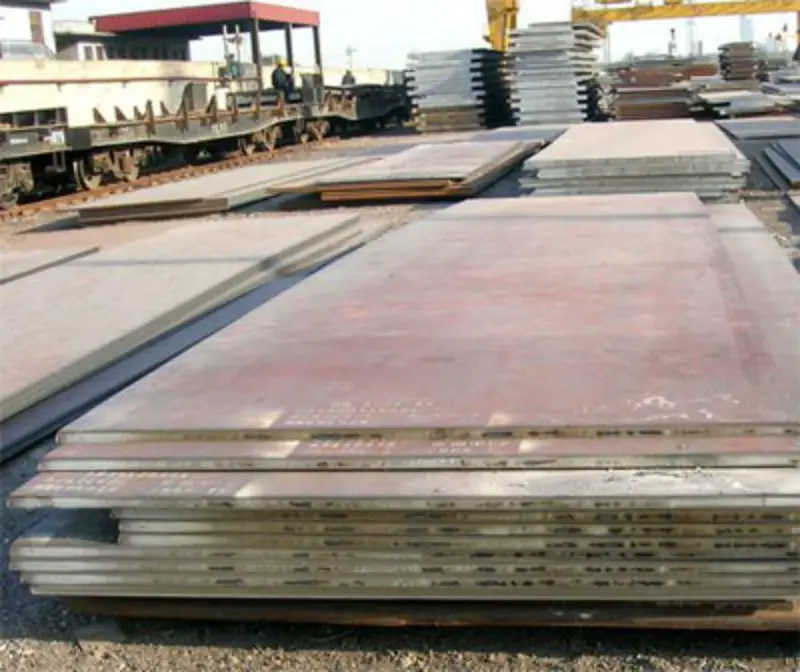
DNV Grade D420 Shipbuilding Steel Plate
DNV Grade D420 Shipbuilding Steel Plate - High Strength Hull Structural Steel
DNV Grade D420 is a high strength shipbuilding steel plate designed for hull and offshore structures, offering minimum yield strength of 420 MPa and excellent low-temperature toughness at -20°C.
Cutting (flame, plasma, laser), welding (all common arc processes), cold forming, machining, hot forming (with controlled heat treatment)
- Phone : +8618037372205
- Email : [email protected]
- WhatsApp: Contact via Whtsapp
- WeChat: +8618037372205
DNV Grade D420 Shipbuilding Steel Plate Introduction
DNV Grade D420 is a high strength structural steel plate for ship and offshore applications, certified by Det Norske Veritas (DNV). It belongs to the D category of DNV's high strength hull structural steels, with guaranteed impact toughness down to -20°C.
The grade delivers a minimum yield strength of 420 MPa and tensile strength in the range 530–680 MPa, combined with good weldability and formability.
The steel is produced by normalised rolling or thermomechanical controlled processing (TMCP), and is supplied in the as‑rolled, normalised or TMCP condition depending on thickness and end use.
The material meets the latest IACS Unified Requirements and can be substituted by equivalent grades from other classification societies.
DNV Grade D420 Shipbuilding Steel Plate Chemical Composition
Chemical requirements for DNV D420 steel plates according to DNV Rules Pt.2 Ch.2. The steel is fully killed and fine‑grain treated. Carbon equivalent (CEV) is controlled for weldability. Microalloying elements (Nb, V, Ti, Al) are added to refine the grain and secure the required strength and toughness.
| Element | Heat Analysis (max unless range) | Remarks |
|---|---|---|
| Carbon (C) | ≤ 0.21 | Ladle analysis; product analysis may differ slightly |
| Silicon (Si) | 0.10 – 0.55 | Typically in the lower part of the range |
| Manganese (Mn) | 0.60 – 1.70 | Increases strength and hardenability |
| Phosphorus (P) | ≤ 0.035 | Maximum for all grades |
| Sulfur (S) | ≤ 0.035 | Maximum for all grades |
| Aluminium (Al) total | ≥ 0.020 | Fine grain practice; usually Al‑killed |
| Niobium (Nb) | ≤ 0.05 | Optional microalloy; enhances strength |
| Vanadium (V) | ≤ 0.10 | Optional microalloy; may substitute Nb |
| Titanium (Ti) | ≤ 0.02 | Optional; improves weldability |
| Copper (Cu) | ≤ 0.35 | Residual; higher with agreement |
| Chromium (Cr) | ≤ 0.20 | Residual; may be higher for thick plates |
| Nickel (Ni) | ≤ 0.40 | Residual; higher with agreement |
| Molybdenum (Mo) | ≤ 0.08 | Residual |
| Nitrogen (N) | ≤ 0.012 | Max; controlled for grain refinement |
| Carbon Equivalent (CEV) | ≤ 0.45 | CEV = C + Mn/6 + (Cr+Mo+V)/5 + (Ni+Cu)/15 |
DNV Grade D420 Shipbuilding Steel Plate Thermal and Electrical Physical Properties
Physical properties are representative for low‑carbon high‑strength steels and can be used for design calculations. Values are not part of the DNV certification but based on published data for similar structural steels (e.g., S420G, EH36).
| Property | Typical Value | Unit | Conditions / Remarks |
|---|---|---|---|
| Density (ρ) | 7850 | kg/m³ | At 20 °C |
| Elastic modulus (E) | 205 – 210 | GPa | At room temperature |
| Shear modulus (G) | ~ 81 | GPa | Calculated from E and ν |
| Poisson's ratio (ν) | 0.29 – 0.30 | – | At room temperature |
| Thermal expansion coefficient (α) | 11.5 – 12.5 × 10⁻⁶ | 1/K | Between 20 °C and 100 °C |
| Thermal conductivity (λ) | ~ 52 | W/(m·K) | At 20 °C |
| Specific heat capacity (cp) | ~ 460 | J/(kg·K) | At 20 °C |
| Electrical resistivity (ρe) | ~ 0.15 – 0.20 × 10⁻⁶ | Ω·m | At 20 °C, for steel with ~0.2% C |
DNV Grade D420 Shipbuilding Steel Plate Mechanical Properties
Mechanical properties for DNV D420 steel plates as per DNV classification rules. Tests are performed on samples taken from the plate in the transverse direction for tensile properties and longitudinal for impact tests. Values apply to TMCP or normalised condition and plate thickness up to 50 mm; for greater thicknesses a slight reduction in strength may be accepted by agreement.
| Property | Specified Value | Unit | Test Conditions / Remarks |
|---|---|---|---|
| Yield strength (ReH) | ≥ 420 | MPa | Upper yield or 0.2% proof stress, transverse; thickness ≤ 50 mm |
| Yield strength (ReH) | ≥ 410 | MPa | Thickness 50 – 70 mm |
| Yield strength (ReH) | ≥ 390 | MPa | Thickness 70 – 100 mm |
| Tensile strength (Rm) | 530 – 680 | MPa | Transverse; all thicknesses |
| Elongation (A5) | ≥ 19 | % | Gauge length 5.65√So; thickness ≤ 20 mm |
| Elongation (A5) | ≥ 18 | % | Thickness 20 – 40 mm |
| Elongation (A5) | ≥ 17 | % | Thickness 40 – 50 mm |
| Elongation (A5) | ≥ 16 | % | Thickness > 50 mm (by agreement) |
| Impact energy (KV) | ≥ 27 (longitudinal) | J | At −20 °C (test temperature for grade D); single value; average of 3 ≥ 27 J, one individual ≥ 20 J |
| Transverse impact energy | ≥ 20 (transverse) | J | At −20 °C; for thickness ≥ 20 mm when specified |
| Bend test (180°) | No cracks or defects | – | Mandrel diameter = 3 × specimen thickness (a) for ReH ≥ 420 MPa; tension side examined |
DNV Grade D420 Shipbuilding Steel Plate Completely Equivalent Standards and Replaceable Grades
| Country/Region | Standard/Governing Body | Grade | Remarks |
|---|---|---|---|
| Worldwide (IACS) | IACS UR W11 | DH420 | Direct equivalent of DNV D420, fully interchangeable in shipbuilding |
| USA | ABS (American Bureau of Shipping) | DH42 | ABS equivalent for hull structural steel, −20°C impact |
| France | Bureau Veritas (BV) | DH420 | Identical strength and toughness class |
| China | CCS (China Classification Society) | DH420 | Same as DNV D420 in CCS rules |
| UK | Lloyd's Register (LR) | DH42 | Equivalent high strength ship plate |
| Japan | ClassNK (NK) | KDH42 | NK notation for grade D high strength steel with 420 MPa yield |
| Italy | RINA | DH420 | RINA equivalent of DNV D420 |
| Korea | Korean Register (KR) | RDH42 | KR grade for D‑class high strength ship steel |
DNV Grade D420 Shipbuilding Steel Plate Application Introduction
DNV D420 steel is designed for heavy‑duty ship and offshore structures where high strength and reliable low‑temperature toughness are essential. It permits weight reduction by using thinner sections while maintaining structural integrity. The steel is fully weldable with standard shipyard procedures.
Product Applications: Vessel hulls (bottom, side, deck plating), Longitudinal and transverse stiffeners, Bulkheads and watertight doors, Deck houses and superstructures, Offshore platform decks and substructures, Jack‑up rig components (legs, spudcans), Container ship hatch coamings
Processed into products: Ship plates (main deck, shell, bottom plates), Stiffener profiles (angles, bulb flats), Bracket plates and webs, Heavy‑duty flanges and gussets, Crane pedestals and boom sections, Wind turbine tower foundations (maritime), Support frames and bearing stools
Application industries: Shipbuilding and ship repair, Offshore oil & gas platforms, Marine and coastal engineering, Harbour and port equipment, Heavy structural engineering (bridges, cranes)
DNV Grade D420 Shipbuilding Steel Plate Similar or Alternative Materials with Comparable Performance
| Country/Region | Standard | Grade | Remarks |
|---|---|---|---|
| Europe | EN 10025‑4 | S420ML/ S420MLO | Thermomechanically rolled structural steel with similar strength, not class‑approved; may be used in non‑ship areas |
| Europe | EN 10225 | S420G2+M / S420G2+QT | Weldable structural steel for fixed offshore structures, slightly different delivery condition |
| USA | ASTM A572/ A572M | Grade 60 [415] | High‑strength low‑alloy structural steel with similar yield, no guaranteed low‑temperature toughness; suitable for onshore use only |
| USA | ASTM A131/ A131M | Grade DH36 / EH36 | Ship hull steel with lower strength (355 MPa) but excellent toughness; not a direct strength replacement but widely used |
| China | GB 712 | DH420 | Chinese ship steel equivalent; matching strength and −20°C impact toughness |
Notes:
DNV certification for D420 includes positive material identification, chemical analyses, mechanical testing and strict quality control. Plates receive a DNV stamp and certificate according to the rules.
For thicknesses above 100 mm, the through‑thickness properties (Z‑grade) can be agreed.
Thermo‑Mechanical Controlled Processing (TM‑TM) is the preferred delivery condition as it optimises strength, toughness and weldability; hot forming after delivery may impair the properties and is generally not recommended without a subsequent normalising heat treatment.
Always consult the latest DNV rules (Pt.2 Ch.2) for the most current requirements.
- Share



