
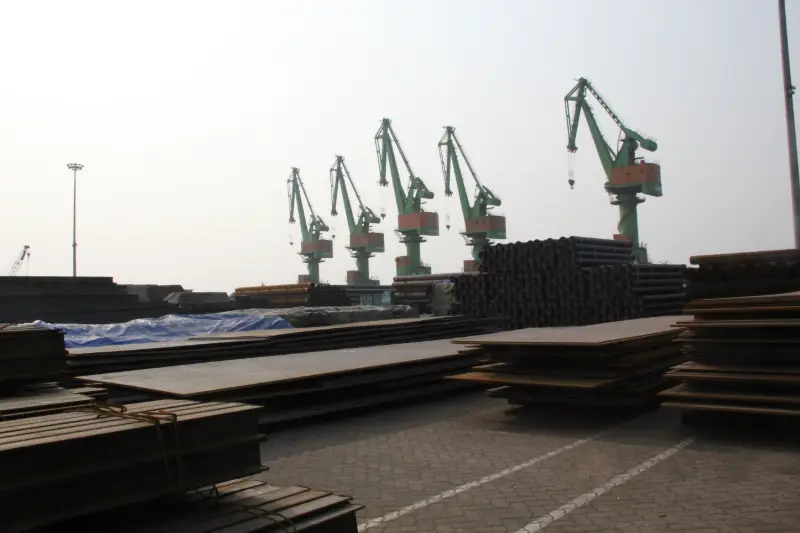
DNV Grade E420 Shipbuilding Steel Plate
DNV Grade E420 Shipbuilding Steel Plate: High Strength, Low Temperature Toughness for Marine Structures
DNV Grade E420 is a high strength structural steel for shipbuilding with minimum yield strength 420 MPa, excellent toughness at -40°C, primarily used in offshore and marine engineering.
Hot rolling, Normalizing, Thermo-Mechanical Control Process (TMCP), Quenching and Tempering (optional for thicker plates)
- Phone : +8618037372205
- Email : [email protected]
- WhatsApp: Contact via Whtsapp
- WeChat: +8618037372205
DNV Grade E420 Shipbuilding Steel Plate Introduction
DNV Grade E420 is a high strength shipbuilding steel plate governed by the Det Norske Veritas (DNV) classification society rules. It belongs to the normalized or thermo-mechanically controlled processed (TMCP) delivery condition group. The designation 'E' indicates enhanced low-temperature impact properties down to -40°C, while '420' denotes a minimum yield strength of 420 MPa for thicknesses up to 50 mm.
- Good weldability and formability with appropriate precautions.
- Fine grain structure ensures superior toughness in Arctic and harsh marine environments.
- Available in a wide range of thicknesses, suitable for critical structural members of ships, offshore platforms, and icebreakers.
DNV Grade E420 Shipbuilding Steel Plate Chemical Composition
The ladle analysis limits for DNV Grade E420 steel plates are specified in the DNV Rules. Key micro-alloying elements such as niobium, vanadium, and titanium are added to achieve fine grain size and high strength. The total content of Nb+V+Ti is restricted to ensure good weldability and toughness. All values are maximum unless a range is indicated.
- Carbon Equivalent (CEV) is often limited to 0.40-0.43 depending on thickness to guarantee weldability.
- Aluminum is added as a deoxidizer and grain refiner, with acid-soluble aluminum at or above 0.015%.
| Element | Specification (max or range) | Remarks |
|---|---|---|
| Carbon (C) | 0.20 | |
| Silicon (Si) | 0.10 - 0.55 | |
| Manganese (Mn) | 1.00 - 1.70 | |
| Phosphorus (P) | 0.030 | |
| Sulfur (S) | 0.030 | |
| Aluminum (Al, acid-soluble) | ≥ 0.015 | |
| Niobium (Nb) | 0.02 - 0.05 | Microalloying element |
| Vanadium (V) | 0.05 - 0.10 | Microalloying element |
| Titanium (Ti) | ≤ 0.02 | |
| Copper (Cu) | 0.35 | |
| Chromium (Cr) | 0.20 | |
| Nickel (Ni) | 0.40 | |
| Molybdenum (Mo) | 0.08 | |
| NB + V + Ti | ≤ 0.12 | Sum of microalloying elements |
DNV Grade E420 Shipbuilding Steel Plate Thermal and Electrical Physical Properties
These typical values are provided for general design calculations and are not mandatory requirements of the DNV standard. They are based on common steel grades with similar composition and structure. Actual values may vary slightly due to manufacturing variations and thermal history.
- Expected density of 7800 kg/m³ at room temperature.
- Thermal conductivity is moderate and decreases with increasing temperature.
- Electrical resistivity is typical for low-alloy steel.
| Property | Typical Value | Unit | Test Condition / Remarks |
|---|---|---|---|
| Density (ρ) | 7800 | kg/m³ | At 20°C |
| Modulus of Elasticity (E) | 210 | GPa | At 20°C |
| Shear Modulus (G) | ~81 | GPa | Calculated from E and ν |
| Poisson's Ratio (ν) | 0.3 | - | Room temperature |
| Thermal Expansion Coefficient (α) | 12 × 10⁻⁶ | 1/K | Average between 20°C and 100°C |
| Thermal Conductivity (λ) | 50 | W/(m·K) | At 20°C, typical structural steel |
| Specific Heat Capacity (c) | 460 | J/(kg·K) | At 20°C to 100°C |
| Electrical Resistivity (ρ_e) | 0.23 × 10⁻⁶ | Ω·m | At 20°C, typical |
DNV Grade E420 Shipbuilding Steel Plate Mechanical Properties
Mechanical properties are verified by tensile and Charpy V-notch impact tests in accordance with DNV requirements. Properties vary with product thickness. The table presents the minimum requirements for plates in the transverse direction, which are typical for structural applications. Impact tests are performed at -40°C, with separate energy requirements for longitudinal and transverse specimens.
- Yield strength decreases for thicker plates, as shown in the rows.
- Elongation is based on a gauge length of 5.65√S₀ (proportional test piece).
- Impact values represent a single test minimum; average of three tests is higher.
| Property | Required Value | Unit | Test Condition / Thickness |
|---|---|---|---|
| Yield Strength (ReH) | ≥ 420 | MPa | t ≤ 50 mm |
| Yield Strength (ReH) | ≥ 400 | MPa | 50 < t ≤ 70 mm |
| Yield Strength (ReH) | ≥ 380 | MPa | 70 < t ≤ 100 mm |
| Tensile Strength (Rm) | 530 - 680 | MPa | t ≤ 100 mm |
| Elongation (A5) | ≥ 18 | % | t ≤ 50 mm, longitudinal |
| Elongation (A5) | ≥ 18 | % | 50 < t ≤ 70 mm, longitudinal |
| Elongation (A5) | ≥ 18 | % | 70 < t ≤ 100 mm, longitudinal |
| Charpy Impact Energy, L-direction | ≥ 27 (-40°C) | J | t ≤ 100 mm, longitudinal |
| Charpy Impact Energy, T-direction | ≥ 20 (-40°C) | J | t ≤ 100 mm, transverse |
DNV Grade E420 Shipbuilding Steel Plate Completely Equivalent Material Grades and Replaceable Designations
| Country/Classification Society | Standard | Grade | Remarks |
|---|---|---|---|
| ABS (American Bureau of Shipping) | ABS Rules | EQ51 | Equivalent high strength grade, minimum yield 420 MPa at t≤50mm, -40°C impact |
| LR (Lloyd's Register) | LR Rules | E420 | Identical mechanical and chemical requirements as DNV E420 |
| BV (Bureau Veritas) | BV Rules | E420 | Full equivalent, recognized by DNV for material substitution |
| CCS (China Classification Society) | CCS Rules | E420 | Same requirements, widely used in Chinese shipyards |
| NK (Nippon Kaiji Kyokai) | NK Rules | KE420 | Japanese equivalent, matches DNV E420 |
| RINA (Registro Italiano Navale) | RINA Rules | E420 | Italian classification equivalent |
| RS (Russian Maritime Register) | RS Rules | E420 | Russian equivalent, cold climate grade |
| KR (Korean Register) | KR Rules | RE420 | Korean equivalent, extensively used in Korean shipbuilding |
DNV Grade E420 Shipbuilding Steel Plate Application Introduction
DNV E420 steel is designed for critical structural applications in the marine and offshore sectors where high strength, excellent toughness at low temperatures, and reliable weldability are paramount. Its specification ensures performance in dynamic loading and harsh environments, making it a material of choice for Arctic-class vessels and deep-sea platforms.
Product Applications: Hull side shell and bottom shell plates, Main deck and strength deck plating, Web frames, stringers, and longitudinal stiffeners, Bulkhead plating and transverse frames, Offshore module support beams and nodes (tubular joints), Ice belt plating for Polar class ships, Foundation structures for heavy machinery
Processed into products: Ship hull plates and stiffeners (structural members), Offshore jacket leg and brace members, Deck beams and pillars, Rudder horns, engine room structures, Crane pedestal tubes, Mooring foundation inserts, Propeller nozzle structures
Application industries: Shipbuilding (merchant and naval vessels, icebreakers, LNG carriers), Offshore Oil & Gas Platforms (jackets, topsides, tension legs), Renewable Energy (offshore wind turbine foundations, substructures), Heavy Engineering (crane booms, heavy lift vessels), Arctic Engineering (structures operating at extremely low temperatures)
DNV Grade E420 Shipbuilding Steel Plate Similar / Near-Equivalent Material Recommendations
| Country/Region | Standard | Grade | Remarks |
|---|---|---|---|
| International | DNV | EH36 | Lower strength (≥355 MPa) but same -40°C toughness; use when lower strength acceptable |
| International | DNV | E500 | Higher strength (≥500 MPa), may require more stringent welding control |
| Europe | EN 10025-4 | S420ML (or S420G2+M) | Structural steel with similar yield strength and good low temperature toughness, but not directly certified for marine |
| Europe | EN 10225 | S420G2+M (offshore) | Weldable structural steel for offshore structures, similar properties, may need additional classification approval |
| USA | ASTM A131 / A131M | EH40 | Shipbuilding steel with 400 MPa min yield (close to 420), -40°C toughness, can be used with engineering assessment |
Notes:
Welding Considerations: Preheating may be required for thicker sections (typically >30 mm) and when using low-hydrogen electrodes. The CEV is controlled to avoid cold cracking. Post-weld heat treatment is generally not required for normal thicknesses but may be applied for stress relief in highly restrained joints.
Certification: Plates must be stamped with the DNV inspector's mark and be accompanied by a 3.1 or 3.2 certificate as per EN 10204. Ultrasonic testing (UT) to class requirements is standard for plates above a certain thickness (often 20 mm).
Dimensional Tolerance: Thickness tolerances follow Class C of EN 10029 or DNV's own standard, with closer tolerances available by agreement. Flatness is guaranteed to meet marine construction requirements.
- Share



