
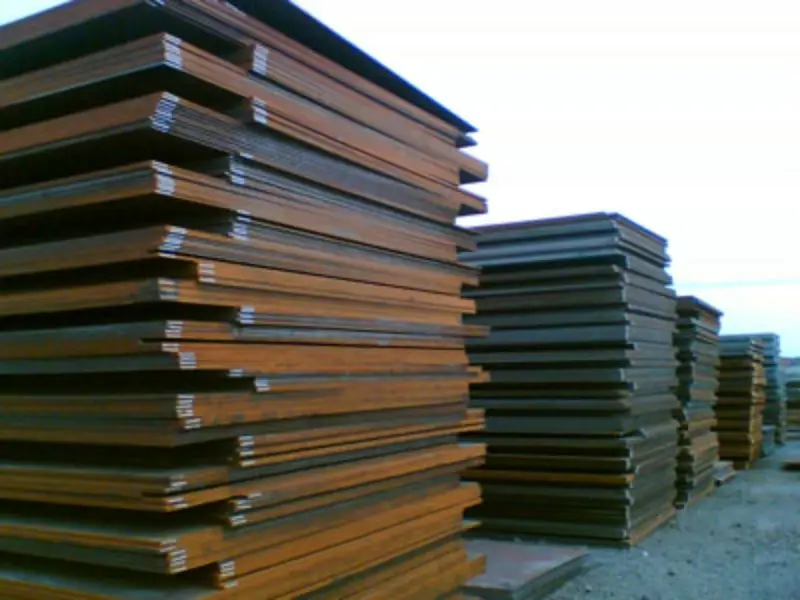
DNV Grade F420 Shipbuilding Steel Plate
DNV Grade F420 Shipbuilding Steel Plate - Ultra-High Strength Marine Steel for Arctic Applications
DNV Grade F420 is a normalised and tempered fine-grain shipbuilding steel plate with a minimum yield strength of 420 MPa, certified by DNV GL for extreme low-temperature environments (-60°C impact toughness). Ideal for hull structures, offshore platforms, and polar vessels.
Suitable for welding (all common processes – SAW, SMAW, GMAW, FCAW), hot and cold forming, cutting, straightening, and machining. Preheating is generally not required for moderate thicknesses due to controlled carbon equivalent.
- Phone : +8618037372205
- Email : [email protected]
- WhatsApp: Contact via Whtsapp
- WeChat: +8618037372205
DNV Grade F420 Shipbuilding Steel Plate Introduction
DNV Grade F420 is a high-strength structural steel plate specified by the DNV GL classification society for shipbuilding and offshore constructions. It belongs to the fine-grain, normalised and tempered (N/T) category, offering an excellent combination of high yield strength (minimum 420 MPa) and superior low-temperature toughness. The 'F' designation indicates guaranteed impact properties down to -60°C, making it suitable for vessels operating in Arctic and harsh cold climates.
- Key attributes: High tensile strength (530–680 MPa), good weldability with low carbon equivalent (CEV), and excellent crack-propagation resistance due to fine-grain microstructure (typically achieved through microalloying with Nb, V, Ti).
- Thickness range: Usually supplied up to 100 mm, with consistent mechanical properties throughout the thickness.
- F420 plates are produced to DNV rules Pt.2 Ch.1 or equivalent, ensuring full traceability, ultrasonic testing, and strict control of phosphorus and sulfur to minimise embrittlement.
DNV Grade F420 Shipbuilding Steel Plate Chemical Composition
The chemical composition of DNV F420 is tightly controlled to ensure weldability and low-temperature toughness. It is based on microalloyed C-Mn steel with elements like niobium, vanadium, and titanium for grain refinement. Maximum limits for phosphorus and sulfur are extremely low to avoid embrittlement. The values below are according to DNV rules for thicknesses ≤ 100 mm.
| Chemical element | Standard value (wt%) | Remarks |
|---|---|---|
| Carbon (C) | ≤ 0.16 | Ladle analysis; lower C improves weldability |
| Silicon (Si) | 0.10 – 0.50 | Deoxidation element |
| Manganese (Mn) | 0.90 – 1.60 | Strength and toughness |
| Phosphorus (P) | ≤ 0.020 | Strict limit to prevent cold shortness |
| Sulfur (S) | ≤ 0.015 | Low S for improved through-thickness properties |
| Chromium (Cr) | ≤ 0.20 | Residual element |
| Molybdenum (Mo) | ≤ 0.08 | Optional |
| Nickel (Ni) | ≤ 0.40 | May be added for toughness |
| Copper (Cu) | ≤ 0.35 | Residual |
| Aluminium (Al, total) | ≥ 0.015 | Grain refinement, acid-soluble Al also acceptable |
| Niobium (Nb) | 0.02 – 0.05 | Microalloy for fine-grain strengthening |
| Vanadium (V) | 0.05 – 0.10 | Microalloy for precipitation strengthening |
| Titanium (Ti) | 0.007 – 0.02 | Grain refinement, also fixes N |
| Nitrogen (N) | ≤ 0.012 | Controlled to avoid detrimental nitrides |
| Carbon Equivalent (CEV) | ≤ 0.42 typical | CEV = C + Mn/6 + (Cr+Mo+V)/5 + (Ni+Cu)/15 (usually ≤ 0.42 for ≤100 mm) |
DNV Grade F420 Shipbuilding Steel Plate Thermal and Electrical Physical Properties
These physical properties are typical for a low-alloy tempered structural steel similar to F420. They are not part of mandatory DNV inspection but serve as design guidelines. Values may vary slightly with supplier and exact chemical batch. Conditions: tested at room temperature and ambient pressure unless stated.
| Property | Typical value | Unit | Temperature / Condition |
|---|---|---|---|
| Density (ρ) | 7850 | kg/m³ | 20°C |
| Modulus of elasticity (E) | 207 | GPa | 20°C |
| Shear modulus (G) | 79.3 | GPa | 20°C (calculated from E and ν) |
| Poisson's ratio (ν) | 0.30 | – | 20°C |
| Thermal expansion coefficient (α) | 11.7 | 10⁻⁶ /K | 20–100°C |
| Thermal conductivity (λ) | ~50 | W/(m·K) | 20°C |
| Specific heat capacity (c) | 460 | J/(kg·K) | 20–100°C |
| Electrical resistivity (ρe) | 0.25 – 0.30 | 10⁻⁶ Ω·m | 20°C |
DNV Grade F420 Shipbuilding Steel Plate Mechanical Properties
Mechanical tests are performed on transverse specimens in accordance with DNV GL test requirements. For plate thicknesses ≤ 100 mm the specified values are guaranteed. Impact energy is measured on Charpy V‑notch specimens at -60°C. All values are minimum values unless stated otherwise.
| Property | Standard requirement | Unit | Test condition / Remarks |
|---|---|---|---|
| Yield strength (ReH) | ≥ 420 | MPa | For thickness 5–100 mm (transverse) |
| Tensile strength (Rm) | 530 – 680 | MPa | Transverse specimen |
| Elongation (A5 ) | ≥ 19 | % | Gauge length 5.65√S₀, transverse, thickness ≤ 100 mm |
| Bend test (180°) | No cracks or defects | – | Bend diameter: 2t (t ≤ 50 mm), 3t (50 < t ≤ 100 mm) |
| Impact energy (KV2), longitudinal | ≥ 27 (average), ≥ 20 (single min.) | J | Charpy V-notch at -60°C |
| Impact energy (KV2), transverse | ≥ 20 (average), ≥ 14 (single min.) | J | Charpy V-notch at -60°C, when transverse testing is specified |
DNV Grade F420 Shipbuilding Steel Plate Fully Equivalent Material Standards and Substitutable Grades
| Country/Region | Standard | Grade | Remarks |
|---|---|---|---|
| International (ABS) | ABS Rules for Materials and Welding | FH42 | Identical minimum yield 420 MPa, -60°C impact |
| International (LR) | Lloyd's Register Rules | FH42 | Same strength and toughness class |
| International (BV) | Bureau Veritas Rules | FH42 | Fully equivalent to DNV F420 |
| China | CCS Rules for Materials | FH420 | Direct equivalent for Chinese classification |
| Japan (NK/ClassNK) | NK Rules | FH420 | NK grade FH420 matches F420 |
| Italy (RINA) | RINA Rules | FH420 | Corresponds to DNV F420 |
| Korea (KR) | Korean Register Rules | FH420 | Equivalent shipbuilding plate |
| Russia (RS) | Russian Maritime Register Rules | FH420 | Equivalent grade for polar ships |
DNV Grade F420 Shipbuilding Steel Plate Application Introduction
DNV F420 steel plates are specifically developed for advanced shipbuilding and offshore engineering where a combination of high strength, excellent cold toughness, and reliable weldability is mandatory. The material can be processed by cutting, cold forming, and all manual and automated welding techniques. Preheating (typically to 75–125°C) is recommended only for high restraint joints or very thick sections (> 50 mm) to avoid hydrogen-induced cracking. Due to its fine-grain structure, F420 shows good resistance to lamellar tearing provided Z-quality plates are ordered when through‑thickness loading occurs.
- Welding consumables: Should match tensile strength (e.g., E5518, ER80S-G) and be low-hydrogen to guarantee toughness in the HAZ.
- Corrosion protection: Standard marine painting systems are effective; the smooth surface finish after normalising facilitates coating adhesion.
Product Applications: Hull plates for ice belt regions, Deck and bottom structural members, Longitudinal stiffeners and web frames, Offshore platform topsides and substructure, Column and bracing elements for semi-submersibles, Heavy-duty crane pedestal box structures
Processed into products: Shell plates in ice-reinforced zones, Bilge strakes and sheer strakes, Keel plates, Transverse and longitudinal girders, Rudder horns and sternframe components, Windlass foundations, Mooring system support plates, Legs and spudcans of jack-up units (when thickness allows)
Application industries: Shipbuilding (icebreakers, LNG carriers, Arctic supply vessels), Offshore oil & gas (platforms, FPSOs, jack-up rigs), Marine engineering (wind turbine foundations, port cranes), Polar and cold-region infrastructure, Heavy-lift and special-purpose vessels
DNV Grade F420 Shipbuilding Steel Plate Similar / Alternative Materials with Close Properties
| Country/Region | Standard | Grade | Remarks |
|---|---|---|---|
| International | EN 10025-6 | S420QL / S420QL1 | Quenched and tempered structural steel with YS 420 MPa, min. -40°C impact; not marine certified but similar weldable high-strength steel. |
| International (ABS) | ABS Rules | FH46 | Higher strength grade (YS 460 MPa) but same -60°C toughness; can be used for heavier load but requires adjusted design. |
| International (DNV) | DNV GL Rules | F460 | Next strength level (YS 460 MPa) in the same fine-grain series; may be considered when higher strength is beneficial. |
| International | API 2Y-60 | 2Y-60 | Offshore structural steel plate with YS ~414 MPa (60 ksi) in thickness ≤ 2 in.; high toughness, used in platform construction, but certification differs. |
Notes:
- When ordering, the required through-thickness (Z‑35 or Z‑25) properties must be specified separately if the component is subjected to high strain in the thickness direction.
- For TMCP (Thermo-Mechanical Control Process) delivered plates, the supplier must demonstrate that the strength and toughness requirements are met without normalising, which may allow reduced alloy content and improved weldability.
- All plates are typically supplied with ultrasonic testing (UT) according to DNV class; acceptance criteria should be agreed (e.g., EN 10160 class S2/E2 or ASTM A578 level C).
- Surface inspection and marking per DNV rules are mandatory; each plate is stamped with the grade (F420), heat number, and classification marks.
- Share



