
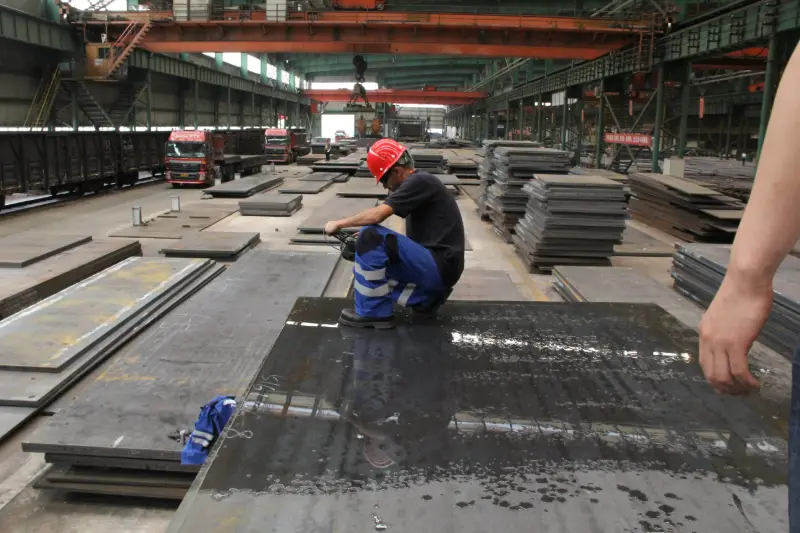
DNV Grade A460 High-Strength Shipbuilding Steel Plate
DNV Grade A460 Shipbuilding Steel Plate: High Strength Marine Structural Material
DNV Grade A460 is a normalized or thermomechanically rolled high strength steel for shipbuilding with minimum yield strength of 460 MPa. It provides excellent weldability and toughness for marine structures.
Welding, bending, cutting, forming, machining
- Phone : +8618037372205
- Email : [email protected]
- WhatsApp: Contact via Whtsapp
- WeChat: +8618037372205
DNV Grade A460 High-Strength Shipbuilding Steel Plate Introduction
DNV Grade A460 is a high-strength structural steel plate classified under the DNV (Det Norske Veritas) rules for shipbuilding. It offers a minimum yield strength of 460 MPa and is designed for use in critical welded structures such as hulls, decks, and offshore platforms. The 'A' designation indicates the impact test temperature at 0°C, ensuring reliable toughness in cold marine environments. The steel is supplied in normalized (N) or thermomechanically controlled processed (TMCP) condition, with tight control over carbon equivalent (Ceq) to guarantee excellent weldability. Typical applications include heavy-duty ship frames and high-stress components where weight reduction and high strength are crucial.
DNV Grade A460 High-Strength Shipbuilding Steel Plate Chemical Composition
The chemical composition of DNV A460 is strictly controlled to achieve high strength, good toughness and weldability. Elements like Nb, V, Al, Ti are used for grain refinement and micro-alloying. Maximum limits are given unless a range is specified.
| Element | Typical / Max Value (%) | Remarks |
|---|---|---|
| Carbon (C) | ≤ 0.18 | Ladle analysis maximum |
| Silicon (Si) | ≤ 0.50 | - |
| Manganese (Mn) | 0.90 – 1.60 | Depending on thickness and delivery condition |
| Phosphorus (P) | ≤ 0.025 | - |
| Sulfur (S) | ≤ 0.025 | - |
| Aluminum (Al, total) | ≥ 0.015 | Typically 0.020 – 0.050, grain refining |
| Niobium (Nb) | 0.02 – 0.05 | Microalloying; may be partly replaced by V+Ti |
| Vanadium (V) | ≤ 0.10 | Optional microalloying |
| Titanium (Ti) | ≤ 0.05 | Nitrogen binding, grain refinement |
| Nitrogen (N) | ≤ 0.012 | For thermomechanically rolled grades, ≤ 0.009 often applied |
| Chromium (Cr) | ≤ 0.25 | Maximum from scrap or intentional addition |
| Nickel (Ni) | ≤ 0.30 | - |
| Molybdenum (Mo) | ≤ 0.08 | - |
| Copper (Cu) | ≤ 0.35 | - |
| Carbon Equivalent (CEV) | ≤ 0.43 | Based on ladle analysis, typical practical value 0.38 – 0.42 |
DNV Grade A460 High-Strength Shipbuilding Steel Plate Thermal & Electrical Physical Properties
Physical properties for DNV A460 are typical for low-alloy structural steel. Values apply at room temperature unless stated. These are not specified in the product standard but are representative for design purposes.
| Property | Typical Value | Unit | Test Condition |
|---|---|---|---|
| Density (ρ) | 7850 | kg/m³ | 20°C |
| Modulus of Elasticity (E) | 205 | GPa | 20°C, longitudinal |
| Shear Modulus (G) | 80 | GPa | 20°C |
| Poisson's Ratio (ν) | 0.3 | - | 20°C |
| Thermal Expansion Coefficient (α) | 12.0 | 10⁻⁶/K | 20 – 100°C |
| Thermal Expansion Coefficient (α) | 12.5 | 10⁻⁶/K | 20 – 200°C |
| Thermal Expansion Coefficient (α) | 13.0 | 10⁻⁶/K | 20 – 300°C |
| Thermal Conductivity (λ) | 50 | W/(m·K) | 20°C |
| Thermal Conductivity (λ) | 45 | W/(m·K) | 100°C |
| Specific Heat Capacity | 460 | J/(kg·K) | 20°C |
| Electrical Resistivity (ρe) | 0.25 | 10⁻⁶ Ω·m | 20°C |
DNV Grade A460 High-Strength Shipbuilding Steel Plate Mechanical Properties
Mechanical properties are guaranteed at ambient temperature for plates up to a certain thickness. The yield strength (ReH) is the main classification criterion. Impact test energy (KV) is verified at 0°C for grade 'A'. Values refer to transverse specimens unless noted.
| Property | Standard Requirement | Unit | Test Condition / Thickness |
|---|---|---|---|
| Yield Strength (ReH) | ≥ 460 | MPa | t ≤ 50 mm, transverse, ambient |
| Yield Strength (ReH) | ≥ 440 | MPa | 50 < t ≤ 100 mm, transverse |
| Tensile Strength (Rm) | 570 – 720 | MPa | t ≤ 100 mm, transverse |
| Elongation (A5) | ≥ 17 | % | Gauge length 5.65√So, transverse |
| Impact Energy (KV) | ≥ 27 (longitudinal) | J | 0°C, Charpy V-notch, t ≤ 50 mm |
| Impact Energy (KV) | ≥ 20 (transverse) | J | 0°C, Charpy V-notch, t ≤ 50 mm (if agreed) |
| Bend Test (mandrel diameter) | 3t (t = plate thickness) | - | 180°, no cracks, for acceptance testing |
DNV Grade A460 High-Strength Shipbuilding Steel Plate Fully Equivalent International Standards and Replaceable Grades
The following ship classification society grades are directly equivalent to DNV A460 in strength level, impact test condition, and general application. They are considered interchangeable for marine structural use.
| Country / Region | Standard / Society | Grade | Remarks |
|---|---|---|---|
| USA | ABS (American Bureau of Shipping) | ABS AQ460 | Identical minimum yield 460 MPa, impact 0°C (Q for Quenched/Tempered, but equivalents exist for TMCP/N) |
| UK | LR (Lloyd's Register) | LR AH460 | A grade for 0°C impact; AH460 for higher strength |
| France | BV (Bureau Veritas) | BV A460 | Same mechanicals, 'A' symbolizes 0°C |
| China | CCS (China Classification Society) | CCS A460 | Direct equivalent under CCS rules |
| Japan | NK (ClassNK) | NK KA460 | KA460 corresponds to A-grade, 0°C impact |
| South Korea | KR (Korean Register) | KR RA460 | RA460 is equivalent to A460 |
| Italy | RINA | RINA A460 | Matched grade and impact class |
| Russia | RS (Russian Maritime Register) | RS A460 | Alignment with DNV rules |
| Europe | EN 10025-6 | S460ML | Not a classification society grade but a thermomechanically rolled structural steel with minimum 460 MPa and similar toughness; can be used with society approval |
DNV Grade A460 High-Strength Shipbuilding Steel Plate Application Introduction
DNV A460 is specifically developed for critical structural components in marine and offshore engineering. Its high strength-to-weight ratio enables reduced plate thickness, leading to lighter vessels and lower fuel consumption. The grade is weldable using all standard methods and exhibits good cold-forming properties. It is essential to follow approved welding procedures and preheating guidelines to avoid hydrogen-induced cracking in thick sections.
Product Applications: Complete ship hulls and superstructures, Oil platform topsides and substructures, Mooring brackets and chain stopper foundations, Bollards and towing gear, Ballast water tanks and structural bulkheads, Padeyes and lifting lugs for offshore installation
Processed into products: Solid and built-up I-beams for ship frames, Stiffeners, girders, and stringers, Rudder horns and rudder stocks, Propeller shaft brackets, Deck crane pedestals, Bracket plates with high fatigue loads, Jack-up rig leg chords, Submerged arc welded (SAW) pipes for structural columns
Application industries: Commercial shipbuilding (container ships, tankers, bulk carriers), Naval shipbuilding, Offshore oil & gas platforms (jacket legs, deck structures), Renewable offshore wind (transition pieces, monopiles), Heavy lifting and transport vessels (crane barges, heavy lift ships), Port and harbor machinery
DNV Grade A460 High-Strength Shipbuilding Steel Plate Near-Equivalent Substitute Materials
| Country / Region | Standard / Specification | Grade | Remarks |
|---|---|---|---|
| International | EN 10025-6 | S460M / S460ML | Hot-rolled fine-grain steel; TMCP condition; similar yield/tensile and impact properties at -20°C or -50°C; may need supplementary approval for marine use. |
| International | EN 10025-3 | S460N / S460NL | Normalized fine-grain steel; similar strength but slightly different CEV; suitable for welded structures. |
| USA | ASTM A572 / A709 | Grade 65 (450 MPa min yield) | Lower strength; closest is A709 Grade 65, but yield 450 MPa. Not a direct substitute without thickness/design adjustment. |
| USA | API 2W / 2Y | Grade 60 (min yield 415 MPa) | Offshore structural steel plates; API 2Y-60 provides 415 MPa yield, not matching 460 MPa; but often used in similar environments. |
| Japan | JIS G 3106 | SM570 | Hot-rolled steel for welded structure; min tensile 570 MPa (yield typically approx 460 MPa for t≤16mm); requires verification for ship classification. |
| China | GB/T 712 | DQ63 | Chinese shipbuilding steel with min yield 460 MPa at a delivery condition 'D' (impact -20°C); DQ63 can be considered where better toughness needed. |
Notes:
Plate thickness tolerance and flatness according to DNV rules and EN 10029. Supplementary testing such as through-thickness tensile (Z35) or CTOD fracture toughness can be agreed upon. For TMCP delivery, reheat and hot rolling parameters must be strictly controlled to avoid strength loss during subsequent hot forming. The CEV maximum of 0.43% ensures good weldability without excessive preheat; however, for thicknesses above 50 mm, a preheat of 75–100°C and low-hydrogen consumables are recommended. Surface condition: free from cracks, scabs, and laminations per ultrasonic testing class S2/E2.
- Share



