
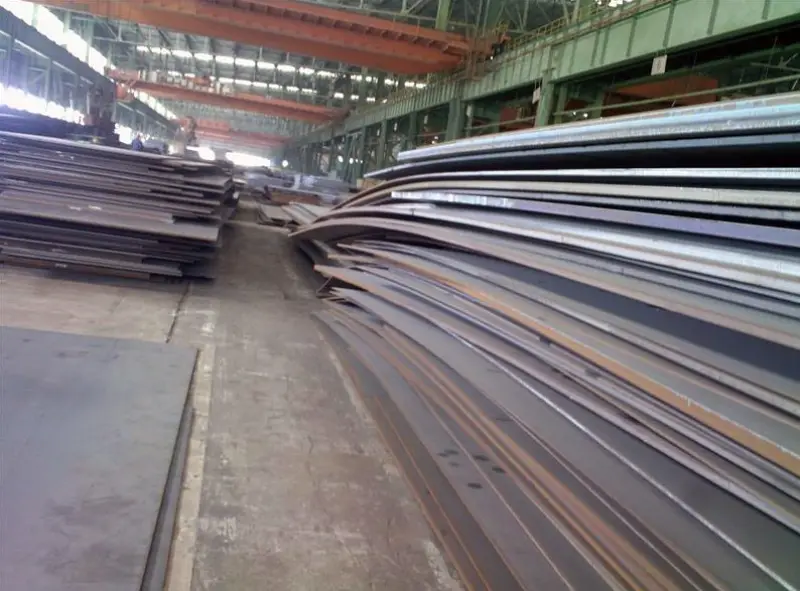
DNV Grade D460 Shipbuilding Steel Plate
DNV Grade D460 Shipbuilding Steel Plate – High Strength, Low Temperature Toughness & IACS Certified
DNV Grade D460 is a normalised or thermo-mechanically rolled high strength hull structural steel with minimum yield strength 460 MPa, certified by DNV. Designed for low-temperature toughness at -20°C, it meets strict classification society requirements for marine applications.
Hot rolling followed by normalising (N) or thermo-mechanical controlled processing (TMCP); cold forming and welding permitted with appropriate procedures
- Phone : +8618037372205
- Email : [email protected]
- WhatsApp: Contact via Whtsapp
- WeChat: +8618037372205
DNV Grade D460 Shipbuilding Steel Plate Introduction
DNV Grade D460 is a high-strength shipbuilding steel plate certified by DNV (Det Norske Veritas), complying with the IACS UR W11 unified requirements for hull structural steels. As a DH460 grade, it offers a minimum yield strength of 460 MPa for thicknesses up to 50mm and guaranteed Charpy V-notch impact toughness at -20°C. The steel is supplied in normalised (N) or thermo-mechanically rolled (TM) condition, providing an optimised balance of strength, weldability and ductility. Its fine-grained microstructure and controlled chemical composition deliver excellent resistance to brittle fracture, making it suitable for critical structural components in shipbuilding and offshore engineering.
- High yield strength reduces structural weight
- Superior low-temperature impact properties
- Good weldability with proper heat input control
- Fully certified for maritime and offshore applications
DNV Grade D460 Shipbuilding Steel Plate Chemical Composition
Typical chemistry according to DNV rules and IACS UR W11 for DH460 high strength structural steel. Fine grain elements (Al, Nb, V, Ti) may be used individually or in combination to achieve the required yield strength and toughness. Carbon Equivalent (CEV) is controlled to ensure good weldability.
| Chemical Elements | Standard Value | Remarks |
|---|---|---|
| C (Carbon) | ≤ 0.20 | Ladle analysis |
| Si (Silicon) | ≤ 0.55 | Ladle analysis |
| Mn (Manganese) | 0.70 – 1.70 | Ladle analysis |
| P (Phosphorus) | ≤ 0.030 | Ladle analysis |
| S (Sulphur) | ≤ 0.030 | Ladle analysis |
| Al (Aluminium, acid soluble) | ≥ 0.015 | Minimum required for fine grain practice |
| Nb (Niobium) | ≤ 0.05 | Optional grain refiner |
| V (Vanadium) | ≤ 0.10 | Optional grain refiner |
| Ti (Titanium) | ≤ 0.03 | Optional grain refiner |
| Cu (Copper) | ≤ 0.35 | Residual element |
| Cr (Chromium) | ≤ 0.20 | Residual element |
| Ni (Nickel) | ≤ 0.40 | Residual element |
| Mo (Molybdenum) | ≤ 0.08 | Residual element |
| CEV (Carbon Equivalent) | ≤ 0.45 (typical) | CEV = C + Mn/6 + (Cr+Mo+V)/5 + (Ni+Cu)/15 |
DNV Grade D460 Shipbuilding Steel Plate Physical & Thermal Properties
These are typical values for carbon-manganese microalloyed high strength structural steels at room temperature, unless otherwise specified. They are not mandatory requirements of the DNV standard but are useful for design calculations.
| Property | Typical Value | Unit | Test Condition |
|---|---|---|---|
| Density (ρ) | 7.85 | g/cm³ | 20°C |
| Modulus of elasticity (E) | 205 | GPa | 20°C |
| Shear modulus (G) | 81 | GPa | 20°C |
| Poisson's ratio (ν) | 0.3 | – | 20°C |
| Thermal expansion coefficient (α) | 11.5 × 10⁻⁶ | 1/K | 20 – 100°C |
| Thermal expansion coefficient (α) | 12.0 × 10⁻⁶ | 1/K | 20 – 200°C |
| Thermal expansion coefficient (α) | 12.5 × 10⁻⁶ | 1/K | 20 – 300°C |
| Thermal conductivity (λ) | 42 – 38 | W/(m·K) | 100 – 200°C |
| Specific heat capacity (c) | 460 – 500 | J/(kg·K) | 20 – 200°C |
| Electrical resistivity (ρₑ) | 0.22 – 0.3 | µΩ·m | 20°C |
DNV Grade D460 Shipbuilding Steel Plate Mechanical Properties
Mechanical requirements according to DNV rules and IACS UR W11 for DH460 plate. Values depend on thickness (t) and test piece orientation (usually transverse). Impact tests are carried out at -20°C on standard Charpy V-notch specimens.
| Property | Standard Requirement | Unit | Test Condition / Thickness |
|---|---|---|---|
| Yield Strength (ReH) | ≥ 460 | MPa | t ≤ 50 mm, transverse |
| Yield Strength (ReH) | ≥ 430 | MPa | 50 < t ≤ 70 mm, transverse |
| Yield Strength (ReH) | ≥ 410 | MPa | 70 < t ≤ 85 mm, transverse |
| Tensile Strength (Rm) | 570 – 720 | MPa | All thicknesses up to 85 mm, transverse |
| Elongation (A) | ≥ 17 | % | t ≤ 50 mm, gauge length 5.65√S₀ |
| Elongation (A) | ≥ 17 | % | 50 < t ≤ 70 mm, gauge length 5.65√S₀ |
| Elongation (A) | ≥ 17 | % | 70 < t ≤ 85 mm, gauge length 5.65√S₀ |
| Charpy V-notch impact energy (KV₂) | ≥ 41 (average) / ≥ 27 (single) | J | -20°C, longitudinal, t ≤ 50 mm |
| Charpy V-notch impact energy (KV₂) | ≥ 41 (average) / ≥ 27 (single) | J | -20°C, longitudinal, 50 < t ≤ 70 mm |
| Charpy V-notch impact energy (KV₂) | ≥ 41 (average) / ≥ 27 (single) | J | -20°C, longitudinal, 70 < t ≤ 85 mm |
| Bend test | No cracks or defects after bending 180° | – | Mandrel diameter = 3 × thickness (t ≤ 50 mm) |
DNV Grade D460 Shipbuilding Steel Plate Fully Equivalent Standards and Replaceable Grades
| Country / Region | Standard | Grade | Remarks |
|---|---|---|---|
| International | IACS UR W11 | DH460 | Unified requirement for hull structural steel, adopted by all IACS members |
| USA | ABS Rules | ABS DH460 | American Bureau of Shipping – identical toughness grade DH460 |
| France | BV Rules | BV DH460 | Bureau Veritas – DH460 grade |
| China | CCS Rules | CCS DH460 | China Classification Society – DH460 |
| UK | LR Rules | LR DH460 | Lloyd's Register – DH460 |
| Japan | NK Rules | NK DH460 | ClassNK – DH460 |
| Italy | RINA Rules | RINA DH460 | Registro Italiano Navale – DH460 |
| South Korea | KR Rules | KR DH460 | Korean Register – DH460 |
DNV Grade D460 Shipbuilding Steel Plate Application Introduction
DNV D460 steel is designed for heavily loaded structural members in ships and offshore installations where weight saving and high toughness under dynamic loading are essential. It is easily weldable with standard procedures, provided preheat and heat input are controlled according to thickness and carbon equivalent. Its balanced chemistry allows hot and cold forming within specified limits.
Product Applications: Main deck and bottom shell plating of large vessels, Side shell and longitudinal bulkheads of container ships and bulk carriers, Crane pedestals and heavy lift gear on offshore vessels, Ship frames, girders and stiffeners in high stress zones, Column and pontoon structures of semi-submersible rigs, Foundation nodes for offshore wind turbines (with additional certification)
Processed into products: Transverse and longitudinal stiffeners, Rudder horns and stern frames, Bitts, bollards and towing structures, Hatch coamings and corner plates, Crane rail support structures, Brackets and flange plates in hull girder connections, Offshore module support beams, Caisson and pile sleeve components
Application industries: Shipbuilding (commercial and naval), Offshore oil & gas (platforms, jack-up rigs, FPSO), Marine heavy engineering, Port & harbour infrastructure, Renewable energy (offshore wind foundations, transition pieces)
DNV Grade D460 Shipbuilding Steel Plate Similar / Substitute Steel Grades
| Country / Region | Standard | Grade | Remarks |
|---|---|---|---|
| Europe | EN 10025-4 | S460M/ML | Thermomechanically rolled weldable fine grain structural steel; similar strength and impact toughness at -20°C (ML). Requires classification society approval for marine application. |
| Europe | EN 10025-6 | S460Q/QL/QL1 | Quenched and tempered structural steels with high strength; suitable if toughness class matches. QL1 guarantees impact at -20°C. |
| International | API 2W Grade 60 | API 2W-60 | For offshore structures; minimum yield 415–450 MPa but not identical. Can be considered with engineering assessment. |
| Europe | EN 10225 | S460G2+Q/M | Weldable structural steels for fixed offshore structures; similar strength level and toughness categories. Usually requires qualification for ship hull construction. |
Notes:
Welding guidelines: Use low-hydrogen consumables matching the mechanical properties; heat input typically 1.5–3.5 kJ/mm; preheat may be required for thicknesses above 30 mm. Forming: Minimum cold forming radius 3t is recommended. Hot forming may alter mechanical properties; re-normalising may be necessary. Certification: Products are normally supplied with DNV material certificate 3.1 or 3.2 according to EN 10204. Additional testing such as through-thickness tensile (Z-properties) can be specified.
- Share



