
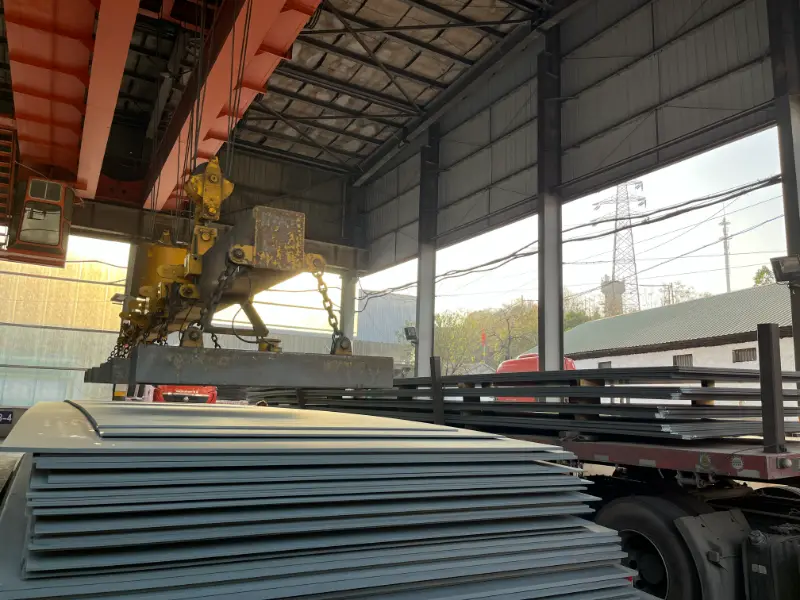
DNV Grade E460 Shipbuilding Steel Plate
DNV Grade E460 Shipbuilding Steel Plate: High-Strength Marine Steel for Extreme Arctic Conditions
Comprehensive material datasheet for DNV Grade E460 steel plate, featuring chemical composition, mechanical properties, thermal and electrical physical data, equivalent grades, and application guidance for shipbuilding and offshore engineering.
Cutting, welding (all common processes), cold and hot forming, bending, machining
- Phone : +8618037372205
- Email : [email protected]
- WhatsApp: Contact via Whtsapp
- WeChat: +8618037372205
DNV Grade E460 Shipbuilding Steel Plate Introduction
DNV Grade E460 is a high-strength structural steel plate specifically designed for shipbuilding and offshore constructions, certified according to the DNV Rules for Classification of Ships. The designation "460" indicates a minimum yield strength of 460 MPa, while the letter "E" denotes its excellent notch toughness at -40°C, making it suitable for structures operating in low-temperature environments, including polar and ice-class vessels.
This steel belongs to the extra-high-strength category of hull structural steels, providing an optimized balance of high strength, excellent weldability, and good formability. It is produced through controlled rolling, thermo-mechanical controlled processing (TMCP), or normalizing, ensuring fine grain structure and homogeneous mechanical properties across a wide thickness range. Its chemical composition is carefully designed with microalloying elements such as niobium, vanadium, and titanium, which contribute to grain refinement and precipitation strengthening while maintaining a low carbon equivalent (Ceq) to ensure good weldability without excessive preheating.
Typical applications include critical structural members of large container ships, bulk carriers, icebreakers, offshore platforms, and wind turbine foundations. The steel fully complies with the International Association of Classification Societies (IACS) Unified Requirements for high-strength ship steel, guaranteeing global acceptance and interchangeability with equivalent grades from other major classification societies.
DNV Grade E460 Shipbuilding Steel Plate Chemical Composition
Chemical composition requirements according to DNV rules for Grade E460. Values are maximum unless a range is specified. For thicknesses up to 100 mm. Microalloying elements are typically added to achieve the required mechanical properties while keeping the carbon equivalent low for superior weldability. The carbon equivalent (Ceq) is calculated using the formula Ceq = C + Mn/6 + (Cr+Mo+V)/5 + (Ni+Cu)/15 and is limited to ensure cold-cracking resistance during welding.
| Chemical Element | Standard Value | Remarks |
|---|---|---|
| Carbon (C) | ≤0.20 | Ladle analysis |
| Silicon (Si) | 0.10–0.55 | |
| Manganese (Mn) | 0.90–1.70 | Typical range; min. 0.90 for deoxidation |
| Phosphorus (P) | ≤0.025 | |
| Sulfur (S) | ≤0.025 | |
| Chromium (Cr) | ≤0.20 | |
| Nickel (Ni) | ≤0.40 | |
| Molybdenum (Mo) | ≤0.08 | |
| Copper (Cu) | ≤0.35 | |
| Aluminium (Al) | ≥0.020 | Total aluminium; required for grain refinement |
| Niobium (Nb) | 0.02–0.05 | |
| Vanadium (V) | 0.05–0.10 | |
| Titanium (Ti) | ≤0.02 | |
| Nitrogen (N) | ≤0.012 | If sufficient amounts of Al, Ti, or Nb are present |
| Carbon Equivalent (Ceq) | ≤0.47 (t ≤ 50 mm) ≤0.48 (50 < t ≤ 100 mm) | Based on ladle analysis; guarantee of weldability |
DNV Grade E460 Shipbuilding Steel Plate Thermal and Electrical Physical Properties
Typical physical properties for high-strength structural steel with similar composition. These values are not mandatory in the DNV standard but are representative for general engineering calculations. Density is assumed at 20°C; thermal expansion and conductivity depend slightly on temperature and delivery condition.
| Property | Typical Reference Value | Unit | Test Condition |
|---|---|---|---|
| Density (ρ) | 7.85 | g/cm³ | 20°C |
| Modulus of Elasticity (E) | 205 | GPa | 20°C, quasi-static |
| Shear Modulus (G) | 79 | GPa | 20°C, derived from E and Poisson ratio |
| Poisson's Ratio (ν) | 0.30 | — | Elastic range |
| Thermal Expansion Coefficient (α) 20–100°C 20–200°C 20–300°C | 11.7 12.3 12.9 | 10-6/K | Mean linear expansion |
| Thermal Conductivity (λ) | 45 | W/(m·K) | 20°C |
| Specific Heat Capacity (c) | 460 | J/(kg·K) | 20°C |
| Electrical Resistivity (ρe) | 2.5 × 10⁻⁷ | Ω·m | 20°C; approx. 0.25 µΩ·m |
DNV Grade E460 Shipbuilding Steel Plate Mechanical Properties
Mechanical strength and toughness requirements for DNV E460 plates at ambient temperature. The test direction is transverse unless otherwise agreed. Elongation values are for longitudinal specimens; for transverse tests the requirement is typically 2% lower. Charpy V-notch impact energy is guaranteed at -40°C for the E grade.
| Property | Standard Requirement | Unit | Test Condition |
|---|---|---|---|
| Yield Strength (ReH) | ≥460 ≥440 ≥420 | MPa | Thickness t [mm]: t ≤ 50 50 < t ≤ 70 70 < t ≤ 100 |
| Tensile Strength (Rm) | 570–720 | MPa | All thicknesses up to 100 mm |
| Elongation (A) | ≥17 ≥17 ≥17 | % | Thickness t [mm]: t ≤ 50 50 < t ≤ 70 70 < t ≤ 100; gauge length L0=5.65√S |
| Bend Test | No cracks (180° bend) No cracks (180° bend) | t ≤ 50 mm: d = 3a 50 < t ≤ 100 mm: d = 4a (a=plate thickness) | |
| Charpy Impact Energy (KV) – Longitudinal | ≥27 (average of 3 tests) | J | Temperature: -40°C; specimen 10x10 mm |
| Charpy Impact Energy (KV) – Transverse | ≥20 (average of 3 tests) | J | Temperature: -40°C; when transverse testing is specified |
DNV Grade E460 Shipbuilding Steel Plate Completely Equivalent Material Standards and Replaceable Grades
| Country / Region | Standard | Grade | Remarks |
|---|---|---|---|
| Norway (DNV) | DNV Rules / DNV-OS-B101 | E460 | Original grade |
| United Kingdom (LR) | Lloyd's Register Rules | EH46 | IACS unified grade; high strength, -40°C |
| USA (ABS) | American Bureau of Shipping Rules | EH46 | Equivalent E-grade |
| France (BV) | Bureau Veritas Rules | EH46 | High strength hull steel |
| China (CCS) | China Classification Society Rules | EH460 | E-grade, 460 MPa grade |
| Japan (NK) | Nippon Kaiji Kyokai Rules (ClassNK) | KE460 | Identical mechanical requirements |
| Korea (KR) | Korean Register of Shipping | REH460 | IACS equivalent |
| Italy (RINA) | RINA Rules | EH460 | High strength grade for marine structures |
| Russia (RS) | Russian Maritime Register of Shipping | E460 | Equivalent to DNV E460 |
| IACS | IACS Unified Requirement UR W11 | E460 | International standard basis |
DNV Grade E460 Shipbuilding Steel Plate Application Introduction
DNV Grade E460 steel plates are essential in modern shipbuilding and offshore engineering, especially where an optimal strength-to-weight ratio and reliable toughness at low temperatures are required. The steel is used in a wide variety of large welded structures and can be processed with conventional workshop methods. Its high strength allows for lighter constructions, leading to increased payload and improved fuel efficiency.
Product Applications: Container ships and bulk carriers, Oil tankers and chemical carriers, Icebreakers and polar supply ships, Semi-submersible and jack-up drilling rigs, Offshore accommodation platforms (flotels), Monopile and jacket foundations for offshore wind turbines, Heavy-lift crane pedestals and structures
Processed into products: Main deck and strength deck plates, Bottom shell and side shell plates, Web frames and stringers, Bulkhead plates and stiffeners, Hatch coamings and crane rails, Legs and spudcans of jack-up units, Reinforced brackets and node joint plates, Longitudinal girders and transverse beams
Application industries: Shipbuilding and ship repair, Offshore oil & gas platforms, Renewable energy – offshore wind turbine foundations, Arctic and Antarctic ice-capable vessels, Heavy engineering and crane construction, Marine infrastructure (quay walls, lock gates, etc.)
DNV Grade E460 Shipbuilding Steel Plate Similar / Comparable Alternative Material Recommendations
| Country / Region | Standard | Grade | Remarks |
|---|---|---|---|
| EU | EN 10025-3 | S460N | Normalized structural steel, min. yield 460 MPa, comparable toughness class (-40°C available as S460NL); not specifically certified for marine use |
| EU | EN 10025-4 | S460M | Thermomechanically rolled, similar strength; suitable for offshore structures when ordered with Z-test and toughness requirements |
| China | GB/T 1591 | Q460D | High strength low alloy steel; yield 460 MPa, impact at -20°C; for Arctic service choose Q460E (-40°C); requires additional ship classification approval |
| International | ISO 4950-2 | S460N | High yield strength flat products; similar mechanicals, but delivered in normalized condition, not directly certified for shipbuilding |
Notes:
Welding recommendations: Preheat is generally not required for plate thicknesses below ~50 mm at ambient temperatures due to the low carbon equivalent. For thicker sections or high humidity conditions, a preheat of 50–100°C is advised. Low hydrogen welding consumables matching the strength class (e.g., AWS A5.28 ER100S-G) should be used.
Further processing: E460 steel shows good cold formability; a minimum bending radius of 3t (t = thickness) for transverse bends and 2t for longitudinal bends is recommended. Hot forming, if performed, should be followed by subsequent normalizing or stress-relieving heat treatment to restore mechanical properties.
Testing and documentation: All plates are delivered with inspection certificates per EN 10204 Type 3.1 or 3.2. Ultrasonic testing according to EN 10160 or ASTM A578 may be agreed upon for critical applications. Classification society surveyor involvement is mandatory for ships subject to class rules.
- Share



