
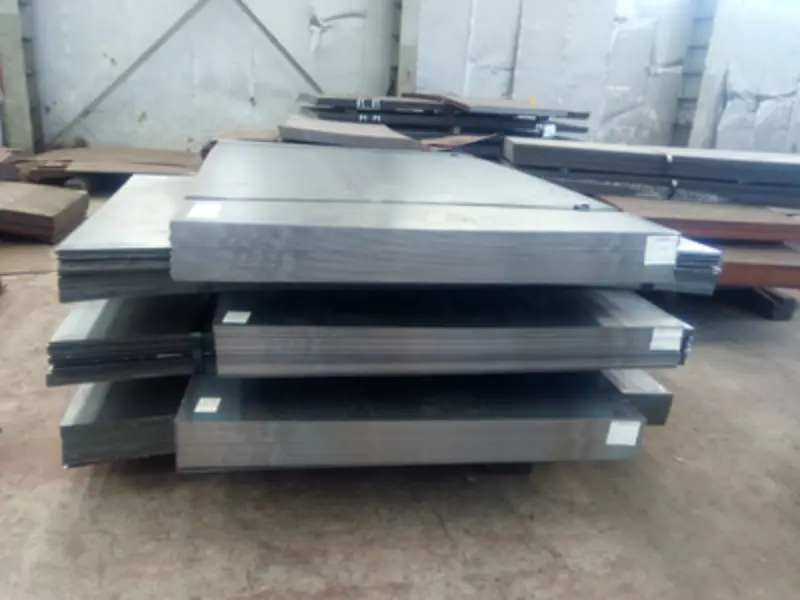
DNV Grade F460 Shipbuilding Steel Plate
DNV Grade F460 Shipbuilding Steel Plate - High Strength Structural Steel for Marine & Offshore Engineering
Comprehensive material data for DNV Grade F460 shipbuilding steel plate: chemical composition, mechanical and physical properties, equivalent standards, and application guide.
Cutting, bending, welding (SMAW, SAW, GMAW), machining, cold forming, hot forming (controlled)
- Phone : +8618037372205
- Email : [email protected]
- WhatsApp: Contact via Whtsapp
- WeChat: +8618037372205
DNV Grade F460 Shipbuilding Steel Plate Introduction
DNV Grade F460 is a high-strength structural shipbuilding steel plate certified by Det Norske Veritas (DNV), now DNV GL. It belongs to the normalized or thermomechanically rolled fine-grain steel category with a minimum yield strength of 460 MPa. Designed for demanding marine and offshore structures, F460 offers excellent low-temperature toughness down to -60°C (Grade F), good weldability, and high resistance to brittle fracture. It is widely used in hulls, decks, and critical structural members of ships, offshore platforms, and other marine engineering projects. The steel is typically delivered in a normalized or thermomechanically rolled condition, often with reduced carbon equivalent to enhance weldability and fabrication reliability.
DNV Grade F460 Shipbuilding Steel Plate Chemical Composition
Chemical composition requirements according to DNV rules for Grade F460. The steel is microalloyed with Nb, V, Ti to achieve fine grain and high strength. Carbon equivalent (CEV) is controlled to ensure weldability, typically CEV ≤ 0.45–0.48 depending on thickness.
- F: Specifies -60°C impact toughness grade.
- Microalloying elements may be added singly or in combination.
| Element | Standard Value (max, %) unless range | Remarks |
|---|---|---|
| Carbon (C) | ≤ 0.18 | Deoxidized fine-grain steel |
| Silicon (Si) | ≤ 0.55 | Killed with sufficient aluminum |
| Manganese (Mn) | 1.00 – 1.70 | Contributes to strength and toughness |
| Phosphorus (P) | ≤ 0.025 | |
| Sulfur (S) | ≤ 0.020 | |
| Aluminum (Al, total) | ≥ 0.015 | Grain refining |
| Niobium (Nb) | ≤ 0.05 | Microalloying element |
| Vanadium (V) | ≤ 0.12 | Microalloying element |
| Titanium (Ti) | ≤ 0.05 | Microalloying element |
| Chromium (Cr) | ≤ 0.25 | Residual / optional |
| Nickel (Ni) | ≤ 0.80 | Residual / optional |
| Copper (Cu) | ≤ 0.50 | Residual / optional |
| Molybdenum (Mo) | ≤ 0.50 | Residual / optional |
| Nitrogen (N) | ≤ 0.015 | Usually combined with Al |
| CEV (IIW) | ≤ 0.45 (t≤50mm) | Carbon equivalent for weldability |
DNV Grade F460 Shipbuilding Steel Plate Thermal and Electrical Physical Properties
Physical properties are typical for low-alloy high-strength structural steels. These values are not part of the mandatory DNV specification but serve as reliable engineering data for design and simulation. Thermal expansion and conductivity influence welding procedure and in-service performance; modulus of elasticity is essential for structural analysis.
| Property | Typical Value | Unit | Test Conditions / Remarks |
|---|---|---|---|
| Density (ρ) | 7.85 | g/cm³ | At 20°C |
| Young's Modulus (E) | 210 | GPa | At 20°C |
| Shear Modulus (G) | 81 | GPa | Calculated |
| Poisson's Ratio (ν) | 0.3 | – | In elastic range |
| Thermal Expansion Coefficient (α) | 12.0 × 10⁻⁶ | K⁻¹ | 20–100°C average |
| Thermal Expansion Coefficient (α) | 13.0 × 10⁻⁶ | K⁻¹ | 20–200°C average |
| Thermal Expansion Coefficient (α) | 13.8 × 10⁻⁶ | K⁻¹ | 20–300°C average |
| Thermal Conductivity (λ) | 48 | W/(m·K) | At 20°C |
| Thermal Conductivity (λ) | 44 | W/(m·K) | At 200°C |
| Specific Heat Capacity (cp) | 460 | J/(kg·K) | At 20°C |
| Electrical Resistivity (ρ_e) | 0.22 × 10⁻⁶ | Ω·m | At 20°C, typical for carbon steel |
DNV Grade F460 Shipbuilding Steel Plate Mechanical Properties
Mechanical properties at ambient temperature to DNV specifications. The tensile test is performed on flat specimens; impact test is done on Charpy-V specimens. Minimum values for yield and tensile strength apply to thickness ≤ 50 mm; for thicker sections (50–100 mm) a slight decrease in strength is allowed. Impact test temperature for Grade F is -60°C.
- Bend test: mandrel diameter = 3a (a = specimen thickness) for 180° bending.
- Through-thickness properties (Z-direction) available on request.
| Property | Standard Requirement | Unit | Test Conditions / Remarks |
|---|---|---|---|
| Yield Strength (ReH) | ≥ 460 | MPa | Thickness ≤ 50 mm, transverse |
| Yield Strength (ReH) | ≥ 440 | MPa | Thickness 50–100 mm, transverse |
| Tensile Strength (Rm) | 570 – 720 | MPa | Transverse |
| Elongation (A5) | ≥ 17 | % | Gauge length 5.65√S0 |
| Impact Energy (KV2) | ≥ 27 (average) | J | Longitudinal, -60°C |
| Impact Energy (KV2) | ≥ 20 (minimum single) | J | Longitudinal, -60°C |
| Impact Energy (KV2) | ≥ 20 (average) | J | Transverse, -60°C (optional) |
| Bend Test (180°) | d = 3a | No cracks, a = specimen thickness |
DNV Grade F460 Shipbuilding Steel Plate Fully Equivalent Material Standards and Replaceable Grade Recommendations
| Country/Region | Standard | Grade | Remarks |
|---|---|---|---|
| Europe | EN 10225:2009 | S460G2+M | Thermomechanically rolled, -60°C impact (Grade 2) |
| Europe | EN 10225:2009 | S460G1+QT | Quenched and tempered, -60°C (Grade 1) alternative |
| International | ISO 4950-2/3 | E460 | High yield strength structural steel, Type E (fine grain) |
| UK | Lloyd's Register Rules | LR F460 | Identical chemical and mechanical requirements |
| USA | ABS Rules | ABS F460 | ABS Grade F460, equivalent toughness and strength |
| France | Bureau Veritas Rules | BV F460 | F460 steel plate to BV classification |
| China | CCS Rules | CCS F460 | Equivalent ship steel governed by China Classification Society |
| DNV | DNV-OS-C401 | F460 | Original designation, offshore structural steel |
DNV Grade F460 Shipbuilding Steel Plate Application Introduction
DNV Grade F460 steel is engineered for the most severe marine environments, where a combination of high strength, excellent toughness at Arctic temperatures, and fatigue resistance is required. It is ideal for weight-critical structures without compromising safety. The steel can be processed by gas or plasma cutting, cold or hot forming, and all common welding methods with appropriate filler metals. Preheating and interpass temperature control are recommended based on thickness and carbon equivalent. Post-weld heat treatment may not be required for normalized grades but can be applied following qualified procedures.
Product Applications: Container ships, bulk carriers, and oil tankers, Icebreakers and polar supply vessels, FPSO (Floating Production, Storage and Offloading) units, Jack-up rigs and semi-submersible platforms, Offshore wind turbine transition pieces and foundations, Submarine pressure hulls and naval combatant structures
Processed into products: Main hull plates, shell plating, and deck plating, Longitudinal stiffeners, transverse frames, and stringers, Heavy-duty crane booms and pedestals, Hatch covers and coamings, Helicopter decks (helidecks) on offshore units, Mooring components and Padeyes, Structural nodes (castings or welded build-ups) in offshore jackets
Application industries: Shipbuilding and Ship Repair, Offshore Oil & Gas Exploration and Production, Renewable Energy (Offshore Wind, Tidal), Naval Defence & Coast Guard, Marine Heavy Lifting & Transportation, Arctic Engineering
DNV Grade F460 Shipbuilding Steel Plate Near/Similar Substitute Material Recommendations
| Country/Region | Standard | Grade | Remarks |
|---|---|---|---|
| China | GB/T 712 | F460 | Chinese ship steel with -60°C impact, similar strength range |
| Europe | EN 10025-6 | S460QL | Quenched and tempered structural steel, -20/ -40°C impact, high strength, may need higher impact qualifications |
| Europe | EN 10025-4 | S460ML | Thermomechanically rolled, -50°C impact, close to F460 when -60°C not mandatory |
| USA | ASTM A709 / A709M | Grade 50W / HPS 70W | Weathering steel for bridges, yield 345-485 MPa, not all satisfy -60°C toughness |
| Russia | GOST R 52927 | F460 | Marine steel grade comparable to DNV, often used in Arctic ships |
Notes:
- For thickness above 100 mm, special agreement with the classification society is often required. Mechanical properties may be slightly reduced; a design factor is applied.
- Z-direction (through-thickness) property: Z25 or Z35 to EN 10164 can be specified to avoid lamellar tearing in heavily restrained welded joints.
- Ultrasonic testing per EN 10160 or equivalent is normally mandatory for Class 1 structural usage.
- Material certificates (DNV 3.1B or 3.2) are issued by the mill and endorsed by the surveyor.
- Share



