
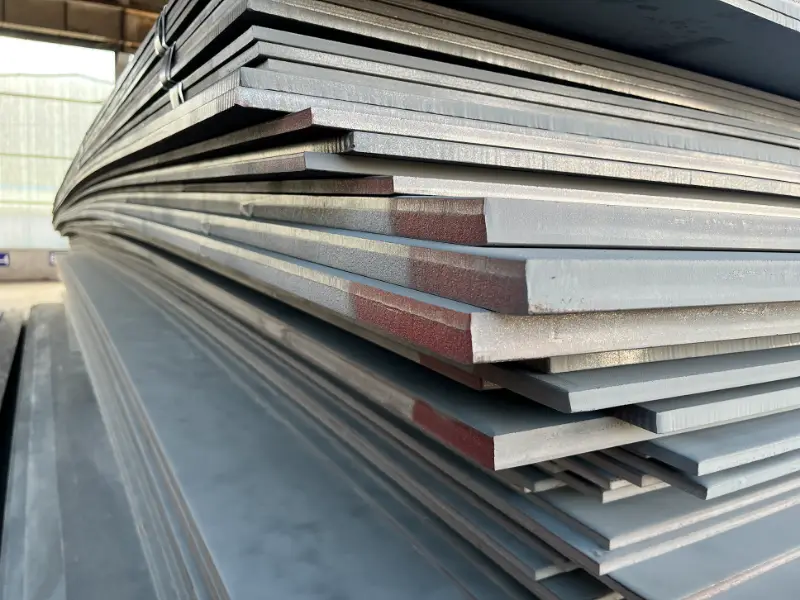
EN 10155 S355J0W Weathering Steel
EN 10155 S355J0W Weathering Steel: Properties, Equivalents & Applications Guide
Comprehensive material data for S355J0W structural weathering steel per EN 10155, including chemical composition, mechanical properties, physical data, and international equivalents for construction applications.
Hot Rolling, Cold Forming, Welding (all common methods), Mechanical Machining (Drilling, Milling, Turning)
- Phone : +8618037372205
- Email : [email protected]
- WhatsApp: Contact via Whtsapp
- WeChat: +8618037372205
EN 10155 S355J0W Weathering Steel Introduction
S355J0W is a weldable structural weathering steel defined under the European standard EN 10155, designed for enhanced resistance to atmospheric corrosion. The alloying elements, particularly copper, chromium, and nickel, promote the formation of a dense, adherent patina layer upon exposure to the environment. This protective layer significantly reduces the need for painting and maintenance compared to standard carbon structural steels. With a minimum yield strength of 355 MPa and a Charpy impact guarantee of 27 Joules at 0°C (designated by the 'J0'), it is ideally suited for load-bearing structures such as bridges, facades, and railway vehicles. Its combination of high strength, toughness, and corrosion resistance enables cost-effective, durable, and aesthetically pleasing architectural and engineering solutions.
EN 10155 S355J0W Weathering Steel Chemical Composition
The chemical composition of S355J0W steel as per EN 10155 is precisely balanced to ensure its weathering characteristics. Key elements like Copper (Cu), Chromium (Cr), and Nickel (Ni) are intentionally added to improve atmospheric corrosion resistance. The maximum carbon content is controlled to ensure good weldability. For carbon equivalent (CEV), a maximum value is typically agreed upon at the time of ordering.
| Chemical Element | Standard Value (%) | Remarks |
|---|---|---|
| Carbon (C) | ≤ 0.16 | Max |
| Silicon (Si) | ≤ 0.50 | Max |
| Manganese (Mn) | 0.50 - 1.50 | Range |
| Phosphorus (P) | ≤ 0.030 | Max |
| Sulfur (S) | ≤ 0.030 | Max |
| Chromium (Cr) | 0.40 - 0.80 | Range |
| Nickel (Ni) | ≤ 0.65 | Max |
| Copper (Cu) | 0.25 - 0.55 | Range |
| Nitrogen (N) | ≤ 0.012 | Max, 1.2% in total with other elements |
| Vanadium (V) | ≤ 0.12 | Max, 1.2% in total with other elements |
| Titanium (Ti) | ≤ 0.14 | Max, 1.2% in total with other elements |
| Aluminum (Al) | ≥ 0.020 | Min, total soluble, if added |
EN 10155 S355J0W Weathering Steel Thermal and Electrical Physical Properties
Physical properties presented are typical values for low-alloy structural steels at room temperature (20°C) unless specified otherwise. These properties are not part of the mandatory delivery standard but are crucial for engineering calculations involving thermal loading, heat transfer, and structural analysis. The values, such as density, elastic moduli, and thermal expansion, are standardized for design purposes.
| Physical Property | Standard Requirement Value | Unit | Test Condition |
|---|---|---|---|
| Density (ρ) | 7800 - 7850 | kg/m³ | At 20°C |
| Modulus of Elasticity (E) | 205 - 215 | GPa | At 20°C |
| Shear Modulus (G) | ≈ 80 | GPa | At 20°C |
| Poisson's Ratio (ν) | ≈ 0.30 | - | At 20°C |
| Thermal Expansion Coefficient (α) | ≈ 12.0 | 10⁻⁶/K | Range 20°C to 100°C |
| Thermal Expansion Coefficient (α) | ≈ 12.5 | 10⁻⁶/K | Range 20°C to 200°C |
| Thermal Expansion Coefficient (α) | ≈ 13.0 | 10⁻⁶/K | Range 20°C to 300°C |
| Thermal Conductivity (λ) | ≈ 45 - 50 | W/(m·K) | At 20°C |
| Specific Heat Capacity | ≈ 460 - 480 | J/(kg·K) | At 20°C |
| Electrical Resistivity (ρ_e) | ≈ 0.20 - 0.25 | µΩ·m | At 20°C |
EN 10155 S355J0W Weathering Steel Mechanical Properties
The following mechanical properties are specified for longitudinal samples with a thickness range of ≤ 16 mm unless otherwise noted. The impact test is performed on Charpy V-notch specimens at a test temperature of 0°C, designated by the J0 quality. Properties for greater thicknesses may differ and should be confirmed against the full standard. The minimum values apply to the delivery condition.
| Property | Standard Requirement Value | Unit | Test Condition |
|---|---|---|---|
| Upper Yield Strength (ReH) | ≥ 355 | MPa | Thickness ≤ 16 mm |
| Upper Yield Strength (ReH) | ≥ 345 | MPa | Thickness > 16 mm ≤ 40 mm |
| Upper Yield Strength (ReH) | ≥ 335 | MPa | Thickness > 40 mm ≤ 63 mm |
| Tensile Strength (Rm) | 470 - 630 | MPa | Thickness ≤ 100 mm |
| Elongation After Fracture (A) | ≥ 22 | % | Longitudinal, thickness ≤ 40 mm, L0=5.65√S0 |
| Elongation After Fracture (A) | ≥ 21 | % | Longitudinal, thickness > 40 mm ≤ 63 mm, L0=5.65√S0 |
| Impact Energy (KV2) | ≥ 27 | J | Transverse, at 0°C |
EN 10155 S355J0W Weathering Steel Complete Material Equivalents and Replaceable Grades
| Country/Region | Standard | Grade | Remarks |
|---|---|---|---|
| Germany | DIN 17119 / SEW 087 | WTSt 52-3 / 1.8961 | Chemically and mechanically equivalent structural weathering steel. |
| USA | ASTM A588 / A588M | Grade B / Grade K | High-strength low-alloy structural steel with atmospheric corrosion resistance. Yield strength is 345 MPa. |
| China | GB/T 4171 | Q355NHD | Structural weathering steel with similar designation system, matching mechanical properties. |
| Japan | JIS G3114 | SMA490AW / SMA490BW | Welded structural steel with enhanced atmospheric corrosion resistance. |
| Russia | GOST 19281 | 17G1S-U | Low-alloy structural steel, with special corrosion resistance denoted by U. |
EN 10155 S355J0W Weathering Steel Application Introduction
S355J0W is a versatile engineering material selected for its balance of strength, toughness, and cost-saving maintenance properties. In atmospheric environments, a protective rust-like patina develops, which seals the surface and slows further corrosion. It is not suitable for continuous immersion in water, marine splash zones, or chemically aggressive environments unless specifically assessed.
- Welding: Readily weldable using all common manual and automatic processes. Consumables should be selected to match the base metal's strength and corrosion resistance.
- Cold Forming: Suitable for cold forming operations like bending and rolling, following minimum bend radii guidelines expressed as a multiple of the plate thickness.
- Coating: While designed for bare use, the surface can be painted or coated if proper surface preparation is performed, though this negates the maintenance-free benefit of the patina.
Product Applications: Railway and highway bridges, Building facades and architectural structural frames, Freight wagons, containers, and passenger coach frames, Steel lighting poles and transmission towers, Sculptures and artistically exposed structural works, Chimneys and flue gas stacks (atmospheric zone)
Processed into products: Bridge box girder webs and flanges, Bolted and welded truss joints and main chords, Flanged tubular poles and lattice masts, Architectural steel wall panels and sunscreens, Rolled and welded structural angles, channels, and I-beams, Bent and press-braked structural brackets and gusset plates
Application industries: Infrastructure and Bridge Engineering, Architectural and Civil Construction, Railway Vehicle Manufacturing, Power Transmission and Telecommunications, Port and Harbor Structural Works (Atmospheric)
EN 10155 S355J0W Weathering Steel Recommendations for Similar or Proximate Substitute Materials
| Country/Region | Standard | Grade | Remarks |
|---|---|---|---|
| Europe | EN 10025-5 | S355J2W | A successor grade from the newer standard, with a finer impact guarantee at -20°C (J2) compared to J0 at 0°C. Slightly different thickness range properties may apply. |
| Europe | EN 10025-5 | S355K2W | Offers higher guaranteed toughness with impact energy of 40J at -20°C, suitable for more demanding low-temperature applications where fracture is a concern. |
| USA | ASTM A709 / A709M | Grade 50W | Specified for use in bridge construction, this grade is chemically and mechanically analogous, with a guaranteed 345 MPa yield strength. |
| China | GB/T 4171 | Q355GNH | Features higher atmospheric corrosion resistance due to greater phosphorus content, often used in thinner gauges for architectural panels and containers. |
Notes:
EN 10155 is now technically superseded by EN 10025-5 for new designs but remains widely referenced and available for maintenance and legacy projects. The maximum carbon equivalent value (CEV) based on heat analysis is typically agreed upon at the time of order, with a common reference value of approximately ≤ 0.44% for thicknesses up to 16mm. Constructional specifications must consider that a stable protective patina requires alternating wet and dry cycles to develop properly, and performance in persistently damp or marine immersion conditions is not assured. The steel is fine-grained practice, and the nitrogen-binding elements like Aluminum, Vanadium, and Titanium are controlled as detailed in the chemical composition table.
- Share



