
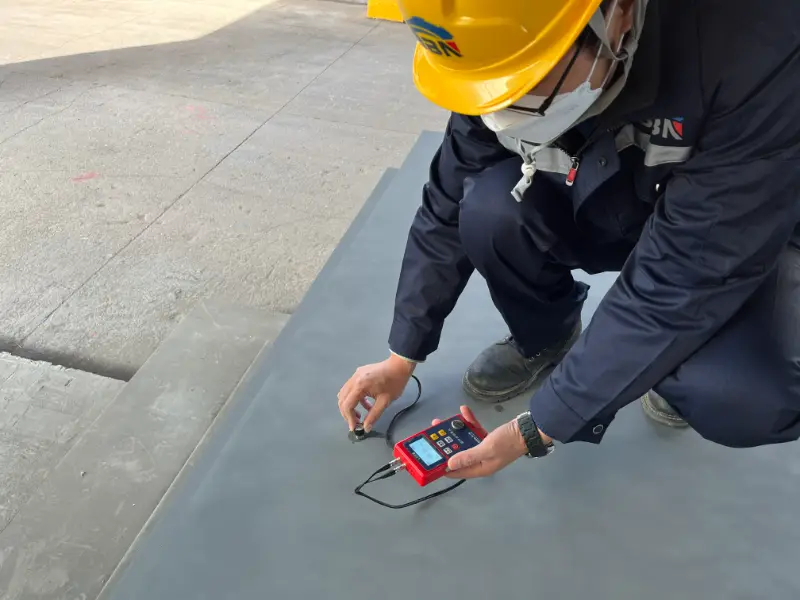
KR Grade D63 High-Strength Shipbuilding Steel Plate
KR Grade D63 High-Strength Shipbuilding Steel Plate: Properties, Equivalents & Applications
Detailed data sheet for KR Grade D63 shipbuilding steel plate covering chemical composition, mechanical and physical properties, international equivalents, and application guidance.
TMCP (Thermo-Mechanical Controlled Process) or Quenching and Tempering (Q&T); suitable for cold forming, flame cutting, and welding under qualified procedures
- Phone : +8618037372205
- Email : [email protected]
- WhatsApp: Contact via Whtsapp
- WeChat: +8618037372205
KR Grade D63 High-Strength Shipbuilding Steel Plate Introduction
KR Grade D63 is a high-strength quenched and tempered (Q&T) or thermomechanically rolled (TMCP) shipbuilding steel plate specified by the Korean Register (KR). It delivers a minimum yield strength of 620 MPa and tensile strength in the range of 720–890 MPa, combined with excellent notch toughness at −20°C. This grade belongs to the higher-strength category (EH-type classification level) and is primarily used for critical structural components in large ocean-going vessels, offshore platforms, and Arctic-class ships where weight reduction without compromising safety is essential. The steel exhibits good weldability under controlled procedures, along with satisfactory formability for cold bending. The delivery condition is typically tempered or TMCP, ensuring uniform mechanical properties across plate thicknesses up to approximately 50 mm. KR D63 conforms to the Korean Register Rules Part 2, Chapter 1, and is internationally recognized through equivalent designations from all IACS classification societies.
KR Grade D63 High-Strength Shipbuilding Steel Plate Chemical Composition
The composition is tightly controlled to achieve the required strength–toughness balance and weldability. Microalloying elements such as niobium, vanadium, and titanium are used for grain refinement and precipitation strengthening. The carbon equivalent (CEV) is restricted, typically CEV ≤ 0.42% (for thicknesses ≤ 50 mm), to ensure good cold cracking resistance during welding. Where detailed product analysis tolerances apply, they are in accordance with the KR Rules.
| Element | Specified Value (max, unless range given) | Remarks |
|---|---|---|
| Carbon (C) | 0.20 | For thickness ≤50 mm; CEV restricted |
| Silicon (Si) | 0.55 | Standard deoxidizer |
| Manganese (Mn) | 0.90–1.60 | Essential for strength and toughness |
| Phosphorus (P) | 0.025 | Strict control for low-temperature toughness |
| Sulfur (S) | 0.025 | Low sulfur for cleanliness and through-thickness properties |
| Aluminium (Al) [total] | ≥0.015 (acid soluble) | Grain refinement; nitrogen fixation |
| Niobium (Nb) | 0.02–0.05 | Grain refiner; may be combined with V/Ti |
| Vanadium (V) | 0.05–0.10 | Precipitation strengthening; optional |
| Titanium (Ti) | ≤0.02 | Grain refinement; optional |
| Chromium (Cr) | ≤0.25 | Residual element; not intentionally added |
| Nickel (Ni) | ≤0.40 | Residual element |
| Molybdenum (Mo) | ≤0.08 | Residual element |
| Copper (Cu) | ≤0.35 | Residual element; may provide some corrosion resistance |
| Nitrogen (N) | ≤0.012 | Controlled when Ti/Nb are present |
| Carbon Equivalent (CEV) | 0.42 (typical max) | CEV = C + Mn/6 + (Cr+Mo+V)/5 + (Ni+Cu)/15 |
KR Grade D63 High-Strength Shipbuilding Steel Plate Thermal and Electrical Physical Properties
These physical properties are representative for a low-carbon microalloyed steel with tempered martensitic/bainitic microstructure. They are not mandatory in the material standard but are useful for engineering design. Values may vary slightly with composition and temperature. Data sourced from published references on similar 690 MPa grade steels.
| Property | Typical Value | Unit | Conditions / Remarks |
|---|---|---|---|
| Density (ρ) | 7.85 | g/cm³ | At 20°C |
| Elastic Modulus (E) | 205–210 | GPa | At 20°C; decreases with temperature |
| Shear Modulus (G) | 80 | GPa | Calculated using ν = 0.3 |
| Poisson's Ratio (ν) | 0.3 | – | Elastic range |
| Thermal Expansion Coefficient (α) | 11.5 × 10⁻⁶ to 13.0 × 10⁻⁶ | K⁻¹ | 20–100°C range |
| Thermal Expansion Coefficient (α) | 12.5 × 10⁻⁶ to 14.0 × 10⁻⁶ | K⁻¹ | 20–200°C range |
| Thermal Expansion Coefficient (α) | 13.5 × 10⁻⁶ to 15.0 × 10⁻⁶ | K⁻¹ | 20–300°C range |
| Thermal Conductivity (λ) | 35–45 | W/(m·K) | At 20°C; slightly lower than mild steel |
| Specific Heat Capacity (Cp) | 460–480 | J/(kg·K) | At 20°C |
| Electrical Resistivity (ρe) | 0.25–0.35 | μΩ·m | At 20°C |
| Melting Point Range | 1450–1520 | °C | Typical for low-alloy steel |
KR Grade D63 High-Strength Shipbuilding Steel Plate Mechanical Properties
Mechanical tests are performed on specimens machined from the delivered condition. Yield strength and tensile properties generally decrease slightly with increasing plate thickness. Impact toughness is verified at −20°C using Charpy V-notch specimens (10×10 mm) taken in the longitudinal direction. For thicknesses over 50 mm, property values may be agreed between the purchaser and manufacturer. Bending tests follow a 180° cold bend with mandrel diameters related to plate thickness.
| Property | Specified Value | Unit | Test Conditions |
|---|---|---|---|
| Upper Yield Strength (ReH) or Proof Strength (Rp0.2) | 620 | MPa | Plate thickness ≤50 mm; transverse test piece |
| Tensile Strength (Rm) | 720–890 | MPa | Plate thickness ≤50 mm; transverse |
| Elongation (A5) | 15 | % | Gauge length 5.65√So; transverse specimen |
| Charpy Impact Toughness (KV) | 31 | J | Longitudinal specimen; test temperature −20°C; average of 3 tests; single value ≥70% of average |
| Bend Test (180°) – thickness ≤25 mm | No cracks; bend mandrel diameter = 3a | – | a = specimen thickness; width ≥2a; tested at ambient temperature |
| Bend Test (180°) – thickness >25 mm to ≤50 mm | No cracks; bend mandrel diameter = 4a | – | a = specimen thickness; width ≥2a |
KR Grade D63 High-Strength Shipbuilding Steel Plate Identical Equivalent Standards and Replaceable Grades
| Country / Region | Standard / Classification Society | Grade Designation | Remarks |
|---|---|---|---|
| Republic of Korea | KR | D63 | Original designation; Korean Register |
| United States | ABS | D63 | American Bureau of Shipping |
| Norway / Germany | DNV | D63 | DNV (formerly DNV GL) |
| China | CCS | D63 | China Classification Society |
| United Kingdom | LR | D63 | Lloyd's Register |
| France | BV | D63 | Bureau Veritas |
| Japan | NK (ClassNK) | KD63 | Nippon Kaiji Kyokai; prefix K for ship steel |
| Italy | RINA | D63 | Registro Italiano Navale |
| Russia | RS | D63 | Russian Maritime Register of Shipping |
| India | IRS | D63 | Indian Register of Shipping |
KR Grade D63 High-Strength Shipbuilding Steel Plate Application Introduction
KR D63 steel plates are engineered for weight-critical, high-stress marine and offshore structures where a minimum yield strength of 620 MPa allows downsizing of sections without compromising safety. The steel is weldable but requires strict heat input control, appropriate preheating, and low-hydrogen consumables to avoid cold cracking. Post-weld heat treatment is generally not required but may be performed following qualified procedures.
Product Applications: Hull structural modules (deck, shell, longitudinal bulkheads, hatch coamings), Jack-up rig components (chord legs, rack plates, spudcans), Offshore crane pedestals and weldments, Wind turbine foundation transition pieces and secondary structures, Arctic vessel ice-belt reinforcements and ice-going propulsion system foundations
Processed into products: Individual main deck plates and bottom shell plates, Girders, frames, and brackets in high-load zones, Lifting lugs and padeyes for heavy loads, Cut-out pieces for watertight doors and manhole rings, Reinforcement doublers and insert plates, Boom sections for shipboard and quay cranes
Application industries: Shipbuilding (container carriers, crude oil tankers, LNG carriers, icebreakers, naval vessels), Offshore engineering (jack-up rig legs, FPSO hulls, semi-submersibles, wind turbine installation vessels), Port and heavy-lift equipment (container cranes, ship-to-shore cranes, loader structures), Bridge construction (box girder bridges requiring high strength-to-weight ratio), Heavy machinery (excavator booms, piling hammers, pressure vessels for marine service)
KR Grade D63 High-Strength Shipbuilding Steel Plate Similar or Near-Equivalent Materials
| Country / Region | Standard | Grade | Remarks |
|---|---|---|---|
| Europe | EN 10025-6 | S690Q | Quenched and tempered structural steel; yield ≥690 MPa; often used offshore; composition and toughness may differ slightly; CEV similar (~0.47); special welding procedure required |
| USA | ASTM A514 / A517 | Grade B / Grade H | High-yield-strength quenched and tempered alloy steel plate for structural applications; min yield 690 MPa; thickness limit 65 mm; similar toughness class at -20°C is not guaranteed by default; supplementary impact testing needed |
| International | ISO 4950-2 | HS690 | High yield strength flat steel products; yield ≥690 MPa; available in QT condition; toughness can be ordered for -20°C |
| Japan | JIS G 3128 | SHY685 | High yield strength steel plate for welded structures; min yield 685 MPa; requires additional agreement for marine environment; NKK and others produced similar grades, but SHY685 is a common reference |
Notes:
Welding recommendations: Use low-hydrogen processes (SMAW with basic electrodes, SAW, GMAW) with controlled heat input between 1.5–3.5 kJ/mm. Preheat temperature typically 75–125°C depending on thickness and combined CEV. Interpass temperature should not exceed 200°C to maintain mechanical properties. Non-destructive testing: Ultrasonic testing to Class A or equivalent according to EN 10160 is often required for critical applications. Through-thickness properties: For attachments subject to lamellar tearing (e.g., heavy welded joints in T- or cruciform configurations), Z-quality steel (Z25 or Z35 according to EN 10164) can be ordered; KR D63 plates may be supplied with guaranteed reduction of area in the thickness direction. Certification: The plates are delivered with KR 3.2 certificate (inspection certificate according to EN 10204). Additional marking includes heat number, plate number, and classification society stamp. Any deviation from standard composition or test requirements must be agreed upon at the time of enquiry and order.
- Share



