
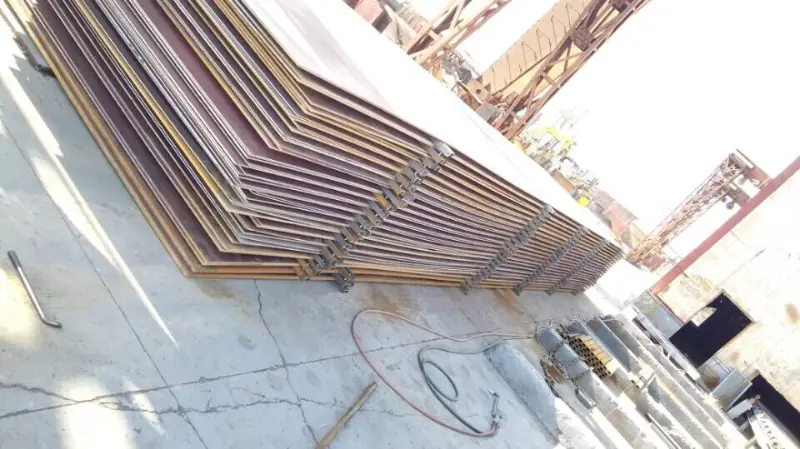
KR Grade A63 Shipbuilding Steel Plate
KR Grade A63 Shipbuilding Steel Plate: High-Strength Quenched & Tempered Hull Structural Steel
Detailed material data for KR Grade A63 (AH63) shipbuilding steel plate per Korean Register rules: chemical composition, mechanical & thermal properties, equivalent materials, and applications in shipbuilding and offshore structures.
Hot rolling, quenching & tempering (Q&T), cutting, cold forming (with precautions), welding with appropriate consumables and procedures
- Phone : +8618037372205
- Email : [email protected]
- WhatsApp: Contact via Whtsapp
- WeChat: +8618037372205
KR Grade A63 Shipbuilding Steel Plate Introduction
KR Grade A63 (also designated AH63) is a high-strength, quenched and tempered steel plate for ship and offshore hull structures, conforming to the Korean Register of Shipping Rules. It offers a minimum yield strength of 620 MPa (63 kgf/mm²) and combines high strength with excellent toughness and weldability. The grade is intended for highly stressed components in large container ships, bulk carriers, and offshore platforms. Carbon equivalent is controlled to ensure good weldability without excessive preheat. The steel is delivered in the quenched and tempered (Q&T) condition, and can also be produced via thermo-mechanically controlled processing (TMCP) with tempering.
KR Grade A63 Shipbuilding Steel Plate Chemical Composition
Based on IACS UR W31 for grade A620 (A63) steel plates. All values are maximum unless a range is indicated. Aluminum is required as a grain refiner. The carbon equivalent Ceq typically ≤0.58 for thickness ≤50 mm to maintain weldability.
| Element | Value (%) | Remarks |
|---|---|---|
| Carbon (C) | ≤ 0.18 | max |
| Silicon (Si) | ≤ 0.55 | max |
| Manganese (Mn) | 0.90 - 1.60 | range |
| Phosphorus (P) | ≤ 0.025 | max |
| Sulfur (S) | ≤ 0.025 | max |
| Chromium (Cr) | ≤ 0.25 | max |
| Nickel (Ni) | ≤ 0.80 | max |
| Molybdenum (Mo) | ≤ 0.30 | max |
| Copper (Cu) | ≤ 0.35 | max |
| Niobium (Nb) | ≤ 0.05 | max |
| Vanadium (V) | ≤ 0.10 | max |
| Titanium (Ti) | ≤ 0.02 | max |
| Aluminum (Al total) | ≥ 0.020 | min |
| Nitrogen (N) | ≤ 0.012 | max |
KR Grade A63 Shipbuilding Steel Plate Physical and Thermal Properties
The following typical physical properties are provided for quenched and tempered high-strength steel grade A63. Actual values may vary slightly depending on exact composition and heat treatment condition. Thermal conductivity decreases with rising temperature; specific heat increases with temperature. Data are for reference for engineering calculations.
| Property | Typical Value | Unit | Condition / Remarks |
|---|---|---|---|
| Density (ρ) | 7.85 | g/cm³ (7850 kg/m³) | At 20°C |
| Elastic Modulus (E) | 205 | GPa | At 20°C |
| Shear Modulus (G) | approx. 80 | GPa | At 20°C |
| Poisson's Ratio (ν) | 0.3 | – | Elastic range |
| Thermal Expansion Coefficient (α) | 12.0 | x10⁻⁶/K | 20–100°C |
| Thermal Expansion Coefficient (α) | 12.5 | x10⁻⁶/K | 20–200°C |
| Thermal Expansion Coefficient (α) | 13.0 | x10⁻⁶/K | 20–300°C |
| Thermal Conductivity (λ) | 45 (range 42–50) | W/(m·K) | At 20°C |
| Specific Heat Capacity (c) | 460–500 | J/(kg·K) | At 20°C |
| Electrical Resistivity (ρ_e) | 0.20–0.25 | µΩ·m | At 20°C |
KR Grade A63 Shipbuilding Steel Plate Mechanical Properties
Mechanical properties as per IACS UR W31 for grade A620, tested on quenched and tempered test coupons in the longitudinal direction. Impact energy requirements are Charpy V-notch at 0°C for A (AH) grade.
- For plate thickness ≤50 mm: Yield strength ≥620 MPa, Tensile strength 720–890 MPa, Elongation ≥15%.
- For 50
Impact values vary by thickness.
| Property | Standard Value | Unit | Test Condition / Remarks |
|---|---|---|---|
| Yield Strength (ReH) | ≥ 620 | MPa | Thickness ≤ 50 mm, transverse or longitudinal |
| Yield Strength (ReH) | ≥ 580 | MPa | 50 < Thickness ≤ 100 mm |
| Tensile Strength (Rm) | 720 - 890 | MPa | Thickness ≤ 50 mm |
| Tensile Strength (Rm) | 680 - 890 | MPa | 50 < Thickness ≤ 100 mm |
| Elongation (A) on 5.65√S | ≥ 15 | % | Thickness ≤ 50 mm, gauge length 5.65√S0 |
| Elongation (A) on 5.65√S | ≥ 14 | % | 50 < Thickness ≤ 100 mm |
| Charpy V-Notch Impact (KV2), longitudinal @ 0°C | ≥ 41 (avg), ≥ 34 (single) | J | Thickness ≤ 50 mm |
| Charpy V-Notch Impact (KV2), longitudinal @ 0°C | ≥ 34 (avg), ≥ 27 (single) | J | 50 < Thickness ≤ 70 mm |
| Charpy V-Notch Impact (KV2), longitudinal @ 0°C | ≥ 27 (avg), ≥ 20 (single) | J | 70 < Thickness ≤ 100 mm |
KR Grade A63 Shipbuilding Steel Plate Equivalent Material Standards and Substitutable Grades
| Country/Region | Standard | Grade | Remarks |
|---|---|---|---|
| South Korea | KR Rules | AH63 (A63) | Original designation |
| Norway | DNV Rules | NV A620 | Identical per IACS UR W31 |
| USA | ABS Rules | ABS AH620 | Identical |
| UK | Lloyd's Register | LR AH620 | Identical |
| France | Bureau Veritas | BV AH620 | Identical |
| China | CCS Rules | CCS AH620 | Identical |
| Japan | Nippon Kaiji Kyokai (NK) | NK KA620 | Identical (K = high-tensile, A620 yield 620) |
| Italy | RINA Rules | RINA AH620 | Identical |
KR Grade A63 Shipbuilding Steel Plate Application Introduction
KR Grade A63 steel is specifically designed for critical structural applications in shipbuilding and offshore industries where high strength and toughness at low temperatures are essential. The material can be processed into various components through cutting, forming, and welding. Proper fabrication practices must be followed, including controlling preheat and interpass temperatures for welding. The steel is often used in as-delivered quenched and tempered condition without further heat treatment.
Product Applications: Container ship hulls, Bulk carriers and ore carriers, Self-elevating platform (jack-up) legs, FPSO hull modules, Deck structures and superstructures, Hatch covers and coamings, Crane pedestals and slewing rings, Heavy-duty frames and girders
Processed into products: Main deck and bottom plating, Longitudinal stiffeners and beams, Web frames and stringers, Bracket and connection plates, Offshore module support stools, Box girder flanges, Fracture-critical welded joints, Insert plates in stress concentration areas
Application industries: Shipbuilding (commercial and naval), Offshore oil & gas platforms, Marine and port equipment, Heavy-lift crane manufacturing, Bridge building (special designs), Pressure vessels and boilers (subject to additional requirements)
KR Grade A63 Shipbuilding Steel Plate Similar or Analogous Material Standards
| Country/Region | Standard | Grade | Remarks |
|---|---|---|---|
| Europe | EN 10025-6 | S620Q (EN 10025-6:2019) | Comparable quenched and tempered structural steel; similar strength but different chemistry and testing requirements. |
| Europe | EN 10025-6 | S620QL/QL1 | Option with low-temperature impact properties (QL1 at -40°C); may substitute with appropriate design. |
| USA | ASTM A514/A514M | Grade B, E, F, H, Q | Yield strength 690 MPa (100 ksi), higher strength. Not directly equivalent; requires engineering review. |
| USA | ASTM A709/A709M | Grade 100W (HPS 100W) | High-performance steel for bridges, yield 690 MPa. Substitute for some structural applications. |
| USA | ASTM A710/A710M | Grade A (Class 1) | Yield 550 MPa typical, Ni-Cr-Cu-Mo-Nb steel. Lower strength; not recommended as direct substitute. |
Notes:
- Welding: Use low-hydrogen processes and matching or slightly undermatching filler metals. Preheat (typically 100–200°C) and interpass temperature control are essential to avoid hydrogen-induced cracking. Post-weld heat treatment is not generally required but may be applied for stress relief in thick sections, with caution to not degrade mechanical properties.
- Cold forming: Due to high strength, large radius bending is recommended. The minimum forming radius is typically 3–5t for quenched and tempered steel. Stress relief may be needed after severe forming.
- Delivery condition: The material is usually delivered in the quenched and tempered condition. Supplementary tests such as Z-grade through-thickness tensile testing can be ordered.
- Corrosion behavior: As a low-alloy steel, normal marine corrosion protection (coating, cathodic protection) is necessary. No special atmospheric corrosion resistance.
- Share



