
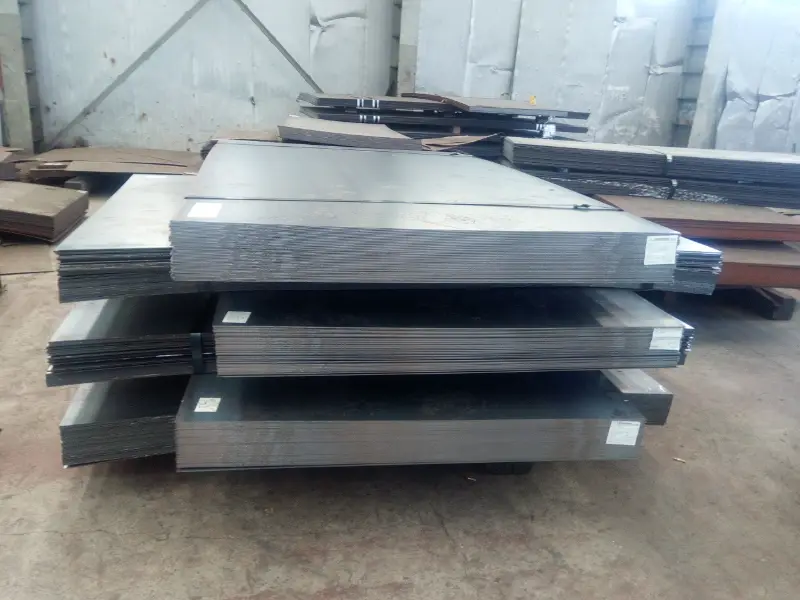
KR Grade E47 Shipbuilding Steel Plate
KR Grade E47 Shipbuilding Steel Plate - High-Strength Quenched & Tempered Hull Structural Steel
Comprehensive material data for KR Grade E47 (EH47) quenched and tempered shipbuilding steel plate, including chemical composition, mechanical properties, physical characteristics, international equivalents, and application guidance according to Korean Register of Shipping rules.
Hot rolling, controlled rolling, quenching and tempering (Q+T), cold forming, welding fabrication
- Phone : +8618037372205
- Email : [email protected]
- WhatsApp: Contact via Whtsapp
- WeChat: +8618037372205
KR Grade E47 Shipbuilding Steel Plate Introduction
KR Grade E47 is a high-strength quenched and tempered shipbuilding steel plate defined by the Korean Register of Shipping (KR) rules, aligning with IACS UR W31 for extra-high-strength hull structural steels. It corresponds to the standard grade EH47, where the 'E' indicates an impact toughness test temperature of -40°C and '47' denotes a minimum yield strength of 460 MPa. The steel is supplied in a quenched and tempered (Q+T) condition, offering an excellent combination of high tensile strength, good ductility, and reliable low-temperature toughness.
Key characteristics include:
- Minimum yield strength of 460 MPa in thicknesses up to 50 mm
- Excellent weldability when proper procedures are followed
- Good cold-forming ability
- Superior crack resistance in harsh marine environments
- Compliance with major classification society requirements
KR E47 plates are used extensively in critical structural components of large container ships, bulk carriers, and offshore structures, where weight reduction and high load-bearing capacity are essential.
KR Grade E47 Shipbuilding Steel Plate Chemical Composition
The chemical composition of KR Grade E47 steel plate complies with IACS UR W31 for quenched and tempered hull structural steels. The limits are designed to achieve the necessary strength and toughness through quenching and tempering heat treatment. Fine-grain practice is mandatory, and microalloying elements such as Nb, V, Ti, or Al are added to ensure grain refinement. Phosphorus and sulfur are strictly controlled to enhance ductility and weldability.
| Chemical Element | Standard Value (max, wt%) | Remarks |
|---|---|---|
| Carbon (C) | ≤ 0.20 | |
| Silicon (Si) | ≤ 0.55 | |
| Manganese (Mn) | 0.70 – 1.70 | |
| Phosphorus (P) | ≤ 0.025 | |
| Sulfur (S) | ≤ 0.025 | |
| Copper (Cu) | ≤ 0.50 | |
| Chromium (Cr) | ≤ 0.25 | |
| Nickel (Ni) | ≤ 0.40 | |
| Molybdenum (Mo) | ≤ 0.08 | |
| Vanadium (V) | ≤ 0.10 | |
| Niobium (Nb) | ≤ 0.05 | |
| Titanium (Ti) | ≤ 0.05 | |
| Aluminium (Al total) | ≥ 0.015 (min) | Fine grain requirement |
| Nitrogen (N) | ≤ 0.012 | Unless sufficient Al is present |
| Boron (B) | ≤ 0.0005 |
KR Grade E47 Shipbuilding Steel Plate Thermal and Electrical Physical Properties
These values represent typical physical properties for quenched and tempered carbon‑manganese‑microalloyed steel used in shipbuilding. Actual values may vary depending on exact composition and heat treatment condition. The data are provided for design and engineering purposes under ambient conditions unless otherwise noted.
| Property | Typical Value | Unit | Test Condition |
|---|---|---|---|
| Density (ρ) | 7850 | kg/m³ | 20°C |
| Elastic Modulus (E) | 205 | GPa | 20°C |
| Shear Modulus (G) | 80 | GPa | 20°C |
| Poisson's Ratio (ν) | 0.3 | – | 20°C |
| Thermal Expansion Coefficient (α) | 11.7 × 10⁻⁶ | K⁻¹ | 20 – 100°C |
| Thermal Expansion Coefficient (α) | 12.5 × 10⁻⁶ | K⁻¹ | 20 – 200°C |
| Thermal Conductivity (λ) | 50 | W/(m·K) | 20°C |
| Specific Heat Capacity | 460 | J/(kg·K) | 20°C |
| Electrical Resistivity (ρₑ) | 0.20 × 10⁻⁶ | Ω·m | 20°C |
KR Grade E47 Shipbuilding Steel Plate Mechanical Properties
The mechanical properties are specified according to IACS UR W31 for EH47 grade, as adopted by KR Rules. The values vary with plate thickness. All tests are performed in the as-delivered quenched and tempered condition. Charpy V-notch impact tests are conducted at -40°C. Multi-line entries indicate the required property for different thickness ranges.
| Property | Standard Requirement Value | Unit | Test Condition |
|---|---|---|---|
| Yield Strength (ReH) | ≥ 460 | MPa | Thickness ≤ 50 mm |
| Yield Strength (ReH) | ≥ 440 | MPa | 50 mm < Thickness ≤ 100 mm |
| Yield Strength (ReH) | ≥ 400 | MPa | 100 mm < Thickness ≤ 150 mm |
| Tensile Strength (Rm) | 570 – 720 | MPa | All thicknesses up to 150 mm |
| Elongation (A) | ≥ 17 | % | Thickness ≤ 50 mm, L₀ = 5.65√So |
| Elongation (A) | ≥ 17 | % | 50 mm < Thickness ≤ 100 mm, L₀ = 5.65√So |
| Elongation (A) | ≥ 16 | % | 100 mm < Thickness ≤ 150 mm, L₀ = 5.65√So |
| Charpy Impact Energy (KV, longitudinal) | ≥ 41 | J | At -40°C, thickness ≤ 50 mm |
| Charpy Impact Energy (KV, longitudinal) | ≥ 34 | J | At -40°C, 50 mm < thickness ≤ 100 mm |
| Charpy Impact Energy (KV, transverse) | ≥ 27 | J | At -40°C, thickness ≤ 50 mm |
| Charpy Impact Energy (KV, transverse) | ≥ 20 | J | At -40°C, 50 mm < thickness ≤ 100 mm |
KR Grade E47 Shipbuilding Steel Plate Fully Equivalent Material Standards and Substitutable Grades
| Country/Region | Standard | Grade | Remarks |
|---|---|---|---|
| South Korea | KR Rules Pt2 Ch1 Sec2 | E47 | Original designation; directly equivalent to IACS EH47 |
| International | IACS UR W31 | EH47 | International Association of Classification Societies |
| USA | ABS Rules | EH47 | American Bureau of Shipping |
| Norway | DNV Rules | E47 | Det Norske Veritas |
| UK | LR Rules | EH47 | Lloyd's Register |
| France | BV Rules | EH47 | Bureau Veritas |
| China | CCS Rules | EH47 | China Classification Society |
| Japan | NK Rules | KE47 | Nippon Kaiji Kyokai (ClassNK) |
| Italy | RINA Rules | EH47 | Registro Italiano Navale |
KR Grade E47 Shipbuilding Steel Plate Application Introduction
KR Grade E47 steel plates are specifically designed for demanding marine and offshore applications where high strength, excellent toughness at sub‑zero temperatures, and good weldability are mandatory. The Q+T delivery condition ensures a fine‑grained tempered martensitic structure that meets the stringent safety requirements of classification societies.
Application highlights:
- Used in the construction of large, high‑speed container vessels and bulk carriers
- Suitable for ice‑strengthened structures in Arctic‑class ships
- Ideal for offshore platform decks, legs, and jackets
- Applied in fatigue‑critical areas such as hatch corners and sheer strakes
Typical fabrication processes include plasma or oxy‑fuel cutting, cold forming, and multi‑pass welding with low‑hydrogen consumables. Preheating and interpass temperature control are recommended based on carbon equivalent and plate thickness.
Product Applications: Hull plates (side, bottom, deck), Stringer plates and sheer strakes, Bulkhead and deck stiffeners, Transverse frames and web frames, Container cell guides, Hatch coamings and covers, Bottom longitudinal girders, Offshore platform tubular joints and bracings
Processed into products: Main deck and shell plating panels, Ice belt plates in ice‑class vessels, Bracket plates in high‑stress areas, Pontoon structural members, Bulk carrier topside tanks and hopper tank plating, Shear plate connections in container ships, Crane pedestals and winch foundations
Application industries: Shipbuilding, Offshore engineering, Marine structures, Heavy fabrication
KR Grade E47 Shipbuilding Steel Plate Similar / Alternative Material Recommendations
| Country/Region | Standard | Grade | Remarks |
|---|---|---|---|
| International | IACS UR W31 | AH47 | Similar yield strength but impact tested at 0°C; suitable for less demanding temperatures |
| International | IACS UR W31 | DH47 | Impact test at -20°C; intermediate toughness level |
| International | IACS UR W31 | FH47 | Superior toughness, impact tested at -60°C; for extreme low‑temperature service |
| Europe | EN 10225 | S460G2+Q | Offshore structural steel with comparable yield strength and good weldability; not class‑certified for ship hull |
| USA | ASTM A514 / A517 | Grade A / Grade B | Quenched and tempered high‑strength alloy steels; may require special welding procedures |
Notes:
Delivery documentation: KR Grade E47 plates are typically supplied with KR survey stamp and full material certificates, including ladle analysis, tensile test results, Charpy impact values, and non‑destructive examination if specified.
Through‑thickness properties: When Z‑quality is requested (e.g., Z25, Z35), the steel must meet additional reduction of area requirements in the through‑thickness direction per IACS UR W31 or KR rules.
Welding: Low hydrogen welding processes are strongly recommended. The carbon equivalent (CEV) is normally limited to ≤0.42–0.45% to ensure cold cracking resistance. Preheating temperature is determined by plate thickness and CEV, typically ranging from 75°C to 150°C. Post‑weld heat treatment is generally not required.
- Share



