
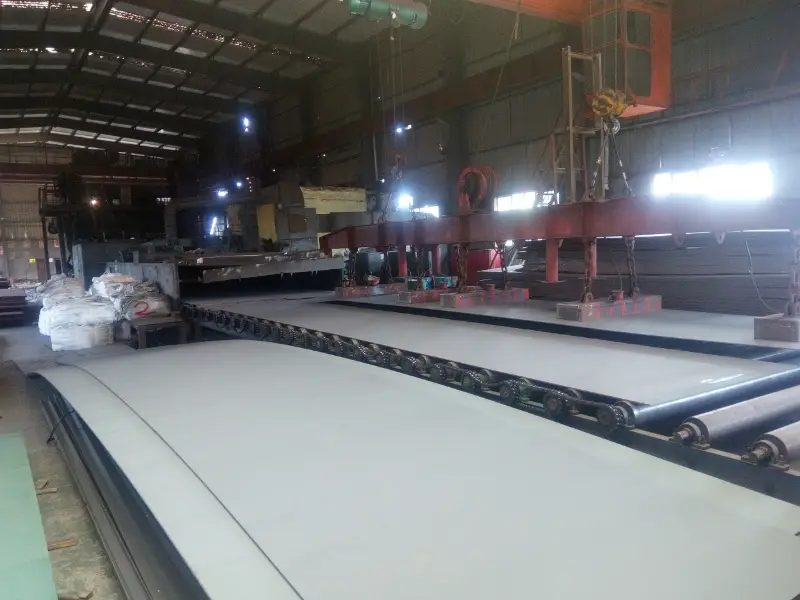
KR Grade F36 Shipbuilding Steel Plate
KR Grade F36 Shipbuilding Steel Plate: High-Strength Marine Steel for Arctic-Class Structures
Complete technical data for KR F36 shipbuilding steel with chemical composition, mechanical properties, international equivalents, and application guidance.
Hot Rolling, Normalizing, Thermo-Mechanical Control Process (TMCP), Quenching and Tempering
- Phone : +8618037372205
- Email : [email protected]
- WhatsApp: Contact via Whtsapp
- WeChat: +8618037372205
KR Grade F36 Shipbuilding Steel Plate Introduction
KR Grade F36 is a high-strength shipbuilding steel plate certified by the Korean Register (KR), designed for critical structural applications in ship hulls and offshore platforms. It belongs to the normalized or thermo-mechanically rolled fine-grain structural steel category with a minimum yield strength of 355 MPa. The 'F' designation indicates minimum impact toughness guaranteed at -60 °C, making it suitable for Arctic and low-temperature service. It exhibits excellent weldability and toughness due to controlled micro-alloying with niobium, vanadium, and titanium. Typical delivery conditions include normalized, TMCP, or quenched and tempered, ensuring consistent mechanical properties across a wide range of thicknesses up to 100 mm.
KR Grade F36 Shipbuilding Steel Plate Chemical Composition
Chemical composition complies with KR Rules and IACS UR W11 for high-strength F-grade steel. Carbon equivalent (CEV) is controlled to a maximum of 0.38% for good weldability. Aluminium is added as a grain refiner; micro-alloying elements (Nb, V, Ti) are present singly or in combination.
| Element | Standard Value (wt%) | Remarks |
|---|---|---|
| Carbon (C) | ≤0.18 | CEV max 0.38 |
| Manganese (Mn) | 0.90–1.60 | Dependent on thickness |
| Silicon (Si) | ≤0.50 | |
| Phosphorus (P) | ≤0.035 | |
| Sulfur (S) | ≤0.035 | |
| Aluminium (Al total) | ≥0.020 | Acid-soluble Al typically ≥0.015 |
| Niobium (Nb) | ≤0.05 | Micro-alloying, single or combined |
| Vanadium (V) | ≤0.10 | Micro-alloying |
| Titanium (Ti) | ≤0.02 | Micro-alloying |
| Copper (Cu) | ≤0.35 | Residual element |
| Chromium (Cr) | ≤0.20 | Residual element |
| Nickel (Ni) | ≤0.40 | Residual element |
| Molybdenum (Mo) | ≤0.08 | Residual element |
| Nitrogen (N) | ≤0.012 | If not fixed by Al/Ti |
KR Grade F36 Shipbuilding Steel Plate Thermal and Electrical Physical Properties
The following values are typical for fine-grain structural steels and are not part of mandatory specification requirements. They serve as engineering reference data for design calculations. Thermal conductivity and specific heat capacity vary with temperature; room-temperature values are given.
| Property | Typical Value | Unit | Condition / Remarks |
|---|---|---|---|
| Density (ρ) | 7850 | kg/m³ | At 20 °C |
| Modulus of Elasticity (E) | 210 | GPa | At 20 °C, static |
| Shear Modulus (G) | 81 | GPa | Calculated from E and ν |
| Poisson's Ratio (ν) | 0.3 | - | Elastic range |
| Thermal Expansion Coefficient (α) | 12 × 10⁻⁶ | K⁻¹ | 20–100 °C average |
| Thermal Expansion Coefficient (α) | 13 × 10⁻⁶ | K⁻¹ | 20–200 °C average |
| Thermal Expansion Coefficient (α) | 14 × 10⁻⁶ | K⁻¹ | 20–400 °C average |
| Thermal Conductivity (λ) | ~50 | W/(m·K) | At 20 °C |
| Thermal Conductivity (λ) | ~45 | W/(m·K) | At 200 °C |
| Thermal Conductivity (λ) | ~38 | W/(m·K) | At 400 °C |
| Specific Heat Capacity (Cp) | ~460 | J/(kg·K) | At 20 °C |
| Specific Heat Capacity (Cp) | ~500 | J/(kg·K) | At 200 °C |
| Specific Heat Capacity (Cp) | ~560 | J/(kg·K) | At 400 °C |
| Electrical Resistivity (ρe) | ~0.20 | μΩ·m | At 20 °C |
KR Grade F36 Shipbuilding Steel Plate Mechanical Properties
Mechanical properties are tested on specimens in the delivery condition (transverse or longitudinal). Impact energy is verified at -60 °C, which distinguishes F-grade from lower toughness grades. Yield strength applies to plate thicknesses up to 100 mm. Bend test diameters are given as multiples of specimen thickness (a).
| Property | Requirement | Unit | Test Condition |
|---|---|---|---|
| Yield Strength (ReH) | ≥355 | MPa | t ≤ 100 mm, transverse |
| Tensile Strength (Rm) | 490–620 | MPa | t ≤ 100 mm, transverse |
| Elongation (A5, longitudinal) | ≥21 | % | t ≤ 50 mm, gauge length 5.65√S0 |
| Elongation (A5, longitudinal) | ≥20 | % | 50 < t ≤ 70 mm |
| Elongation (A5, longitudinal) | ≥20 | % | 70 < t ≤ 100 mm |
| Elongation (A5, transverse) | ≥19 | % | t ≤ 50 mm |
| Elongation (A5, transverse) | ≥18 | % | 50 < t ≤ 70 mm |
| Elongation (A5, transverse) | ≥18 | % | 70 < t ≤ 100 mm |
| Impact Energy (KV, longitudinal) | ≤34 | J | t ≤ 50 mm, -60 °C, V-notch |
| Impact Energy (KV, longitudinal) | ≤41 | J | 50 < t ≤ 70 mm, -60 °C |
| Impact Energy (KV, longitudinal) | ≤50 | J | 70 < t ≤ 100 mm, -60 °C |
| Impact Energy (KV, transverse) | ≤24 | J | t ≤ 50 mm, -60 °C |
| Impact Energy (KV, transverse) | ≤27 | J | 50 < t ≤ 70 mm, -60 °C |
| Impact Energy (KV, transverse) | ≤34 | J | 70 < t ≤ 100 mm, -60 °C |
| Bend Test (180°) | 2a | a = thickness | t ≤ 25 mm, no cracks |
| Bend Test (180°) | 3a | a = thickness | 25 < t ≤ 35 mm |
| Bend Test (180°) | 4a | a = thickness | 35 < t ≤ 50 mm |
| Bend Test (180°) | 5a | a = thickness | 50 < t ≤ 100 mm |
KR Grade F36 Shipbuilding Steel Plate Exact Equivalent Standards and Substitutable Grades
| Country / Region | Standard / Classification Society | Grade | Remarks |
|---|---|---|---|
| South Korea | KR | F36 | Korean Register, base specification |
| International | IACS UR W11 | High-strength F-grade, min 355 MPa | Unified requirement for F36 steel |
| USA | ABS | ABS F36 | American Bureau of Shipping |
| Norway / Germany | DNV | DNV F36 | Det Norske Veritas |
| France | BV | BV F36 | Bureau Veritas |
| China | CCS | CCS F36 | China Classification Society |
| UK | LR | LR F36 | Lloyd's Register |
| Japan | NK | NK F36 | Nippon Kaiji Kyokai |
| Italy | RINA | RINA F36 | Registro Italiano Navale |
| Russia | RS | RS F36 | Russian Maritime Register of Shipping |
| Croatia | CRS | CRS F36 | Croatian Register of Shipping |
KR Grade F36 Shipbuilding Steel Plate Application Introduction
KR F36 steel is engineered for welded structures requiring high strength and guaranteed low-temperature toughness. It is used primarily in shipbuilding and offshore engineering where safety and service performance at temperatures down to -60 °C are critical.
Product Applications: Hull shell plates, deck plates, bottom plates, and side shells, Longitudinal stiffeners, frames, and girders, Ice belts and ice-strengthened structures, Pressure hulls for submersibles, Offshore module support structures (flare booms, helidecks), Heavy welded fabrications for harbor and coastal infrastructure
Processed into products: Ship hull modules and panels (laser- and hybrid-welded), Stiffened plate panels for decks and bulkheads, Brackets, floors, and web frames, Pile sleeves and transition pieces for offshore wind foundations, Mooring components and chocks in low-temperature environments, Welded tubular joints and nodes for jacket structures
Application industries: Shipbuilding (commercial and naval vessels), Offshore oil & gas platforms, Arctic and ice-class marine structures, Heavy-lift crane and drilling derrick substructures, Bridge and structural engineering (special low-temperature requirements)
KR Grade F36 Shipbuilding Steel Plate Similar or Near-Equivalent Steel Grades
| Country / Region | Standard / Classification Society | Grade | Remarks |
|---|---|---|---|
| EU | EN 10025-3 | S355NL | Normalized fine-grain steel, min 355 MPa, impact at -50 °C, close to F36 toughness |
| EU | EN 10025-4 | S355ML | TMCP fine-grain steel, similar strength, -50 °C impact |
| International | IACS UR W11 | EH36 | Same strength, impact tested at -40 °C; suitable where lower toughness is acceptable |
| Russia | GOST R 52927 | F36W | Strength and toughness equivalent, specific to Arctic service |
| China | GB/T 712 | FH36 | CCS FH36, essentially identical to F36 with -60 °C impact requirement |
Notes:
Weldability: F36 steel is designed for easy welding with low-hydrogen processes. Preheating may be required for thicknesses above 30 mm, typically 50–100 °C. Post-weld heat treatment: usually not needed when TMCP or normalized plates are used within recommended heat input ranges. Through-thickness properties: available upon request (Z35 quality) for critical lamellar-tearing-resistant applications. All plates are ultrasonically tested according to KR rules. Hardenability: the low carbon equivalent (CEV ≤0.38) minimizes heat-affected zone hardness and cold cracking susceptibility.
- Share



