
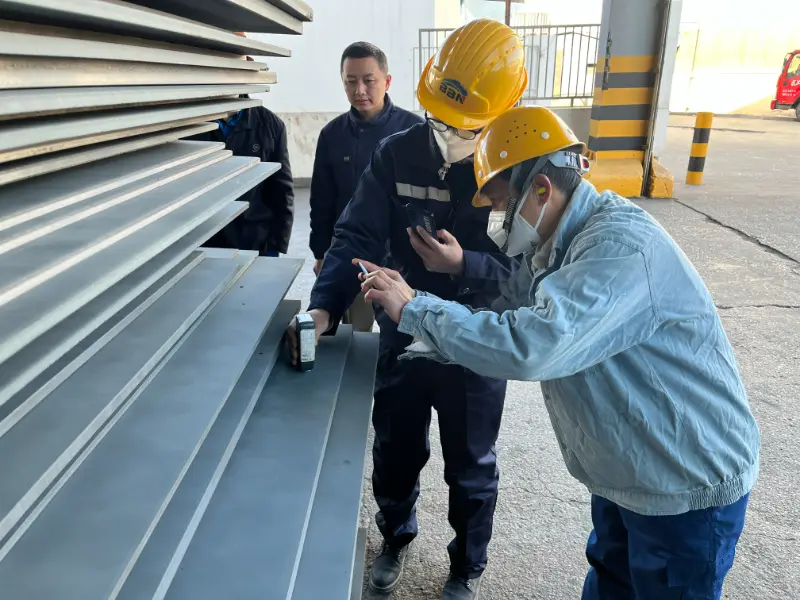
BV Grade AH32 Shipbuilding Steel Plate
BV Grade AH32 Shipbuilding Steel Plate – Composition, Properties & Equivalents
Complete material datasheet for BV Grade AH32 shipbuilding steel plate: chemical composition, mechanical and physical properties, international equivalents, and application guide.
Hot rolling, controlled rolling, normalizing, welding, bending, cutting
- Phone : +8618037372205
- Email : [email protected]
- WhatsApp: Contact via Whtsapp
- WeChat: +8618037372205
BV Grade AH32 Shipbuilding Steel Plate Introduction
BV Grade AH32 is a normalized or controlled-rolled high-strength shipbuilding structural steel plate certified by Bureau Veritas (BV), complying with IACS UR W11. It is designed for hull structures and offshore applications requiring good weldability, toughness at 0°C impact temperature, and a minimum yield strength of 315 MPa. This grade belongs to the AH series of high-strength hull steels, offering a balanced combination of strength, ductility, and low-temperature toughness suitable for ship plates, profiles, and components in general shipbuilding and marine engineering.
BV Grade AH32 Shipbuilding Steel Plate Chemical Composition
The following chemical composition limits are based on IACS UR W11 and BV Rules for Grade AH32. Refining elements such as aluminium, niobium, vanadium, and titanium may be added singly or in combination to achieve fine-grain strengthening. Residual elements are strictly controlled to ensure weldability and mechanical performance.
| Element | Content (%) | Remarks |
|---|---|---|
| Carbon (C) | ≤ 0.18 | Maximum value |
| Manganese (Mn) | 0.90 – 1.60 | Permissible range |
| Silicon (Si) | 0.10 – 0.50 | Permissible range |
| Phosphorus (P) | ≤ 0.035 | Maximum value |
| Sulfur (S) | ≤ 0.035 | Maximum value |
| Acid-soluble aluminium (Als) | ≥ 0.015 | Minimum when used as grain refiner |
| Niobium (Nb) | 0.02 – 0.05 | Optional grain-refining element |
| Vanadium (V) | 0.05 – 0.10 | Optional grain-refining element |
| Titanium (Ti) | ≤ 0.02 | Maximum if used alone |
| Copper (Cu) | ≤ 0.35 | Maximum residual |
| Chromium (Cr) | ≤ 0.20 | Maximum residual |
| Nickel (Ni) | ≤ 0.40 | Maximum residual |
| Molybdenum (Mo) | ≤ 0.08 | Maximum residual |
BV Grade AH32 Shipbuilding Steel Plate Thermal and Electrical Physical Properties
The physical property values below are typical for carbon-manganese structural steels and are suitable for engineering calculations. They are not part of the mandatory certification requirements but are collected from documented references for Grade AH32 or similar shipbuilding steels at room temperature unless otherwise indicated.
| Property | Value | Unit | Test Condition / Temperature |
|---|---|---|---|
| Density (ρ) | 7.85 | g/cm³ | At 20°C |
| Elastic modulus (E) | 205 | GPa | At 20°C |
| Shear modulus (G) | ≈ 80 | GPa | At 20°C |
| Poisson's ratio (ν) | 0.3 | — | At 20°C |
| Thermal expansion coefficient (α) | 12.0 × 10⁻⁶ | K⁻¹ | 20 – 100°C |
| Thermal conductivity (λ) | ≈ 52 | W/(m·K) | At 20°C |
| Specific heat capacity (cp) | ≈ 460 | J/(kg·K) | At 20°C |
| Electrical resistivity (ρe) | ≈ 0.15 × 10⁻⁶ | Ω·m | At 20°C |
BV Grade AH32 Shipbuilding Steel Plate Mechanical Properties
Mechanical properties are specified for plates in as-delivered condition according to IACS UR W11. Tensile and impact tests are carried out on longitudinal specimens. The impact energy requirement applies to standard 10×10 mm Charpy V-notch specimens at 0°C. For sub-size specimens, the minimum energy values are proportional to the specimen cross-section.
| Property | Value | Unit | Test Condition |
|---|---|---|---|
| Yield strength (ReH) | ≥ 315 | MPa | Longitudinal, room temperature; plate thickness ≤ 100 mm |
| Tensile strength (Rm) | 440 – 590 | MPa | Longitudinal, room temperature |
| Elongation after fracture (A5) | ≥ 22 | % | Gauge length 5.65√So, longitudinal, room temperature |
| Charpy impact energy (KV2, longitudinal) | ≥ 34 | J | At 0°C; standard specimen 10×10 mm |
| Charpy impact energy (KV2, transverse) | ≥ 24 | J | At 0°C; standard specimen 10×10 mm |
| Bend test (180°) | d = 3a | — | Bend diameter d, specimen thickness a; no cracks |
BV Grade AH32 Shipbuilding Steel Plate Fully Equivalent Standards and Replaceable Grades
| Country/Region | Standard | Grade | Remarks |
|---|---|---|---|
| International (IACS) | IACS UR W11 | AH32 | Unified Requirement for normal and high-strength hull structural steel |
| USA | ABS Rules | AH32 | American Bureau of Shipping |
| Norway / Germany | DNV Rules | AH32 | Det Norske Veritas |
| UK | LR Rules | AH32 | Lloyd's Register |
| Germany | GL Rules (historic) | GL-AH32 | Now part of DNV GL / DNV |
| Japan | NK Rules | AH32 | Nippon Kaiji Kyokai (ClassNK) |
| South Korea | KR Rules | AH32 | Korean Register |
| China | CCS Rules | AH32 | China Classification Society |
| Italy | RINA Rules | AH32 | Registro Italiano Navale |
| France | BV Rules | AH32 | Bureau Veritas – base standard of this datasheet |
BV Grade AH32 Shipbuilding Steel Plate Application Introduction
BV AH32 steel is primarily used in the shipbuilding and marine engineering sectors where certified high-strength steel with guaranteed impact toughness at 0°C is required. Its good weldability, formability, and moderate cost make it a standard choice for hull construction and offshore structures.
Product Applications: Bulk carriers, Container ships, Tankers, Floating cranes, Jack-up rig legs (where permitted), Bridge pontoons
Processed into products: Hull plating (shell, bottom, side), Deck plates and stringers, Bulkheads and web frames, Longitudinal stiffeners and ribs, Transverse frames, Engine seatings and foundations, Hatch coamings
Application industries: Shipbuilding (commercial vessels, naval ships), Offshore oil & gas (platforms, FPSOs), Marine equipment fabrication, Port and harbour construction, Barge and tug construction
BV Grade AH32 Shipbuilding Steel Plate Similar Alternative Materials with Close Performance
| Country/Region | Standard | Grade | Remarks |
|---|---|---|---|
| International | IACS UR W11 | AH36 | Higher strength (yield ≥ 355 MPa), same impact temperature; not a direct substitute but overlapping applications. |
| International | IACS UR W11 | DH32 | Same strength but with improved low-temperature toughness at -20°C; suitable for lower service temperatures. |
| China (GB) | GB 712 | AH32 | Chinese standard for hull steel; essentially identical requirements. |
| Russia | GOST R 52927 | AH32 | Russian maritime register grade with comparable properties. |
| International | EN 10025-2 | S355J2+N | A general structural steel with similar yield strength but no ship classification certification; acceptable only in non-marine applications. |
Notes:
The material must be certified by Bureau Veritas or an equivalent IACS member society. Traceability, positive material identification, and marking according to BV Rules are mandatory. For thicknesses above 50 mm through-properties agreements may be required. The steel is normally supplied with a standard surface finish suitable for welding; pre-treatment such as shot blasting and shop priming is common for shipbuilding plates.
- Share



