
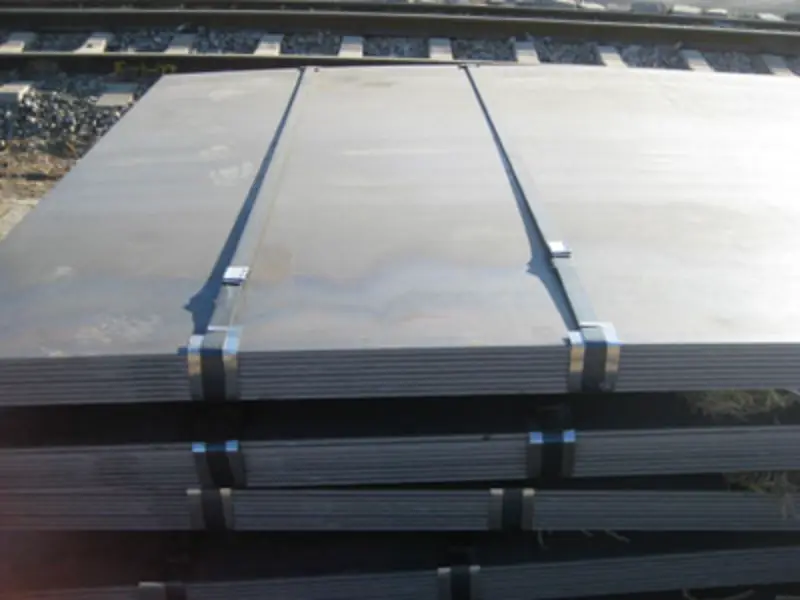
Complete Material Guide for DNV Grade A620 Shipbuilding Steel Plate
DNV Grade A620 Shipbuilding Steel Plate: High-Strength Quenched & Tempered Marine Steel
Detailed material data for DNV Grade A620 shipbuilding steel plate including chemical composition, mechanical and thermal properties, international equivalents, and applications.
Hot rolling, quenching and tempering, normalised rolling possible for some thicknesses; suitable for welding, cold forming and machining.
- Phone : +8618037372205
- Email : [email protected]
- WhatsApp: Contact via Whtsapp
- WeChat: +8618037372205
Complete Material Guide for DNV Grade A620 Shipbuilding Steel Plate Introduction
DNV Grade A620 is a high-strength, quenched and tempered structural steel plate primarily used in shipbuilding and offshore constructions. Classified according to the Det Norske Veritas (DNV) rules, it offers a minimum yield strength of 620 MPa with guaranteed Charpy impact toughness at 0 °C. Key features include excellent weldability, high strength-to-weight ratio, and reliable low-temperature toughness, making it suitable for critical structural components in harsh marine environments. The steel is produced via controlled rolling followed by quenching and tempering to achieve a fine-grained bainitic/martensitic microstructure.
Complete Material Guide for DNV Grade A620 Shipbuilding Steel Plate Chemical Composition
Typical ladle analysis according to DNV rules for high-strength structural steels. Microalloying elements like Nb, V, Ti are added to refine grain and improve strength and toughness. Carbon equivalent (Ceq) is controlled to ensure weldability.
| Element | Content (%) | Remarks |
|---|---|---|
| Carbon (C) | ≤0.20 | Ladle analysis |
| Silicon (Si) | 0.10 – 0.55 | Typically required |
| Manganese (Mn) | 0.90 – 1.70 | Adjust for strength |
| Phosphorus (P) | ≤0.025 | Max |
| Sulfur (S) | ≤0.025 | Max |
| Chromium (Cr) | ≤1.50 | Optional |
| Nickel (Ni) | ≤2.00 | Optional, improves toughness |
| Molybdenum (Mo) | ≤0.70 | Optional |
| Copper (Cu) | ≤0.50 | Optional |
| Niobium (Nb) | ≤0.06 | Microalloy |
| Vanadium (V) | ≤0.12 | Microalloy |
| Titanium (Ti) | ≤0.05 | Microalloy |
| Aluminium (Al) | ≥0.015 | Total aluminium |
| Nitrogen (N) | ≤0.015 | Max (if not Al-killed) |
| Boron (B) | ≤0.005 | Optional |
| Carbon equivalent (Ceq) | ≤0.52 typically | Ceq = C + Mn/6 + (Cr+Mo+V)/5 + (Ni+Cu)/15 |
Complete Material Guide for DNV Grade A620 Shipbuilding Steel Plate Thermal and Electrical Physical Properties
Typical physical properties for quenched and tempered high-strength steel at room temperature unless otherwise noted. These values may vary slightly depending on exact chemical composition and heat treatment condition.
| Property | Value | Unit | Test Condition |
|---|---|---|---|
| Density (ρ) | 7.85 | g/cm³ | At 20 °C |
| Modulus of elasticity (E) | 200 – 210 | GPa | At 20 °C |
| Shear modulus (G) | 80 – 81 | GPa | Calculated |
| Poisson's ratio (ν) | 0.30 | – | Elastic range |
| Thermal expansion coefficient (α) | 11.5 – 12.5 | 10⁻⁶/K | 20 – 100 °C |
| Thermal expansion coefficient (α) | 12.5 – 13.5 | 10⁻⁶/K | 20 – 200 °C |
| Thermal conductivity (λ) | 35 – 45 | W/(m·K) | At 20 °C |
| Specific heat capacity (cp) | 460 – 500 | J/(kg·K) | At 20 °C |
| Electrical resistivity (ρe) | 0.25 – 0.35 | μΩ·m | At 20 °C |
Complete Material Guide for DNV Grade A620 Shipbuilding Steel Plate Mechanical Properties
Mechanical properties as required by DNV for Grade A620 steel plate. Tensile test is conducted at room temperature, and Charpy V-notch impact test is performed at 0 °C. Properties may vary with thickness; values below represent minimum requirements for longitudinal test pieces.
| Property | Value | Unit | Test Condition / Remarks |
|---|---|---|---|
| Yield strength (ReH) | ≥620 | MPa | Thickness ≤ 50 mm |
| Yield strength (ReH) | ≥580 | MPa | 50 < t ≤ 100 mm |
| Tensile strength (Rm) | 720 – 890 | MPa | All thicknesses |
| Elongation (A5) | ≥15 | % | Gauge length 5.65√So |
| Charpy impact energy (KV2) | ≥27 (longitudinal) | J | At 0 °C, average of 3 tests, single min. 19 J |
| Charpy impact energy (KV2) | ≥20 (transverse) | J | At 0 °C, average of 3 tests, single min. 14 J (if applicable) |
| Bend test (mandrel diameter) | d = 4a (bend angle 180°) | – | a = specimen thickness; no cracks |
Complete Material Guide for DNV Grade A620 Shipbuilding Steel Plate Fully Equivalent Material Standards and Substitution Grades
| Region | Standard | Grade | Remarks |
|---|---|---|---|
| International (IACS) | DNV Rules | NV A620 | Original classification |
| USA / International | ABS Rules | ABS AQ620 | Identical requirements |
| UK / International | Lloyd's Register Rules | LR A620 | Identical requirements |
| France / International | Bureau Veritas Rules | BV A620 | Identical requirements |
| China / International | CCS Rules | CCS A620 | Identical requirements |
| Japan / International | ClassNK Rules | NK KA620 | Identical requirements |
| Italy / International | RINA Rules | RINA A620 | Identical requirements |
| South Korea / International | Korean Register | KR RA620 | Identical requirements |
| Russia / International | Russian Maritime Register | RS A620 | Identical requirements |
Complete Material Guide for DNV Grade A620 Shipbuilding Steel Plate Application Introduction
DNV A620 steel plates are optimised for heavy-load marine and offshore structures where weight savings and high reliability are essential. The excellent combination of strength and toughness allows design of lighter hulls and critical components without compromising safety. Typical applications require good weldability under yard conditions, as well as resistance to brittle fracture at low service temperatures.
Product Applications: Ship hulls (container ships, bulk carriers, tankers, ice-class vessels), Offshore platform topsides and jackets, Offshore wind turbine monopiles and substructures, Crane pedestals, A-frames and heavy lift booms, Pressure vessels built into marine structures, Bridge structures over waterways
Processed into products: Deck plates and sheer strakes, Bottom shell plates and bilge keels, Hatch coamings and coaming stays, Longitudinal stiffeners and frames, Rudder horns and rudder plates, Offshore module support beams and columns, Brackets, gusset plates and high-stress connections, Crane boom chords and lattice members
Application industries: Shipbuilding and ship repair (commercial and naval vessels), Offshore oil & gas (platforms, FPSOs, rigs), Marine engineering and port structures, Renewable energy (offshore wind turbine foundations, transition pieces), Heavy lifting and transport equipment
Complete Material Guide for DNV Grade A620 Shipbuilding Steel Plate Similar / Alternative Materials Recommendation
| Region | Standard | Grade | Remarks |
|---|---|---|---|
| Europe | EN 10025-6 | S620Q / S620QL | Comparable quenched & tempered structural steel with min. yield 620 MPa; direct substitution often possible with thickness adjustment |
| USA | ASTM A514 / A517 | Grade S (or other grades) | High-strength quenched & tempered alloy steel plate with yield ≥620 MPa; used in structures and pressure vessels, but not ship-specific |
| USA | ASTM A710 | Grade A | Age-hardening steel, similar strength level, but different metallurgy |
| International | API 2Y | Grade 60 (≥414 MPa) | Offshore structural steel; A620 significantly higher strength |
| International | EN 10225 | S620G1 / S620G2 | Weldable structural steels for fixed offshore structures, similar mechanical properties |
Notes:
Welding: Preheat and interpass temperature control are recommended based on thickness and carbon equivalent. Low-hydrogen welding consumables are mandatory. Tolerances: Dimensional tolerances shall be as per DNV rules or agreed upon purchase order. Certification: Material must be delivered with DNV inspection certificate 3.1 or 3.2 as per EN 10204.
- Share



