
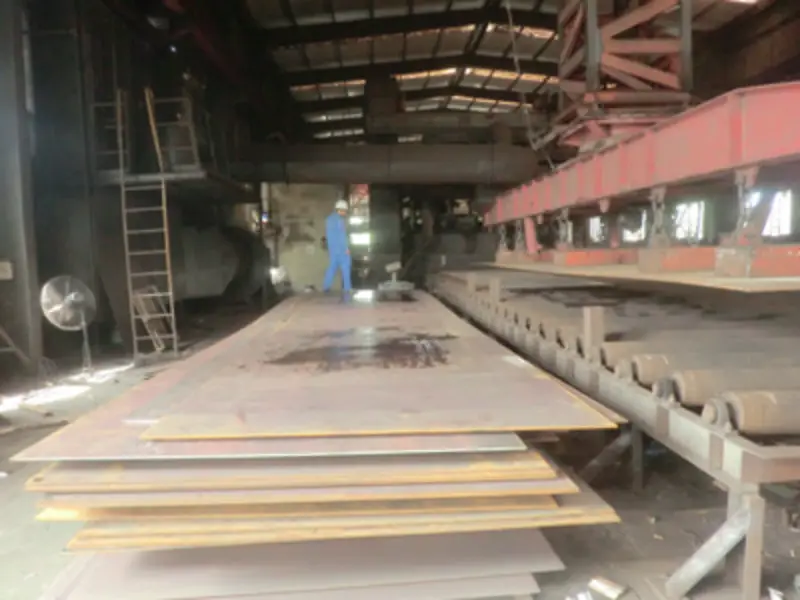
DNV Grade D620 Shipbuilding Steel Plate
DNV Grade D620 Ultra-High Strength Shipbuilding Steel Plate | Chemical & Mechanical Properties & Equivalent Grades
Comprehensive technical data for DNV Grade D620 shipbuilding steel plate: chemical composition, mechanical properties, thermal and electrical physical properties, international equivalent grades, and application guide. Ideal for offshore structures and heavy ship components.
Hot rolling, thermomechanical controlled processing (TMCP) with optional accelerated cooling, followed by quenching and tempering (Q+T). Can be cut, welded, formed, and machined.
- Phone : +8618037372205
- Email : [email protected]
- WhatsApp: Contact via Whtsapp
- WeChat: +8618037372205
DNV Grade D620 Shipbuilding Steel Plate Introduction
DNV Grade D620 is an extra-high strength shipbuilding structural steel plate certified by DNV (Det Norske Veritas) classification society. It belongs to the 420-690 MPa yield strength family and is designed for critical offshore and marine applications where high load-bearing capacity, excellent weldability, and superior low-temperature toughness are required. The steel is typically supplied in the quenched and tempered (Q+T) condition, offering a minimum yield strength of 620 MPa and tensile strength in the range of 720-890 MPa. D620 exhibits good formability, resistance to brittle fracture, and can be welded with proper preheating and heat input control.
Main characteristics include:
- High strength-to-weight ratio for weight reduction in large structures
- Excellent notch toughness down to -20°C (grade D)
- Good weldability with low carbon equivalent (CEV typically ≤0.52)
- Available in plate thicknesses up to 100 mm and beyond with special agreement
- Fully killed and fine-grained microstructure for uniform properties
DNV Grade D620 Shipbuilding Steel Plate Chemical Composition
The following table presents the maximum permissible limits for chemical elements in DNV Grade D620 according to DNV Rules Pt.2 Ch.2. The steel is fully killed with fine-grain practice. Microalloying elements such as Nb, V, Ti, and Al are added to ensure high strength and toughness. Sulfur and phosphorus levels are kept low to improve ductility and welding properties.
Note:Values are in weight percent unless a range is specified. The sum of Nb+V+Ti is typically limited to ≤0.12%. Carbon equivalent (CEV) is normally ≤0.52% for good weldability.
| Element | Standard Value (max unless range given) | Remarks |
|---|---|---|
| Carbon (C) | 0.20 | Max. limits for t ≤ 100 mm |
| Silicon (Si) | 0.10 - 0.55 | Typical range; max. 0.55 |
| Manganese (Mn) | 1.00 - 1.70 | May be adjusted for CEV |
| Phosphorus (P) | 0.025 | Low P for toughness |
| Sulfur (S) | 0.020 | Strictly controlled for ductility |
| Chromium (Cr) | 0.80 | Allowable maximum |
| Nickel (Ni) | 1.00 | Optional; enhances low-temperature toughness |
| Molybdenum (Mo) | 0.50 | Improves hardenability |
| Copper (Cu) | 0.50 | Atmospheric corrosion resistance; max. limit |
| Niobium (Nb) | 0.05 | Grain refiner |
| Vanadium (V) | 0.10 | Precipitation strengthener |
| Titanium (Ti) | 0.05 | Low addition for grain refinement |
| Aluminium (Al, total) | ≥0.015 | Minimum for deoxidation |
| Nitrogen (N) | 0.015 | Max. to avoid aging effects |
| Carbon Equivalent (CEV) | ≤0.52 (typical) | CEV = C + Mn/6 + (Cr+Mo+V)/5 + (Ni+Cu)/15 |
DNV Grade D620 Shipbuilding Steel Plate Thermal and Electrical Physical Properties
The data below represent typical physical properties for quenched and tempered high-strength structural steels at room temperature and elevated temperatures. They are not specified by DNV but are commonly used for design calculations. Density, elastic modulus, and thermal expansion are taken from published metallurgical references for similar steel grades.
| Property | Typical Value | Unit | Test Condition / Remarks |
|---|---|---|---|
| Density (ρ) | 7.85 | g/cm³ | At 20 °C |
| Elastic Modulus (E) | 205 | GPa | At 20 °C (dynamic method) |
| Shear Modulus (G) | 80 | GPa | Calculated; G = E / [2(1+ν)] |
| Poisson's Ratio (ν) | 0.3 | — | In the elastic range |
| Thermal Expansion Coefficient (α) | 12.0 | 10⁻⁶/K | Between 20 °C and 100 °C |
| Thermal Expansion Coefficient (α) | 12.5 | 10⁻⁶/K | Between 20 °C and 200 °C |
| Thermal Expansion Coefficient (α) | 13.0 | 10⁻⁶/K | Between 20 °C and 300 °C |
| Thermal Conductivity (λ) | 40 | W/(m·K) | At 20 °C |
| Specific Heat Capacity (c) | 460 | J/(kg·K) | At 20 °C |
| Electrical Resistivity (ρ_e) | 0.25 | μΩ·m (10⁻⁶ Ω·m) | At 20 °C (approx.) |
DNV Grade D620 Shipbuilding Steel Plate Mechanical Properties
The following mechanical properties apply to DNV Grade D620 plates in the quenched and tempered condition. Values are according to DNV Rules Pt.2 Ch.2 Sec.2. Test specimens are taken in the transverse direction unless noted otherwise. Impact test temperature for Grade D is -20°C, with minimum absorbed energy of 27 J (longitudinal). Bending test uses a mandrel diameter of 3×thickness for plates with tensile strength >590 MPa.
Note: Properties may vary slightly with thickness; representative values for common thickness ranges are shown.
| Property | Standard Requirement Value | Unit | Test Condition / Thickness |
|---|---|---|---|
| Yield Strength (ReH) | 620 (min.) | MPa | Transverse, t ≤ 100 mm |
| Tensile Strength (Rm) | 720 - 890 | MPa | Transverse, t ≤ 100 mm |
| Elongation after fracture (A5) | 16 (min.) | % | Longitudinal, t ≤ 50 mm |
| Elongation after fracture (A5) | 15 (min.) | % | Longitudinal, 50 < t ≤ 100 mm |
| Elongation after fracture (A5) | 14 (min.) | % | Transverse, t ≤ 50 mm |
| Elongation after fracture (A5) | 13 (min.) | % | Transverse, 50 < t ≤ 100 mm |
| Bending Test – mandrel diameter | 3 × thickness (a) | - | 180° bend, no cracks |
| Impact Energy (KV) at -20°C | 27 (min.) | J (Joules) | Charpy V-notch, longitudinal, t ≤ 50 mm |
| Impact Energy (KV) at -20°C | 27 (min.) | J | Charpy V-notch, longitudinal, 50 < t ≤ 100 mm |
DNV Grade D620 Shipbuilding Steel Plate Fully Equivalent International Standards & Substitute Grades
DNV Grade D620 has direct counterparts in other major classification societies' rules for extra-high strength shipbuilding steels with a minimum yield strength of 620 MPa and impact test at -20°C (or equivalent temperature). These grades are fully interchangeable for marine applications.
| Country/ Region | Standard | Grade/ Designation | Remarks |
|---|---|---|---|
| International | ABS Rules for Building and Classing Steel Vessels | EQ70 | Identical yield strength (620 MPa) and impact grade E (-20°C test in ABS corresponds to D in DNV) |
| United Kingdom | Lloyd's Register Rules | FH70 | FH designates extra-high strength 620 MPa, -20°C impact. '70' refers to 70 ksi minimum UTS equivalent. |
| France | Bureau Veritas Rules | E620 | E indicates impact temperature -20°C, 620 yield strength. |
| China | CCS Rules for Classification of Sea-going Steel Ships | FH620 | CCS FH620 matches D620 in strength and toughness. |
| Japan | ClassNK Rules | KE620 | K denotes high-strength steel, E for -20°C, 620 yield. |
| Italy | RINA Rules | E620 | Same strength and impact designation. |
| Korea | KR Rules | RE620 | R indicates high-tensile, E for -20°C, 620 yield. |
DNV Grade D620 Shipbuilding Steel Plate Application Introduction
DNV Grade D620 is utilized where high strength, reduced weight, and reliable toughness at low temperatures are essential. Its typical applications span the offshore, shipbuilding, and heavy engineering sectors.
Key application areas:
Product Applications: Self-elevating drilling units (jack-up rigs) – main legs and spudcans, Heavy lift crane vessels (HLV) – crane booms and pedestals, Large container ships and ice-class vessels – hull plating and deck structures, Subsea pressure vessels and pipelines, Offshore wind turbine substructures – transition pieces and jacket legs
Processed into products: Rack and pinion drives for jack-ups, Chords and braces of offshore platforms, Ship frames, stiffeners, and brackets for high-stress areas, Gantry crane girders and trolley support structures, Welded T-joints and K-joints in tubular constructions
Application industries: Marine & Offshore Engineering, Shipbuilding (defense and commercial), Port & Heavy Lifting Equipment, Renewable Energy (offshore wind foundations)
DNV Grade D620 Shipbuilding Steel Plate Similar / Alternative Materials
The grades listed below have comparable mechanical properties (yield strength ~620 MPa, tensile ~720-890 MPa) and are often used for offshore/heavy structural applications but may not always carry separate ship classification society certificates or have identical impact test temperatures. Process adjustments or supplementary testing may be required for full substitution.
| Country/ Region | Standard | Grade | Remarks |
|---|---|---|---|
| European Union | EN 10025-6 | S620Q (1.8914) | Quenched and tempered structural steel with similar strength; impact temperature may differ (e.g., -20°C at J or L quality). Not specifically marine-certified. |
| European Union | EN 10225 | S620G1+M / S620G2+Q | Weldable structural steels for fixed offshore structures; impact testing often at -40°C or -50°C, higher toughness. |
| USA | ASTM A514 / A517 | Grade B, H, E | Quenched and tempered alloy steel plate with min. yield 690 MPa and min. tensile 760 MPa; slightly overstrength but can be used if strength margins are acceptable and toughness is matched. |
| USA | ASTM A709 / AASHTO | Grade HPS 690W | High-performance steel for bridges; yield ≥ 690 MPa; not for marine classification. |
| International | ISO 4950-2 | S620Q | Similar to EN 10025-6 S620Q. |
Notes:
Welding and fabrication: D620 requires low-hydrogen welding processes (SMAW, SAW, GMAW) with appropriate preheat (typically 100-200°C depending on thickness) and controlled interpass temperature. Post-weld heat treatment (PWHT) is usually not required for thicknesses below 50 mm but may be considered for thicker sections to reduce residual stresses.
Corrosion protection: In marine environments, coating systems (e.g., zinc-rich epoxy primer with antifouling topcoats) or cathodic protection are recommended.
Ordering information: When ordering, specify: - Standard: DNV Rules Pt.2 Ch.2 - Grade D620 - Dimensions and thickness - Impact test temperature (-20°C) - Delivery condition: Q+T - Any special requirements (ultrasonic testing class, through-thickness property Z-test, etc.)
- Share



