
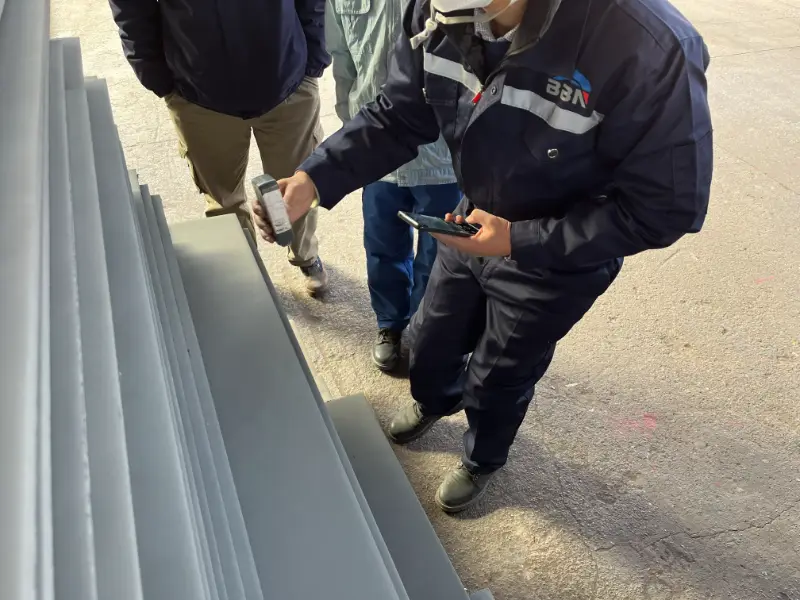
DNV Grade E620 Shipbuilding Steel Plate
DNV Grade E620 Shipbuilding Steel Plate: Ultra-High Strength & Weldability for Marine Structures
Explore DNV Grade E620, a premium quenched and tempered offshore steel with minimum yield strength of 620 MPa, exceptional toughness at -40°C, and superior weldability. Ideal for critical ship and offshore structures.
Thermal cutting, cold forming, welding (all common methods with proper preheat and consumables), machining
- Phone : +8618037372205
- Email : [email protected]
- WhatsApp: Contact via Whtsapp
- WeChat: +8618037372205
DNV Grade E620 Shipbuilding Steel Plate Introduction
DNV Grade E620 is a high-strength, quenched and tempered structural steel plate for shipbuilding and offshore applications, certified by DNV (Det Norske Veritas). It belongs to the extra-high-strength category with a specified minimum yield strength of 620 MPa. The steel is designed to provide excellent weldability, good low-temperature toughness (guaranteed at -40°C), and high resistance to brittle fracture, meeting the rigorous requirements of the DNV Rules for Classification of Ships. Typical delivery condition is quenched and tempered (Q&T). E620 plates are used in highly stressed parts of ships, offshore platforms, and marine equipment where weight savings and high load-bearing capacity are critical.
DNV Grade E620 Shipbuilding Steel Plate Chemical Composition
The chemical composition limits for DNV E620 are defined in the DNV rules. This grade is characterized by a low carbon equivalent (CEV) to ensure good weldability. Microalloying elements like Nb, V, Ti, and Al are added for grain refinement and precipitation strengthening. The maximum contents shown are in weight percent as per heat analysis; the product analysis tolerances are also specified in the standard.
| Element | Standard Requirement (max, %) | Remarks |
|---|---|---|
| Carbon (C) | 0.20 | For thickness ≤ 50 mm; 0.22 for > 50 mm |
| Silicon (Si) | 0.55 | For product analysis, may be slightly higher |
| Manganese (Mn) | 1.70 | The sum of Mn and C shall be considered for weldability |
| Phosphorus (P) | 0.025 | Steelmaking control is essential for toughness |
| Sulfur (S) | 0.025 | Low sulfur ensures good through-thickness properties |
| Chromium (Cr) | 1.50 | Optional but often present for strength |
| Nickel (Ni) | 2.0 | Improves toughness and hardenability |
| Molybdenum (Mo) | 0.70 | Increases high-temperature strength and hardenability |
| Copper (Cu) | 0.50 | May be added for corrosion resistance |
| Niobium (Nb) | 0.06 | Grain refiner and precipitation hardener |
| Vanadium (V) | 0.12 | Precipitation strengthening element |
| Titanium (Ti) | 0.05 | Grain refinement and nitrogen control |
| Aluminium (Al), total | 0.020 min | Fine grain practice; acid-soluble Al also accepted |
| Nitrogen (N) | 0.020 | Controlled to avoid strain ageing |
| Boron (B) | 0.005 | Optional for hardenability improvement |
| Carbon Equivalent (CEV) | Typically 0.46 – 0.55 | Calculated according to IIW formula; exact max depends on thickness and tensile class |
DNV Grade E620 Shipbuilding Steel Plate Thermal & Electrical Physical Properties
The following physical properties are typical for quenched and tempered high-strength low-alloy steels similar to E620. They are not mandatory in the DNV standard but are useful for design calculations. Values may vary slightly depending on the exact chemical composition and heat treatment.
| Property | Typical Value | Unit | Test Condition / Remarks |
|---|---|---|---|
| Density (ρ) | 7850 | kg/m³ | At 20 °C |
| Modulus of elasticity (E) | 205 | GPa | At 20 °C, longitudinal |
| Shear modulus (G) | 80 | GPa | At 20 °C |
| Poisson's ratio (ν) | 0.30 | – | Elastic range |
| Thermal expansion coefficient (α) | 12.0 × 10⁻⁶ | K-1 | Between 20 °C and 100 °C |
| Thermal expansion coefficient (α) | 13.0 × 10⁻⁶ | K-1 | Between 20 °C and 400 °C |
| Thermal conductivity (λ) | 35 | W/(m·K) | At 20 °C |
| Thermal conductivity (λ) | 33 | W/(m·K) | At 200 °C |
| Specific heat capacity (c) | 460 | J/(kg·K) | At 20 °C |
| Electrical resistivity (ρe) | 0.25 × 10⁻⁶ | Ω·m | At 20 °C |
DNV Grade E620 Shipbuilding Steel Plate Mechanical Properties
The mechanical properties are determined on transverse test pieces taken from the plate. The values apply to thicknesses typically up to 100 mm; for greater thicknesses, some reduction in properties may be agreed upon. The minimum impact energy is specified at -40 °C for Grade E. For thinner products, the test piece orientation and dimensions are according to ISO 6892-1 and ISO 148-1.
| Property | Required Value | Unit | Test Condition / Remarks |
|---|---|---|---|
| Yield strength (ReH) | 620 min | MPa | For thickness ≤ 50 mm; ≥ 580 MPa for 50–100 mm |
| Tensile strength (Rm) | 720 – 890 | MPa | Entire thickness range |
| Elongation (A5) | 14 min | % | Gauge length L0 = 5.65√S0, for thickness ≤ 50 mm |
| Elongation (A5) | 15 min | % | For 50 < thickness ≤ 100 mm |
| Charpy impact (KV, longitudinal) | 69 min (average) / 52 min (single) | J | At -40 °C, V-notch, transverse testing also possible |
| Charpy impact (KV, transverse) | 46 min (average) / 35 min (single) | J | At -40 °C, when specified for transverse properties |
| Bend test (bending angle) | 180° | degrees | Mandrel diameter: 3t for t ≤ 50 mm, 4t for 50 < t ≤ 100 mm, no cracks |
DNV Grade E620 Shipbuilding Steel Plate Fully Equivalent Material Standards & Substitutable Grades
The following designations from other major classification societies are considered directly equivalent to DNV E620, as they are all based on the same IACS (International Association of Classification Societies) unified requirement for extra-high-strength quenched and tempered steels. These grades are interchangeable for marine applications upon approval by the respective society.
| Country/Region | Standard / Classification Society | Grade Designation | Remarks |
|---|---|---|---|
| International | American Bureau of Shipping (ABS) | EQ62 | Yield 620 MPa, -40 °C impact |
| International | Lloyd's Register (LR) | FH62 | Equivalent for plate; F indicates fine grain |
| International | Bureau Veritas (BV) | E620 | Same grade nomenclature |
| International | China Classification Society (CCS) | F620 | F means yield 620 MPa, -40 °C |
| International | RINA (Italy) | F620 | Toughness class F, yield 620 MPa |
| International | ClassNK (Nippon Kaiji Kyokai) | KE620 | K indicates extra-high strength |
| International | Korean Register (KR) | RE62 | R for high strength, class -40 °C |
DNV Grade E620 Shipbuilding Steel Plate Application Introduction
DNV E620 steel plates are specifically designed for highly loaded marine and offshore structures where excellent strength-to-weight ratio, outstanding notch toughness at low temperatures, and reliable weldability are mandatory. Its superior mechanical properties allow for thinner, lighter designs without compromising safety. Key application areas include:
Product Applications: Hull and deck plating of large container ships and VLCCs, Jack-up rig legs, spudcans, and cantilever structures, Upper hull and node sections of semi-submersibles, Transition pieces and monopiles for offshore wind farms, Offshore crane booms and pedestals, Highly stressed underwater equipment frames and supports
Processed into products: Ship hull stiffeners and girders, Deck panels and hatch coamings, Column and brace members of jacket structures, Truss members for heavy-lift ship-mounted cranes, Quarter- and butt-weld details for very thick plate assemblies, Padeyes, brackets, and connecting plates in lifting systems
Application industries: Shipbuilding (naval and commercial vessels), Offshore oil & gas (fixed and floating platforms), Renewable energy (offshore wind turbine foundations, substructures), Heavy-lift and crane manufacturing, Pressure vessels and boilers for marine service
DNV Grade E620 Shipbuilding Steel Plate Similar / Equivalent Alternative Materials
These grades are not identical but exhibit comparable mechanical characteristics (yield strength around 620-690 MPa) and are often considered for similar applications. Some have higher or slightly lower strength and may require additional engineering assessment for substitution.
| Country/Region | Standard | Grade | Remarks |
|---|---|---|---|
| Europe | EN 10025-6 | S690Q / S690QL | Quenched and tempered structural steel, min. yield 690 MPa; slightly higher strength; good toughness |
| Europe | EN 10025-6 | S620Q | Direct 620 MPa grade; not always available; E620 is often selected instead |
| USA | ASTM A709 / A709M | Grade 690W (HPS 690W) | High-performance steel for bridges, 690 MPa yield; chemistry and carbon equivalent may differ |
| USA | ASTM A514 / A517 | Grade F / Grade Q | Quenched and tempered alloy steel plates, 690 MPa yield; used in structural and pressure vessel applications |
| Japan | JIS G 3128 | SHY 685 / SHY 685N | High yield strength steel for welded structures, min. yield 685 MPa; similar weldability |
| International | API RP 2A | API 2H Grade 70 | Offshore structural steel with 690 MPa yield; not identical to E620 but overlapping in use |
Notes:
The CEV (carbon equivalent value) must be controlled within the range defined by DNV to guarantee weldability without cold cracking. Preheating and interpass temperatures should be followed according to the consumable manufacturer's recommendations and the DNV approved welding procedure specification. For thicknesses above 50 mm, the minimum yield strength is reduced to 580 MPa. Through-thickness (Z-direction) properties, if required, shall be agreed upon and tested according to DNV rules.
- Share



