
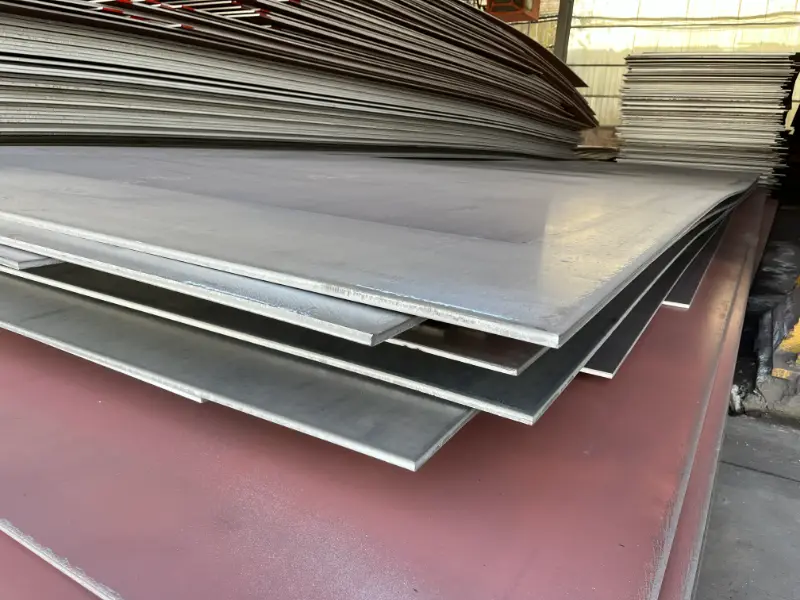
DNV Grade F620 Shipbuilding Steel Plate
DNV Grade F620 Shipbuilding Steel Plate: Ultra-High Strength Quenched & Tempered Marine Steel
DNV F620 is a weldable fine-grain structural steel plate with a minimum yield strength of 620 MPa, certified by DNV. It is designed for demanding shipbuilding and offshore applications where high strength, excellent toughness at low temperatures, and good weldability are required.
Cutting, cold forming, hot forming, welding (preheating may be required), and machining
- Phone : +8618037372205
- Email : [email protected]
- WhatsApp: Contact via Whtsapp
- WeChat: +8618037372205
DNV Grade F620 Shipbuilding Steel Plate Introduction
DNV Grade F620 is an ultra-high strength quenched and tempered (Q&T) structural steel plate produced in accordance with DNV rules for ship classification. It belongs to the group of fine-grain, thermomechanically rolled or heat-treated steels with a guaranteed minimum yield strength of 620 MPa. The steel exhibits a superior combination of high strength, excellent low-temperature notch toughness (Charpy impact test at -60°C for the 'F' quality level), and good weldability when proper procedures are followed.
- Key features: Yield strength ≥ 620 MPa, tensile strength 720–890 MPa, excellent ductility, and guaranteed impact properties down to -60°C.
- Delivery condition: Normally supplied in the quenched and tempered (Q&T) condition, with possible tempering or normalizing treatments depending on thickness and application requirements.
- Applications: Primary structural members of ships, offshore platforms, jack-up rigs, heavy-lift crane booms, pressure vessels, and subsea equipment operating in Arctic or harsh marine environments.
DNV Grade F620 Shipbuilding Steel Plate Chemical Composition
The chemical composition complies with DNV rules for F620 grade. Elements are carefully balanced to achieve high strength and toughness while maintaining weldability.
- Microalloying: Niobium, vanadium, titanium, and aluminium are added singly or in combination for grain refinement and precipitation strengthening.
- Maximum limits: Impurity elements like phosphorus and sulfur are strictly controlled to ensure ductility and resistance to brittle fracture.
- Actual mill certificates may show slightly lower carbon and alloy contents for enhanced weldability.
| Element | Standard Value (Max, unless range) | Remarks |
|---|---|---|
| Carbon (C) | ≤ 0.20% | Product analysis may allow +0.02% |
| Silicon (Si) | ≤ 0.60% | Killed steel; typically 0.10–0.60% |
| Manganese (Mn) | 0.90–1.70% | Enhances hardenability and strength |
| Phosphorus (P) | ≤ 0.020% | Lower for better ductility |
| Sulfur (S) | ≤ 0.015% | Low sulfur for notch toughness |
| Chromium (Cr) | ≤ 0.30% | Optional; contributes to strength |
| Nickel (Ni) | ≤ 0.50% | Optional; improves low-temperature toughness |
| Molybdenum (Mo) | ≤ 0.10% | Optional; increases hardenability |
| Copper (Cu) | ≤ 0.35% | Optional; weather resistance |
| Nitrogen (N) | ≤ 0.015% | Total nitrogen including bound nitride |
| Aluminium (Al) | ≥ 0.015% | Acid-soluble; grain refining |
| Niobium (Nb) | ≤ 0.05% | Microalloy grain refiner |
| Vanadium (V) | ≤ 0.10% | Microalloy; precipitation hardening |
| Titanium (Ti) | ≤ 0.05% | Microalloy; deoxidation and grain refinement |
| Niobium + Vanadium + Titanium | ≤ 0.12% | Sum of microalloying elements |
| Carbon Equivalent (CEV) | ≤ 0.50% (typical) | Calculated as C + Mn/6 + (Cr+Mo+V)/5 + (Ni+Cu)/15 |
DNV Grade F620 Shipbuilding Steel Plate Physical Properties
Physical properties are approximate and typical for low-alloy carbon steel plates in the quenched and tempered condition. Values may vary slightly with chemical composition and heat treatment. They are provided for engineering calculations and are not part of the mandatory certification.
- Data apply to temperatures around 20–25°C unless noted.
- Thermal expansion is an average coefficient between 20°C and 100°C.
- Electrical resistivity increases with temperature.
| Property | Standard Required Value | Unit | Test Conditions |
|---|---|---|---|
| Density (ρ) | 7850 | kg/m³ | Room temperature |
| Elastic Modulus (E) | 205 – 210 | GPa | Room temperature, tension |
| Shear Modulus (G) | 79 – 81 | GPa | Room temperature |
| Poisson's Ratio (ν) | 0.29 – 0.30 | – | Within elastic range |
| Thermal Expansion Coefficient (α) | 12.0 × 10⁻⁶ | K⁻¹ | 20–100°C average |
| Thermal Conductivity (λ) | 40 – 45 | W/(m·K) | At 20°C |
| Specific Heat Capacity (cp) | 460 – 480 | J/(kg·K) | At 20°C |
| Electrical Resistivity (ρe) | 0.20 – 0.25 × 10⁻⁶ | Ω·m | At 20°C |
DNV Grade F620 Shipbuilding Steel Plate Mechanical Properties
The mechanical properties are guaranteed for plates in the quenched and tempered condition, tested at the specified thickness ranges. Tensile testing is performed on round or flat specimens at room temperature. Impact energies are determined on Charpy V-notch specimens at -60°C for the F grade.
- Yield strength remains above 620 MPa for thicknesses up to 100 mm (subject to certification).
- Elongation values apply to longitudinal specimens; transverse values may be slightly lower.
- All values are minimum unless a range is given.
| Property | Standard Required Value | Unit | Test Conditions |
|---|---|---|---|
| Yield Strength (ReH) | ≥ 620 | MPa | Room temperature; thickness ≤ 100 mm |
| Yield Strength (ReH) | ≥ 580 | MPa | Thickness > 100 mm (by agreement) |
| Tensile Strength (Rm) | 720 – 890 | MPa | Room temperature |
| Elongation (A5, longitudinal) | ≥ 15 | % | Gauge length 5.65√So; thickness ≤ 50 mm |
| Elongation (A5, longitudinal) | ≥ 14 | % | Thickness > 50 to 100 mm |
| Elongation (A5, transverse) | ≥ 13 | % | Transverse test piece, thickness ≤ 50 mm |
| Charpy Impact Energy (KV2, -60°C) | ≥ 27 (average) | J | Transverse, -60°C, 3 specimen average |
| Charpy Impact Energy (KV2, -60°C) | ≥ 20 (single min.) | J | Single test result |
| Bend Test (180° bend) | D = 3a (t ≤ 25 mm) | mm | Mandrel diameter D, specimen thickness a |
| Bend Test (180° bend) | D = 4a (25 < t ≤ 50) | mm | No cracks are permitted |
DNV Grade F620 Shipbuilding Steel Plate Fully Equivalent International Standards and Replacement Grades
| Country / Region | Standard | Grade | Remarks |
|---|---|---|---|
| International (IACS) | IACS UR W11 | F620 | Unified Requirement for normal and higher strength hull structural steel |
| USA | ABS Rules | ABS Grade F620 | Corresponds to 620 MPa yield strength, -60°C impact |
| UK | Lloyd's Register Rules | LR FH620 | F indicates fine-grain, H for higher strength (identical mechanicals) |
| France | Bureau Veritas Rules | BV F620 | Equivalent to DNV F620 |
| China | CCS Rules | CCS F620 | China Classification Society, same definition |
| Italy | RINA Rules | RINA F620 | Recognised equivalent |
| Japan | ClassNK Rules | NK F620 | Nippon Kaiji Kyokai grade |
| Korea | Korean Register Rules | KR F620 | Same chemical and mechanical boundaries |
| Germany | GL Rules | GL F620 | Now part of DNV GL; legacy notation |
| Generic Euronorm | EN 10025-6 | S700Q or S690Q | Not ship-specific but similar strength class; see similar materials |
DNV Grade F620 Shipbuilding Steel Plate Application Introduction
DNV F620 steel is engineered for heavy-duty ship and offshore structures where weight reduction, high strength, and reliable low-temperature toughness are critical. The quenched and tempered condition provides an optimum balance of mechanical properties, but care must be taken during fabrication to preserve the tempering effects.
- Welding: Low hydrogen process, preheat and interpass temperature control, and post-weld heat treatment may be needed depending on thickness. Consumables matching the 620 MPa yield class are recommended.
- Forming: Cold forming is possible with generous radius; hot forming must be followed by a re-tempering treatment to restore properties.
- Corrosion protection: As a non-stainless steel, surface coatings or cathodic protection are necessary in sea water immersion or splash zones.
Product Applications: Hull plates and stiffeners for Arctic-class vessels, Upper deck and bottom structures of large container ships, Leg chords and rack chocks of self-elevating drilling units, Bearing pads and high-load structural nodes, Offshore module support frames, Heavy-lift mast and boom sections
Processed into products: Jack-up rig chord members, Spud can transition pieces, Ice belt plating, Crane slewing ring supports, Subsea lifting eyes, Heavy deck beams, Submarine pressure hull segments, Tubular nodes for offshore jacket structures
Application industries: Shipbuilding (naval vessels, ice-strengthened ships, high-speed ferries), Offshore oil & gas (jack-up rig legs, spud cans, crane pedestals, riser hang-off structures), Offshore wind (transition pieces, heavy-lift crane booms), Defence (submarine hulls, aircraft carrier decks), Heavy engineering (hydraulic press frames, mining excavator booms, high-capacity crane structures)
DNV Grade F620 Shipbuilding Steel Plate Similar / Near-Equivalent Steel Grades for Comparison
| Country / Region | Standard | Grade | Remarks |
|---|---|---|---|
| International | DNV/ABS/LR etc. | E620 / EH620 | Same yield strength but impact test at -40°C instead of -60°C. Lower toughness. |
| Europe | EN 10025-6 | S690Q | Minimum yield 690 MPa; impact at -20°C (QL1) or -40°C (QL). Chemical limits similar, but not certified for shipbuilding. |
| USA | ASTM A514/A517 | Grade B / F | Quenched & tempered alloy steel; yield 690 MPa, used in structural applications; not marine certified. |
| USA | API 2Y / 2W | Grade 60 | Offshore structural steel, yield 414–620 MPa; notch toughness required. |
| Japan | JIS G 3128 | SHY685 / SHY685N | High yield point steel for welded structures; 685 MPa yield, similar shipbuilding qualification. |
| Europe | EN 10225 | S620G1+M / S620G2+M | Weldable structural steel for fixed offshore structures; 620 MPa yield, fully killed fine-grain. |
| Russia | GOST 5521 | E620 / F620 | Russian marine steel grades (if equivalent), often denoted with impact temperature suffix. |
Notes:
The data provided are based on publicly available information from DNV rules for the classification of ships and offshore units, typical mill certificates, and general engineering references. Actual delivered chemical composition and mechanical properties may be further restricted by supplementary requirements (e.g., Z-direction through-thickness properties, CTOD testing, or ultrasonic examination) as agreed between purchaser and steel manufacturer. Always consult the latest edition of DNV's 'Rules for Classification: Ships' and the project-specific material specification before ordering.
- Share



