
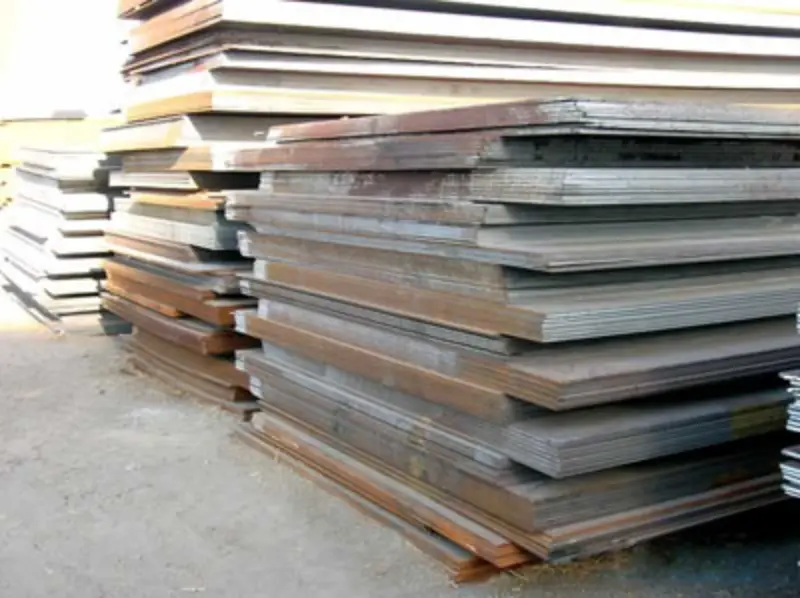
DNV Grade A690 Shipbuilding Steel Plate
DNV Grade A690 Shipbuilding Steel Plate - High-Strength Quenched & Tempered Marine Steel
Comprehensive technical data for DNV Grade A690 steel plate, including chemical composition, mechanical and physical properties, international equivalents, and application guide.
Hot rolling, quenching and tempering (Q&T), normalizing (optional for some gauges), cold forming (limited), welding (with preheat and controlled heat input)
- Phone : +8618037372205
- Email : [email protected]
- WhatsApp: Contact via Whtsapp
- WeChat: +8618037372205
DNV Grade A690 Shipbuilding Steel Plate Introduction
DNV Grade A690 is a high-strength, quenched and tempered structural steel plate certified by DNV (Det Norske Veritas) for shipbuilding and offshore applications. It provides a minimum yield strength of 690 MPa, combined with excellent toughness at low temperatures and good weldability after appropriate preheating. The steel is primarily used in critical load-bearing structures such as heavy-lift crane vessels, jack-up rig legs, and arctic-grade ship hulls where weight savings and high strength are essential. Its fine-grain microstructure, achieved through controlled rolling and heat treatment, ensures reliable performance under dynamic loads and harsh marine environments.
DNV Grade A690 Shipbuilding Steel Plate Chemical Composition
Typical chemical composition limits for DNV A690 as specified in DNV material standards. The steel is micro-alloyed with Cr, Ni, Mo, V, Ti, and Nb to achieve high strength and toughness. Carbon equivalent (CEV) is controlled to ensure good weldability. Low sulphur and phosphorus contents enhance cleanliness and impact properties.
| Element | Standard Value (max, unless range given) | Remarks |
|---|---|---|
| Carbon (C) | ≤ 0.20 | Heat analysis |
| Silicon (Si) | 0.10 – 0.50 | Heat analysis |
| Manganese (Mn) | ≤ 1.70 | Heat analysis |
| Phosphorus (P) | ≤ 0.025 | Heat analysis |
| Sulphur (S) | ≤ 0.015 | Heat analysis |
| Chromium (Cr) | ≤ 1.50 | Heat analysis |
| Nickel (Ni) | ≤ 2.0 | Heat analysis |
| Molybdenum (Mo) | ≤ 0.70 | Heat analysis |
| Copper (Cu) | ≤ 0.50 | Heat analysis |
| Vanadium (V) | ≤ 0.12 | Heat analysis |
| Titanium (Ti) | ≤ 0.05 | Heat analysis |
| Aluminium (Al total) | ≥ 0.020 | For grain refinement |
| Niobium (Nb) | ≤ 0.06 | Heat analysis |
| Nitrogen (N) | ≤ 0.015 | Heat analysis |
| Boron (B) | ≤ 0.005 | Optional, for hardenability |
| Carbon Equivalent (CEV) | ≤ 0.65 | CEV = C + Mn/6 + (Cr+Mo+V)/5 + (Ni+Cu)/15 |
DNV Grade A690 Shipbuilding Steel Plate Physical and Thermal Properties
The physical constants below are typical for quenched and tempered low-alloy steels similar to DNV A690. These values are not specified in the material standard but are useful for design calculations. Thermal conductivity and specific heat capacity vary with temperature; data provided for ambient conditions unless noted.
| Property | Typical Value | Unit | Test Condition |
|---|---|---|---|
| Density (ρ) | 7.85 | g/cm³ | 20 °C |
| Elastic modulus (E) | 210 | GPa | 20 °C, static |
| Shear modulus (G) | 81 | GPa | 20 °C, derived |
| Poisson's ratio (ν) | 0.3 | – | 20 °C, elastic range |
| Thermal expansion coefficient (α) | 11.7 × 10⁻⁶ | K⁻¹ | 20–100 °C |
| Thermal conductivity (λ) | 42 | W/(m·K) | 20 °C |
| Specific heat capacity (c) | 460 | J/(kg·K) | 20 °C |
| Electrical resistivity (ρ_e) | 0.22 | µΩ·m | 20 °C |
DNV Grade A690 Shipbuilding Steel Plate Mechanical Properties
Mechanical properties of DNV A690 are verified by tensile and impact testing in accordance with DNV rules. Values below refer to transverse test pieces unless otherwise stated. The yield and tensile strength requirements are divided into thickness ranges. Minimum impact energy at -40 °C ensures suitability for cold climate service.
| Property | Required Value | Unit | Test Condition / Remarks |
|---|---|---|---|
| Yield strength (ReH) | ≥ 690 | MPa | Thickness ≤ 50 mm |
| Yield strength (ReH) | ≥ 670 | MPa | 50 < t ≤ 100 mm |
| Yield strength (ReH) | ≥ 630 | MPa | 100 < t ≤ 150 mm |
| Tensile strength (Rm) | 770 – 940 | MPa | Thickness ≤ 50 mm |
| Tensile strength (Rm) | 760 – 930 | MPa | 50 < t ≤ 100 mm |
| Tensile strength (Rm) | 710 – 900 | MPa | 100 < t ≤ 150 mm |
| Elongation (A) | ≥ 14 | % | Gauge length 5.65√S₀; thickness ≤ 150 mm |
| Impact energy (KV₂) | ≥ 27 | J | Transverse, -40 °C; average of three tests, single min. 19 J |
DNV Grade A690 Shipbuilding Steel Plate Directly Equivalent Grades and Substitute Designations
| Country / Region | Standard | Grade / Designation | Remarks |
|---|---|---|---|
| Norway / DNV | DNV-OS-B101 | NV A690 | Original classification; often called DNV A690 |
| Europe | EN 10025-6 | S690Q / S690QL | Identical mechanical requirements; L-grade offers guaranteed low-temperature toughness (-40 °C or -50 °C) |
| USA | ASTM A514/A514M | Grade Q | Quenched & tempered alloy steel plate, 690 MPa YS; suitable for structural applications |
| USA | ASTM A517/A517M | Grade Q | Pressure vessel quality version of A514, similar strength and composition |
| Japan | JIS G3128 | SHY685 | High yield strength steel for welded structures, 685 N/mm² class, commonly used in shipbuilding |
| China | GB/T 16270 | Q690D / Q690E | High strength structural steel with impact test at -20 °C (D) or -40 °C (E); E grade preferred for direct substitution |
| International | ISO 4950-2 | S690Q | High yield strength flat products; technically equivalent |
DNV Grade A690 Shipbuilding Steel Plate Application Introduction
DNV A690 is designed for critical structural components where high strength-to-weight ratio, good low-temperature toughness, and weldability are mandatory. It is extensively used in marine and offshore engineering. Quenched and tempered condition provides superior mechanical properties but demands careful fabrication practices, including preheating before welding and post-weld heat treatment when necessary.
Product Applications: Heavy-lift crane vessels and their booms, Jack-up rig legs and spudcans, Ice-class ship hulls and frames, Offshore platform topsides and jacket structures, Subsea lifting appliances and padeyes, Pressure hulls of deep-sea submersibles
Processed into products: Reinforcement brackets and gussets, Crane pedestals and slewing rings, Pile sleeves and insert plates, Towline tension units, High-stress deck plating in way of mooring equipment, Fatigue-critical welded nodes in truss structures
Application industries: Marine & Shipbuilding, Offshore Oil & Gas, Renewable Energy (Offshore Wind), Heavy Lifting & Transport Engineering, Arctic Infrastructure
DNV Grade A690 Shipbuilding Steel Plate Similar and Comparable Steel Grades
| Country / Region | Standard | Grade | Remarks |
|---|---|---|---|
| Europe | EN 10025-6 | S690QL1 | Similar to S690QL but with even lower carbon equivalent and improved weldability; often specified for heavy offshore structures |
| USA | ASTM A514 | Grade S | Yield strength 690 MPa, differs in Ni and Cr content; suitable for structural use, not specifically ship classed |
| USA | API 2W | Grade 60 / 70 | TMCP steel for offshore platforms; slightly lower YS (414–483 MPa) but may be upgraded with higher thickness compensation |
| Japan | JIS G3106 | SM570TMC | TMCP steel with YS ≥ 460 MPa; not direct strength match but used in similar marine structural applications |
| China | GB/T 1591 | Q690D | High-strength low-alloy structural steel; mechanical properties comparable, may need additional ship class certification |
Notes:
Welding: Use low-hydrogen processes and consumables matching the strength level. Preheating (typically 100–175 °C, depending on thickness and CEV) is necessary to avoid cold cracking. Maximum heat input should be controlled to preserve the heat-affected zone toughness.
Forming: Cold forming radius should be at least 3 times the plate thickness to avoid strain-age embrittlement. Hot forming, if required, must be followed by re-tempering to restore properties.
Corrosion Protection: When used in marine environments, coating (e.g., zinc silicate or epoxy) and cathodic protection are recommended. DNV A690 has limited inherent corrosion resistance due to its low alloy content.
- Share



