
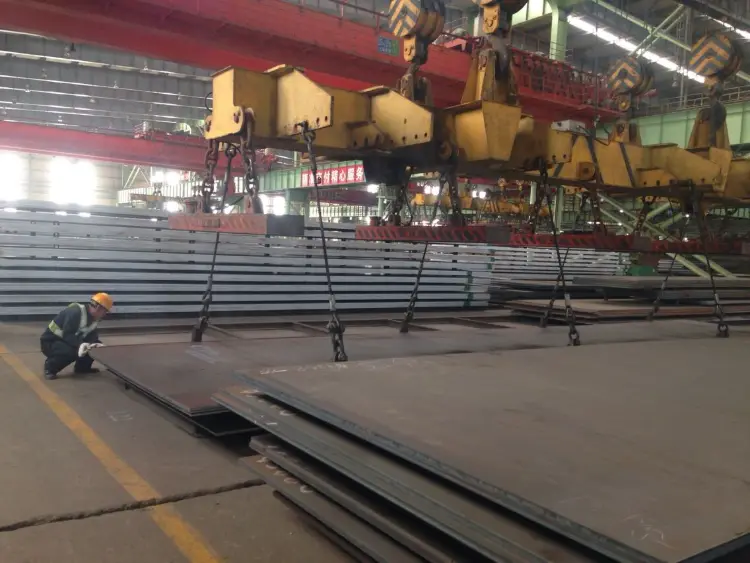
DNV Grade D690 Shipbuilding Steel Plate
DNV Grade D690 Shipbuilding Steel Plate - Properties, Equivalents & Applications
Complete material data for DNV D690 shipbuilding steel: chemical composition, mechanical & thermal properties, international equivalents, and application guide for marine engineering.
Hot rolling + Quenching and Tempering (Q&T); further processing: cutting, cold forming, welding (with preheating and PWHT guidelines)
- Phone : +8618037372205
- Email : [email protected]
- WhatsApp: Contact via Whtsapp
- WeChat: +8618037372205
DNV Grade D690 Shipbuilding Steel Plate Introduction
DNV Grade D690 is a high-strength, quenched and tempered structural steel plate primarily used in shipbuilding and offshore structures. Governed by the Det Norske Veritas (DNV) classification society rules, it offers a minimum yield strength of 690 MPa and excellent toughness at low temperatures (D-grade: -20°C Charpy impact). This steel provides high load-bearing capacity and good weldability, making it suitable for critical components in harsh marine environments. The material is typically supplied in the quenched and tempered condition (Q&T). Key features:
- High strength-to-weight ratio
- Excellent notch toughness at -20°C (D grade)
- Good weldability with proper preheating and low-hydrogen practices
- Compliance with strict marine classification society requirements
DNV Grade D690 Shipbuilding Steel Plate Chemical Composition
The chemical composition of DNV D690 steel is strictly controlled to achieve the required mechanical properties and weldability. Elements like carbon, manganese, and micro-alloys (Nb, V, Ti) are balanced to provide high strength and toughness. The maximum phosphorus and sulfur levels are kept low to ensure ductility and resistance to brittle fracture. The carbon equivalent value (CEV) is limited to guarantee good field weldability. Typical ladle analysis according to DNV rules:
| Element | Standard Value (max unless range given) | Remarks |
|---|---|---|
| Carbon (C) | ≤0.20 | Key hardenability element, kept low for weldability |
| Silicon (Si) | 0.10 - 0.55 | Deoxidizer, strength contributor |
| Manganese (Mn) | 0.90 - 1.70 | Improves hardenability and strength |
| Phosphorus (P) | ≤0.025 | Impurity, minimized for toughness |
| Sulfur (S) | ≤0.025 | Impurity, minimized for toughness |
| Chromium (Cr) | ≤1.50 | Optional alloy for strength; if not added, residual level controlled |
| Nickel (Ni) | ≤2.00 | Optional alloy for toughness; if not added, residual level controlled |
| Molybdenum (Mo) | ≤0.70 | Optional alloy for hardenability; residual limit applied |
| Copper (Cu) | ≤0.50 | Residual element from scrap; may improve corrosion resistance slightly |
| Aluminium (Al, total) | ≥0.015 | Grain refinement, deoxidation |
| Niobium (Nb) | ≤0.06 | Micro-alloy for grain refinement and precipitation strengthening |
| Vanadium (V) | ≤0.12 | Micro-alloy for precipitation strengthening |
| Titanium (Ti) | ≤0.05 | Micro-alloy for grain refinement; also forms TiN to inhibit grain growth |
| Nitrogen (N) | ≤0.015 | Controlled to avoid strain aging and to optimize Ti/Nb effects |
| Carbon Equivalent (CEV) | Typically ≤0.45 - 0.50 (depending on thickness) | CEV = C + Mn/6 + (Cr+Mo+V)/5 + (Ni+Cu)/15; DNV may set specific maximum |
DNV Grade D690 Shipbuilding Steel Plate Thermal and Electrical Physical Properties
The physical properties listed below are typical for quenched and tempered high-strength low-alloy steels of this grade. Actual values may vary slightly based on exact chemical composition and heat treatment condition. These data are useful for design calculations involving thermal stress, heat transfer, and electrical resistance.
| Property | Typical Value | Unit | Test Condition / Remarks |
|---|---|---|---|
| Density (ρ) | 7.80 | g/cm³ | At 20°C |
| Modulus of elasticity (E) | 205 | GPa | At 20°C, in tension |
| Shear modulus (G) | 80 | GPa | At 20°C, estimated from E and ν |
| Poisson's ratio (ν) | 0.30 | — | At 20°C, within elastic range |
| Coefficient of thermal expansion (α) | 12.0 | 10⁻⁶/K | Between 20°C and 100°C |
| Coefficient of thermal expansion (α) | 12.8 | 10⁻⁶/K | Between 20°C and 200°C |
| Coefficient of thermal expansion (α) | 13.5 | 10⁻⁶/K | Between 20°C and 300°C |
| Thermal conductivity (λ) | 40 | W/(m·K) | At 20°C |
| Thermal conductivity (λ) | 38 | W/(m·K) | At 100°C |
| Specific heat capacity (cp) | 460 | J/(kg·K) | At 20°C, approximate for low-alloy steels |
| Electrical resistivity (ρe) | 0.25 | μΩ·m | At 20°C, typical for structural steel |
DNV Grade D690 Shipbuilding Steel Plate Mechanical Properties
Mechanical properties are determined on specimens taken from quenched and tempered plates according to DNV test standards. The steel must meet minimum yield and tensile strength requirements, adequate elongation, and specific Charpy V-notch impact energy at -20°C (D grade). Bend tests ensure formability. Properties apply to transverse test pieces for thicknesses ≤150 mm unless otherwise noted.
| Property | Required Value | Unit | Test Condition / Remarks |
|---|---|---|---|
| Yield Strength (ReH) | ≥690 | MPa | Thickness ≤ 50 mm |
| Yield Strength (ReH) | ≥690 | MPa | 50 mm < Thickness ≤ 100 mm |
| Yield Strength (ReH) | ≥660 | MPa | 100 mm < Thickness ≤ 150 mm (typical reduction allowed by some standards) |
| Tensile Strength (Rm) | 770 - 940 | MPa | Thickness ≤ 100 mm |
| Tensile Strength (Rm) | 750 - 940 | MPa | 100 mm < Thickness ≤ 150 mm |
| Elongation after fracture (A) | ≥14 | % | Gauge length 5.65√So; Thickness ≤ 100 mm |
| Elongation after fracture (A) | ≥14 | % | 100 mm < Thickness ≤ 150 mm |
| Charpy V-notch impact energy (KV2) | ≥27 (average) | J | Test temperature -20°C; single minimum typically 19 J; transverse specimen |
| Bend test (180°) | No cracks or defects | — | Bend diameter = 3t (t = plate thickness); specimen width ≥ 50 mm for plate thickness ≤ 25 mm, adjusted for thicker plates |
DNV Grade D690 Shipbuilding Steel Plate Fully Equivalent Material Standards and Replaceable Grades
| Country / Region | Standard | Grade | Remarks |
|---|---|---|---|
| USA / International | ASTM A131 / A131M | DH690 | Charpy impact at -20°C; same strength level as DNV D690 |
| UK / Europe | EN 10025-6 | S690Q (with -20°C impact option) | Must specify impact temperature of -20°C when ordering; also supply in Q&T condition. EN 10025-6 S690Q has similar chemistry and properties. |
| UK / Europe | EN 10225 | S690QL1 | Weldable structural steels for fixed offshore structures; often ordered with Charpy at -20°C. |
| USA / ABS | ABS Rules | DH690 | American Bureau of Shipping equivalent, essentially the same as DNV D690. |
| UK / LR | Lloyd's Register Rules | DH690 | Lloyd's Register high-strength ship plate with D-grade toughness. |
| France / BV | Bureau Veritas Rules | DH690 | Bureau Veritas equivalent. |
| China / CCS | CCS Rules | DH690 | China Classification Society equivalent. |
| Japan / ClassNK | Nippon Kaiji Kyokai Rules | KD690 | ClassNK high-strength hull steel; D-grade toughness. |
| Norway / International | DNV | D690 | The base material; also referred to as NV D690 in some markets. |
DNV Grade D690 Shipbuilding Steel Plate Application Introduction
DNV D690 steel is specifically designed for heavy-load marine and offshore applications where high strength, excellent weldability, and low-temperature toughness are mandatory. Its 690 MPa yield strength allows weight reduction compared to conventional EH36 or DH36 grades. Processing guidelines:
- Preheating (typically 75-150°C) and interpass temperature control are recommended for welding, depending on thickness and hydrogen content.
- Post-weld heat treatment (PWHT) is not usually required for thicknesses under 50 mm, but stress relief may be applied.
- Forming should be done in the tempered condition; hot forming may require re-tempering to restore properties.
Product Applications: Ship hull plates, decks, bulkheads, and superstructures, Offshore platform nodes, legs, and deck modules, Crane pedestals, booms, and heavy-lift beams, Pressure hulls for manned/unmanned submersibles and submarines, Mooring chain stoppers and tensioner structures, Wind turbine transition pieces and monopile sections
Processed into products: Bottom and side shell plates of ice-going vessels, Main deck stringer plates, Watertight bulkheads and collision bulkheads, Jack-up leg chords and rack plates (Charpy D-grade adequate for moderate cold), Spudcan components, Crawler crane base frames, Flange connection plates for tubular joints, Padeyes and lifting lugs welded into hull structure, Reinforced brackets and stiffeners in high-stress areas
Application industries: Shipbuilding (naval vessels, cargo ships, icebreakers), Offshore oil & gas platforms (jack-ups, semi-submersibles, FPSOs), Marine engineering (cranes, lifting equipment, mooring components), Renewable energy (offshore wind turbine support structures), Subsea engineering (ROV frames, pressure housings), Heavy civil construction (bridge components in marine environments)
DNV Grade D690 Shipbuilding Steel Plate Similar / Closely Related Material Substitutes
| Country / Region | Standard | Grade | Remarks |
|---|---|---|---|
| Europe | EN 10025-6 | S690QL | Higher low-temperature toughness (L grade: -40°C or -50°C). Can be used if better toughness is required, but verify strength and welding compatibility. |
| USA | ASTM A514 / A517 | Grade Q or S | High-strength quenched & tempered plates with ~690 MPa yield. Not identical in chemistry but can be considered with careful welding evaluation. Usually higher CEV. |
| Japan | JIS G 3128 | SHY 685 | High yield strength steel for welded structures, 685 N/mm² yield. Similar strength, but toughness temperature must be checked. |
| Europe | EN 10025-6 | S690QH | Hollow sections version with similar properties; possible alternative for tubular components. |
| Korea / International | KR Rules | DH690 | Korean Register equivalent; essentially identical for all practical purposes. |
Notes:
Special requirements: DNV may require additional testing such as ultrasonic testing (UT) per class rules, drop-weight (NDT) tests, or through-thickness (Z-grade) properties for highly restrained joints. Always consult the latest DNV rules for the exact material specification and fabrication requirements. Welding: Low-hydrogen welding processes (SMAW, SAW, FCAW, GMAW) are mandatory. Proper drying of consumables and workpiece cleanliness are critical to avoid hydrogen-induced cracking. Heat input should be controlled to maintain mechanical properties in the heat-affected zone.
- Share



