
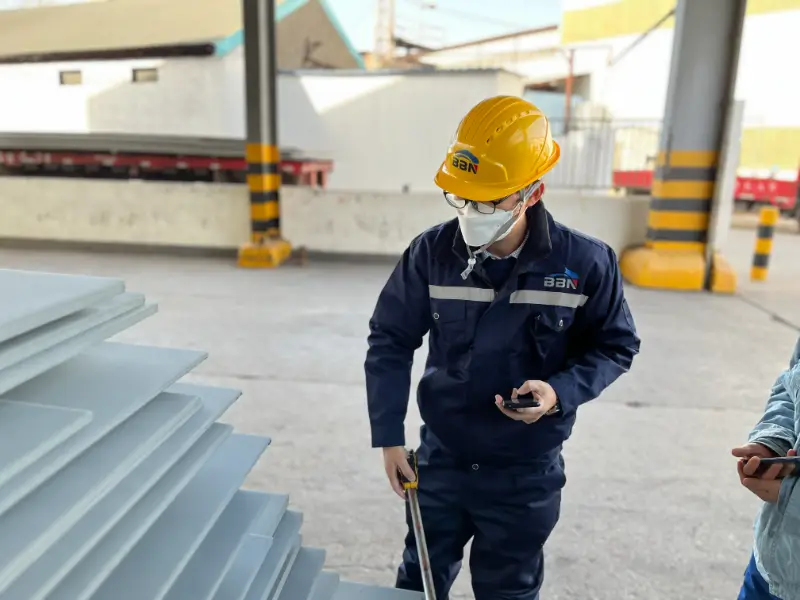
DNV Grade E690 Shipbuilding Steel
DNV Grade E690 Shipbuilding Steel: High Strength Quenched & Tempered Marine Plate
DNV E690 is a high-strength shipbuilding steel plate classified by Det Norske Veritas, designed for heavy marine and offshore structures requiring excellent toughness at low temperatures.
Cutting (plasma, laser, waterjet), cold forming, hot forming (with re-tempering), welding (SMAW, SAW, FCAW, GMAW), machining
- Phone : +8618037372205
- Email : [email protected]
- WhatsApp: Contact via Whtsapp
- WeChat: +8618037372205
DNV Grade E690 Shipbuilding Steel Introduction
DNV Grade E690 is a premium quenched and tempered (Q&T) high-strength steel specifically developed for shipbuilding and offshore applications. It conforms to the DNV Rules for Classification of Ships, offering a minimum yield strength of 690 MPa combined with outstanding low-temperature toughness (E-grade), making it suitable for critical welded structures in harsh marine environments. The steel exhibits good weldability when proper procedures are followed, high resistance to brittle fracture, and can be supplied in a wide range of thicknesses. Its fine-grained microstructure ensures uniform mechanical properties and excellent fatigue strength. Typical applications include hull girders, heavy-lift crane pedestals, legs of jack-up rigs, and other dynamically loaded components in the shipbuilding and offshore industry.
DNV Grade E690 Shipbuilding Steel Chemical Composition
The chemistry of DNV E690 is controlled to achieve high strength and good low-temperature toughness. Elements such as Nb, V, and Ti provide grain refinement, while Cr, Ni, and Mo contribute to hardenability. The table below lists the maximum allowed contents (unless a range is indicated) as per DNV rules.
| Element | Specified Value (wt%) | Remarks |
|---|---|---|
| Carbon (C) | ≤0.20 | Max |
| Silicon (Si) | 0.10–0.55 | Range |
| Manganese (Mn) | 0.90–1.70 | Range |
| Phosphorus (P) | ≤0.025 | Max |
| Sulfur (S) | ≤0.025 | Max |
| Chromium (Cr) | ≤1.50 | Max |
| Nickel (Ni) | ≤2.00 | Max |
| Molybdenum (Mo) | ≤0.70 | Max |
| Copper (Cu) | ≤0.50 | Max |
| Niobium (Nb) | ≤0.06 | Max |
| Vanadium (V) | ≤0.12 | Max |
| Titanium (Ti) | ≤0.05 | Max |
| Aluminium (Al, total) | ≥0.015 | Min, for grain refinement |
| Nitrogen (N) | ≤0.012 | Max |
| Boron (B) | ≤0.005 | Optional, may be added for hardenability |
DNV Grade E690 Shipbuilding Steel Thermal, Electrical & Physical Properties
Physical properties are not part of the normative delivery requirements but are useful for design and processing. The values below are typical for high-strength quenched and tempered steel of this grade and may vary slightly depending on exact composition and heat treatment.
| Property | Typical Value | Unit | Test Condition / Remarks |
|---|---|---|---|
| Density (ρ) | 7850 | kg/m³ | At 20°C |
| Modulus of Elasticity (E) | 210 | GPa | At 20°C |
| Shear Modulus (G) | ≈80 | GPa | At 20°C, calculated from E and ν |
| Poisson's Ratio (ν) | 0.3 | - | At 20°C, in elastic range |
| Thermal Expansion Coeff. (α) | 12×10⁻⁶ | K⁻¹ | Between 20°C and 100°C |
| Thermal Expansion Coeff. (α) | 13×10⁻⁶ | K⁻¹ | Between 20°C and 200°C |
| Thermal Conductivity (λ) | ~50 | W/(m·K) | At 20°C |
| Thermal Conductivity (λ) | ~45 | W/(m·K) | At 200°C |
| Specific Heat Capacity (cp) | ~460 | J/(kg·K) | At 20°C |
| Specific Heat Capacity (cp) | ~500 | J/(kg·K) | At 200°C |
| Electrical Resistivity (ρₑ) | 0.25×10⁻⁶ | Ω·m | At 20°C |
DNV Grade E690 Shipbuilding Steel Mechanical Properties
The mechanical properties of DNV E690 are verified on test pieces taken from the delivered plates. Values depend on plate thickness and sampling direction. The specified minimum values are guaranteed for the QT condition. Tensile testing is performed in the transverse direction, and impact testing at -40°C in the longitudinal direction.
| Property | Specified Value | Unit | Test Condition / Remarks |
|---|---|---|---|
| Yield Strength (ReH) | ≥690 | MPa | Plate thickness ≤50 mm, transverse |
| Yield Strength (ReH) | ≥670 | MPa | Plate thickness >50 mm to 100 mm, transverse |
| Tensile Strength (Rm) | 770–940 | MPa | Plate thickness ≤100 mm, transverse |
| Elongation (A5) | ≥14 | % | Gauge length 5.65√So, transverse |
| Bend Test (180° bend) | d = 3t | - | Thickness ≤25 mm; no cracks |
| Bend Test (180° bend) | d = 4t | - | Thickness >25 mm to 50 mm; no cracks |
| Charpy V‑notch Impact (KV) | ≥27 (average), ≥20 (single) | J | -40°C, longitudinal, standard 10×10 mm specimen |
| Charpy V‑notch Impact (KV) | ≥27 (average), ≥20 (single) | J | -40°C, transverse, if specified |
DNV Grade E690 Shipbuilding Steel Fully Equivalent Grades
| Country / Society | Standard / Rules | Designation | Remarks |
|---|---|---|---|
| ABS (USA) | ABS Rules for Building and Classing Steel Vessels | ABS Grade E690 | Identical mechanical and toughness requirements |
| BV (France) | Bureau Veritas Rules for Steel Ships | BV Grade E690 | Equivalent Q&T shipbuilding plate |
| CCS (China) | CCS Rules for Materials and Welding of Steel Ships | CCS Grade E690 | Full mutual recognition with DNV E690 |
| KR (South Korea) | Korean Register Rules for the Classification of Ships | KR Grade E690 | Chemically and mechanically equivalent |
| LR (UK) | Lloyd's Register Rules for the Manufacture, Testing and Certification of Materials | LR Grade E690 | Interchangeable for ship construction |
| NK (Japan) | Nippon Kaiji Kyokai Rules for the Survey and Construction of Steel Ships | NK Grade E690 | Same yield/tensile and impact requirements |
| RINA (Italy) | RINA Rules for the Classification of Ships | RINA Grade E690 | Recognized as direct equivalent |
| RS (Russia) | Russian Maritime Register of Shipping Rules | RS E690 | Meets same quality standards |
DNV Grade E690 Shipbuilding Steel Application Introduction
DNV E690 is the material of choice for extremely highly stressed ship and offshore components. Its combination of high strength and excellent low-temperature toughness (E‑class, -40°C) enables weight reduction and extended service life in cryogenic and Arctic environments. It is ideally processed by plasma or laser cutting, and welding must follow a qualified WPS with low-hydrogen practices. Preheating and controlled heat input are generally required, and post-weld heat treatment (PWHT) is normally avoided to preserve the quenched and tempered properties unless specifically qualified.
Product Applications: Hull girders and strength decks of ultra-large container ships and LNG carriers, Legs and spudcans of self-elevating platforms (jack-ups), Pedestals and revolving frames of shipboard cranes, Crane booms and heavy-lift attachments, Offshore mooring components and winch bases, Fatigue-critical structural nodes in semi-submersibles and TLPs
Processed into products: Longitudinal stiffeners and web frames in midship sections, Transverse bulkheads and watertight doors, Deck plates under high equipment loads (e.g., helicopter deck, crane rail plates), Heavy-duty pad eyes, lifting lugs, and towing brackets, Jack-up leg chord and rack components, Reinforcement inserts for hatch corners and sheer strakes
Application industries: Shipbuilding (naval, commercial, and specialized vessels), Offshore oil & gas (platforms, FPSO, jack-up rigs), Marine heavy lifting and transport, Dredging equipment, Offshore wind (transition pieces, foundation components)
DNV Grade E690 Shipbuilding Steel Similar / Alternative Materials
| Country / Region | Standard / Specification | Designation | Remarks |
|---|---|---|---|
| Europe | EN 10025-6 | S690Q / S690QL / S690QL1 | Hot rolled Q&T structural steel; similar YS/TS but may require additional tests for marine approval |
| USA | ASTM A514 / A517 | Grade S (690 MPa YS) | Available as plate up to 150 mm; used in structural applications, needs marine qualification |
| USA | ASTM A709 | Grade HPS 690W | Bridge steel with comparable strength, not directly certified for ships |
| Offshore | EN 10225 | S690G1+M / S690G1+QT | Weldable structural steels for fixed offshore structures; could substitute with special agreement |
Notes:
Welding and fabrication: Use low-hydrogen consumables (H4 or H5 scale). Preheating to 100–175°C is typical depending on thickness; interpass temperature should not exceed 250°C. Heat input is often limited to 2.5–4.0 kJ/mm to avoid grain coarsening. Forming: Cold bending up to 5% strain is usually allowed without re-tempering; hot forming requires a subsequent QT treatment unless final mechanical properties are verified. Inspection: Ultrasonic testing per EN 10160 or equivalent is commonly specified. The steel is supplied with full traceability and a 3.1 or 3.2 certificate per EN 10204.
- Share



