
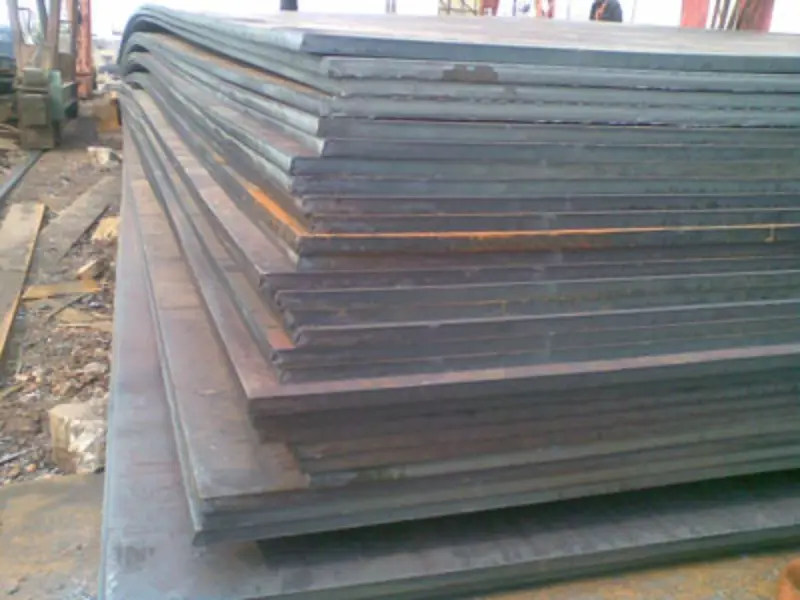
DNV Grade F690 High-Strength Shipbuilding Steel Plate
DNV Grade F690 High-Strength Shipbuilding Steel Plate: Properties & Equivalents
Comprehensive material data sheet for DNV Grade F690 steel plate, including chemical composition, mechanical properties, thermal and electrical physical properties, international equivalents, and application guide.
Hot rolling, quenching, tempering, oxy‑fuel cutting, plasma cutting, welding (low‑hydrogen procedures)
- Phone : +8618037372205
- Email : [email protected]
- WhatsApp: Contact via Whtsapp
- WeChat: +8618037372205
DNV Grade F690 High-Strength Shipbuilding Steel Plate Introduction
DNV Grade F690 is a quenched and tempered high‑strength low‑alloy steel plate specifically designed for demanding shipbuilding and offshore structural applications. It guarantees a minimum yield strength of 690 MPa and offers outstanding low‑temperature notch toughness down to −60 °C (F‑grade). The material is produced under the strict rules of Det Norske Veritas (DNV) and meets the corresponding IACS unified requirements. Its balanced chemical composition with microalloying additions ensures a fine‑grained structure, superior weldability, and high resistance to brittle fracture in harsh marine environments. Typical thicknesses range from 5 to 150 mm, delivered in the as‑quenched and tempered condition. The grade is widely accepted for critical structural members in ice‑class vessels, offshore platforms, and heavy‑duty lifting equipment.
DNV Grade F690 High-Strength Shipbuilding Steel Plate Chemical Composition
The chemical composition of DNV F690 is tightly controlled to achieve high strength, excellent weldability, and superior low‑temperature toughness. Maximum limits are set for residuals and hardenability elements to avoid cracking and to ensure consistent mechanical properties. Microalloying elements such as niobium, vanadium, and titanium are added for grain refinement and precipitation strengthening. Total aluminum is specified to guarantee full deoxidation and nitrogen binding.
| Chemical Element | Standard Value (wt%) | Remarks |
|---|---|---|
| C | ≤ 0.20 | Maximum |
| Si | ≤ 0.50 | Maximum |
| Mn | ≤ 1.70 | Maximum |
| P | ≤ 0.025 | Maximum |
| S | ≤ 0.015 | Maximum |
| Cr | ≤ 0.70 | Maximum |
| Ni | ≤ 1.50 | Maximum |
| Mo | ≤ 0.70 | Maximum |
| Cu | ≤ 0.50 | Maximum |
| V | ≤ 0.12 | Maximum |
| Ti | ≤ 0.05 | Maximum |
| Nb | ≤ 0.06 | Maximum |
| N | ≤ 0.015 | Maximum |
| Al (total) | ≥ 0.020 | Minimum (acid‑soluble or total) |
DNV Grade F690 High-Strength Shipbuilding Steel Plate Thermal and Electrical Physical Properties
The following physical properties are typical for a quenched and tempered low‑alloy structural steel similar to DNV F690. They are not mandatory requirements but serve as engineering reference data for design and heat transfer calculations. Small variations may occur with actual heat batch composition and processing history.
| Property | Typical Value | Unit | Test Condition / Remarks |
|---|---|---|---|
| Density (ρ) | 7850 | kg/m³ | At room temperature (20 °C) |
| Elastic modulus (E) | 210 | GPa | At room temperature |
| Shear modulus (G) | ~80 | GPa | At room temperature |
| Poisson's ratio (ν) | 0.3 | — | At room temperature |
| Thermal expansion coefficient (α) | 11.5 | 10⁻⁶/K | 20 – 100 °C |
| Thermal expansion coefficient (α) | 12.0 | 10⁻⁶/K | 20 – 200 °C |
| Thermal expansion coefficient (α) | 12.5 | 10⁻⁶/K | 20 – 300 °C |
| Thermal conductivity (λ) | ~42 | W/(m·K) | At 20 °C |
| Specific heat capacity (cp) | ~460 | J/(kg·K) | At 20 °C |
| Electrical resistivity (ρe) | ~0.25 | μΩ·m | At 20 °C |
DNV Grade F690 High-Strength Shipbuilding Steel Plate Mechanical Properties
The mechanical properties are determined on quenched and tempered test pieces taken in the transverse direction. Values follow the IACS UR W31 and DNV specifications for extra‑high‑strength structural steel. Impact toughness is assessed by Charpy V‑notch tests at the F‑grade temperature of −60 °C. Bending requirements are derived from similar quenched and tempered grades (EN 10025‑6) and represent mandrel diameters that ensure crack‑free performance.
| Property | Standard Requirement Value | Unit | Test Condition / Remarks |
|---|---|---|---|
| Yield strength (ReH) | ≥ 690 | MPa | Thickness t ≤ 50 mm |
| Yield strength (ReH) | ≥ 670 | MPa | 50 < t ≤ 100 mm |
| Yield strength (ReH) | ≥ 630 | MPa | 100 < t ≤ 150 mm |
| Tensile strength (Rm) | 770 – 940 | MPa | Thickness t ≤ 50 mm |
| Tensile strength (Rm) | 700 – 890 | MPa | 50 < t ≤ 100 mm |
| Tensile strength (Rm) | 630 – 760 | MPa | 100 < t ≤ 150 mm |
| Elongation (A) | ≥ 14 | % | Lo = 5.65√So, transverse, all thicknesses |
| Impact energy (KV2), average | ≥ 27 | J | Transverse Charpy V‑notch, −60 °C |
| Impact energy (KV2), single minimum | ≥ 20 | J | Transverse Charpy V‑notch, −60 °C |
| Bend test (mandrel diameter) | 3t | – | t ≤ 16 mm, 180° bend, no cracks |
| Bend test (mandrel diameter) | 4t | – | 16 < t ≤ 40 mm, 180° bend, no cracks |
| Bend test (mandrel diameter) | 5t | – | 40 < t ≤ 63 mm, 180° bend, no cracks |
| Bend test (mandrel diameter) | 6t | – | 63 < t ≤ 100 mm, 180° bend, no cracks |
DNV Grade F690 High-Strength Shipbuilding Steel Plate Fully Equivalent Material Standards & Replaceable Grades
| Country / Region | Standard | Grade Designation | Remarks |
|---|---|---|---|
| International | IACS UR W31 | F690 | Unified requirement for extra‑high strength quenched and tempered steel; identical impact class (−60 °C) |
| USA | ABS Rules | FH690 | American Bureau of Shipping equivalent |
| France | BV Rules | FH690 | Bureau Veritas equivalent |
| UK | LR Rules | FH690 | Lloyd's Register equivalent |
| Italy | RINA Rules | FH690 | Registro Italiano Navale equivalent |
| China | CCS Rules | FH690 | China Classification Society equivalent |
| Japan | ClassNK Rules | KF690 | Nippon Kaiji Kyokai equivalent |
| South Korea | KR Rules | FH690 | Korean Register equivalent |
DNV Grade F690 High-Strength Shipbuilding Steel Plate Application Introduction
DNV Grade F690 is designed for heavy‑duty structural components exposed to low ambient temperatures and high dynamic loads. It can be welded by all common processes provided low‑hydrogen consumables and controlled heat input are used. Preheating (typically 100 – 150 °C) is recommended for thicknesses above 30 mm. The steel is not intended for extensive hot forming; if hot forming is necessary, a subsequent re‑tempering may be required to restore properties.
Product Applications: Hull plates for ice‑strengthened ships, Structural modules for offshore platforms (jacket legs, braces, decks), Heavy‑duty telescopic crane booms, Offshore drilling substructures (derrick supports, skid beams), Pressure hulls for submarines (with additional certification)
Processed into products: Transverse frames and web frames, Longitudinal stiffeners and girders, Deck‑ and bottom‑plating in high‑stress areas, Crane pedestals and slewing rings, Lifting lugs, pad eyes, and shackles, Spud cans and shear keys for jack‑up rigs, Mud‑mat and pile‑sleeve plates, Reinforcing plates around openings (manholes, hawse pipes)
Application industries: Shipbuilding (ice‑class and Arctic vessels), Offshore oil & gas (jackets, topsides, decks), Heavy construction / crane manufacturing, Marine and port engineering, Wind turbine foundations (offshore)
DNV Grade F690 High-Strength Shipbuilding Steel Plate Similar / Substitute Materials with Comparable Performance
| Country / Region | Standard | Grade Designation | Remarks |
|---|---|---|---|
| European Union | EN 10025‑6 | S690QL1 | Quenched & tempered; impact at −60 °C; mechanical properties almost identical; may require additional certification for marine use. |
| European Union | EN 10025‑6 | S690QL | Quenched & tempered; impact at −50 °C; slightly lower low‑temperature toughness, suitable if −60 °C not mandatory. |
| European Union | EN 10025‑6 | S690Q | Quenched & tempered; no guaranteed low‑temperature impact; only for reference if toughness is not critical. |
| USA | ASTM A514/A514M | Grade B, H, Q | Yield 690 min, tensile 760‑895 MPa; not specifically certified for −60 °C; supplemental Charpy testing required for substitution. |
| International | ISO 4950‑2 | E690QL1 | Similar to S690QL1, with impact at −60 °C; often accepted as alternate material. |
Notes:
- Welding: Use low‑hydrogen electrodes (e.g., AWS E11018‑M, equivalent) and strictly control interpass temperature (≤250 °C). Post‑weld heat treatment is generally not required for thicknesses up to 50 mm, but may be considered for stress relief of very heavy sections.
- Testing: Each plate is normally supplied with a DNV inspection certificate (3.2) including chemical analysis, tensile, impact (at −60 °C), and ultrasonic testing (UT) according to EN 10160 or equivalent.
- Tolerances: Thickness, flatness, and surface quality are in accordance with DNV rules and the relevant material specification.
- Storage: The steel should be stored in dry conditions to avoid any hydrogen pick‑up before welding.
- Share



